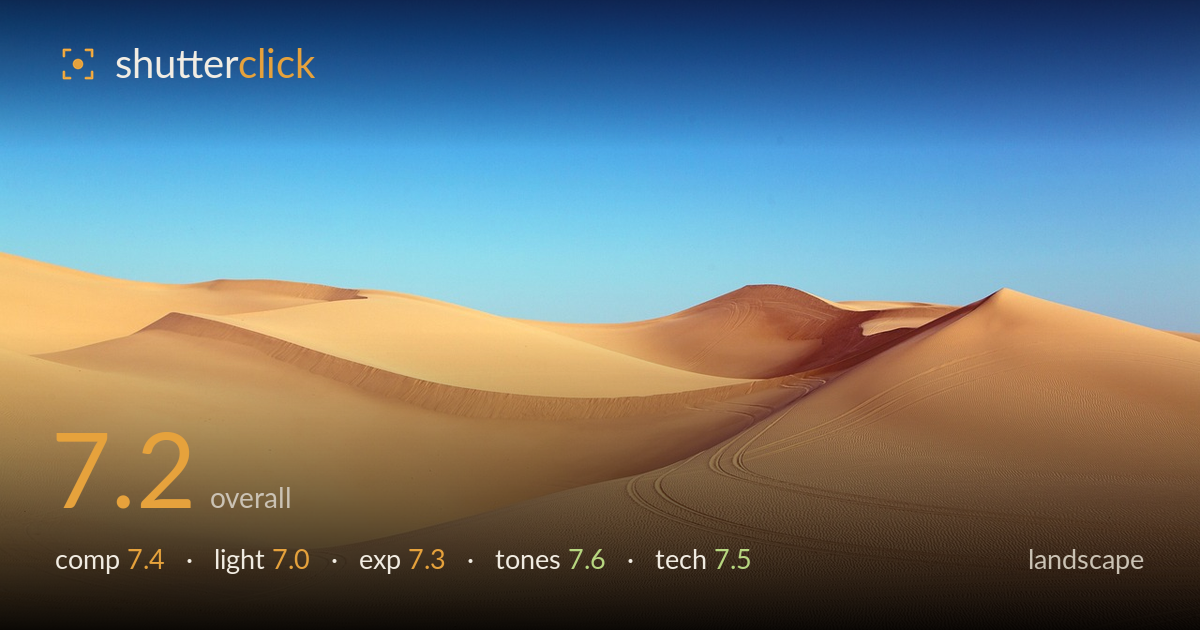
Curving dunes under a blue sky
Photo by Falkenpost

No EXIF metadata in this file
Technical analysis based on visual assessment only.
A clean, graphic dune study that leans on the interplay of sculpted ridgelines against a deep blue sky. The strongest asset is the curving crest lines that guide the eye across the frame and the two-colour simplicity of gold against blue. What holds it back is the flat, near-midday light — the sand reads soft and low in relief because shadows are minimal, and the foreground carries little detail beyond faint vehicle tracks. Warmer, lower-angle light would carve the dunes into far more three-dimensional forms. As it stands it's a competent, well-balanced desert image that stops short of dramatic.
The frame is anchored by the sinuous ridgeline sweeping from lower right up toward the central peaks, a natural leading line that works well. Sky occupies roughly the top third, a reasonable division that lets the dune forms dominate. The curving crest and secondary dune on the left create pleasing rhythm. The foreground, however, is a large expanse of relatively featureless sand that adds little beyond faint tracks — a lower angle or a stronger foreground element would give the base more purpose and depth.
The light is high and fairly frontal, producing an even wash across the sand that keeps colours clean but flattens relief. Dunes reward raking side light, and here the shadows are shallow, so the ridges read more as tonal shifts than sculpted three-dimensional forms. The deep saturated sky suggests a clear, harsh sun. Shooting in early or late golden hour, with light skimming across the crests, would deepen shadow lines and give the sand the texture and drama the shapes are asking for.
Exposure is well controlled for a high-contrast desert scene. The bright sand holds highlight detail without clipping into pure white, and the sky gradient is smooth and free of banding. Shadow areas retain information rather than blocking up. The overall brightness feels deliberate and reads the scene as it likely appeared under strong sun. There's little dynamic-range struggle here because the light is even, so the histogram sits comfortably in the upper mids without alarm at either end.
The two-colour palette is the image's signature — warm golden sand against a rich blue sky that deepens toward the top of the frame. White balance leans warm, which suits the desert mood, and the sand carries a natural range from pale crests to shadowed golden slopes. The blue is strongly saturated; it works but sits close to the point where it looks pushed. A subtle gradient reduction in the upper sky saturation would keep it believable while preserving the graphic contrast.
From visual evidence the image is well executed. Sharpness across the dune ridges looks solid, suggesting a small-to-mid aperture that held depth from foreground sand to distant crests. There's no obvious motion issue — this is a static scene — and noise appears well controlled in both the smooth sky and the sand, indicating a low ISO and good light. Focus appears placed on the mid-ground dunes where it matters most, and the whole frame reads clean and detailed. The fine sand ripple texture in the lower right survives without smearing, a good sign for both capture and processing restraint. The main technical opportunity isn't in execution but in timing: the same competent capture under low, raking light would have delivered far more textural payoff for the same settings. Lens choice appears appropriate, giving natural proportions to the dune forms without distortion. Overall this is technically sound work; the ceiling is set by lighting conditions rather than any handling error.
What would elevate it
Tags
Shot something like this?
Expert photo critique, on demand — scored across six categories, EXIF-aware. Start with 3 free critiques, no credit card.
critique my photo — free