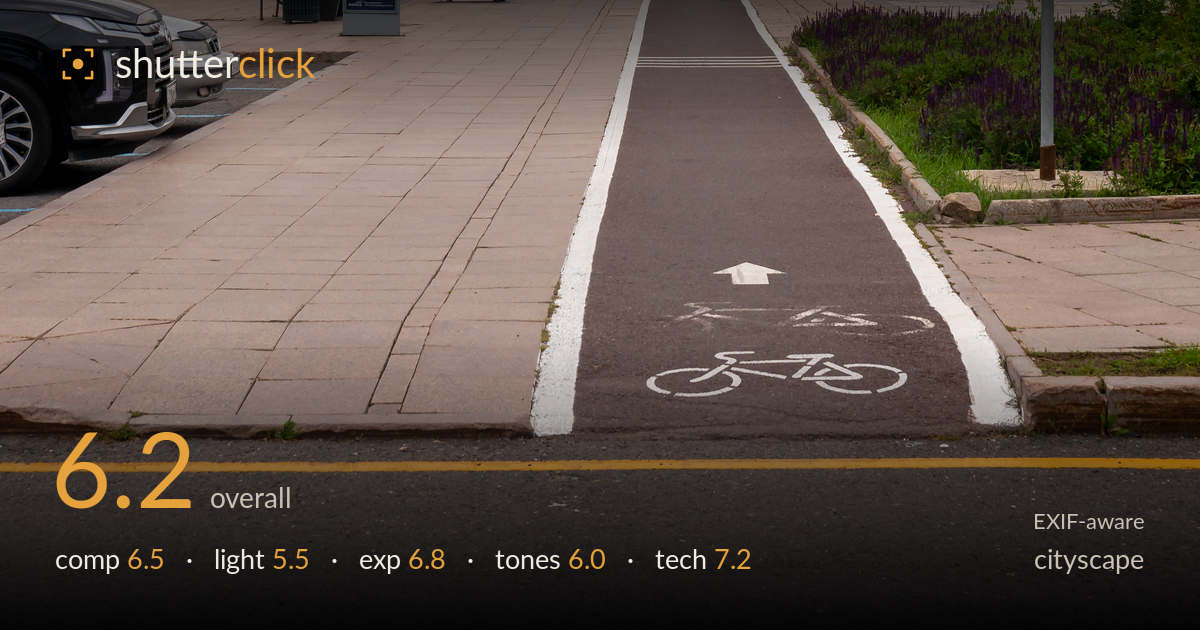
Cycle lane down a city avenue
Photo by Matti Blume

| Focal length | 29 mm |
| Aperture | f / 5.6 |
| Shutter | 1/200 s |
| ISO | ISO 160 |
| Exp. comp. | 0.0 EV |
| Shot at | 14:33 · Aug 15, 2024 |
A clear, well-organized document of urban cycling infrastructure, carried by the bike lane leading the eye straight into the frame — but flat overcast light and a subject that reads more as civic record than photograph hold it back. The lane, the painted markings, the blue directional sign and the surrounding streetscape are all legibly rendered and thoughtfully arranged. What's missing is a moment or a quality of light to lift it above documentation. The heavy grey sky occupies a large share of the frame without contributing atmosphere, and the muted tones leave the whole scene feeling low in energy despite the strong central line.
The bike lane forms a strong central leading line that pulls the eye from the foreground markings deep into the tree-lined avenue — a solid, decisive backbone for the frame. The blue bicycle sign on the right anchors the composition and echoes the lane's purpose. However, the flat grey sky claims roughly the top third without adding interest; a lower horizon would concentrate attention on the street. The dead-centre symmetry of the lane is deliberate but risks feeling static, and the busy left edge competes with the cleaner right.
Flat, diffuse light from a fully overcast sky is the main limitation here. It renders everything evenly and avoids harsh shadows, but it also drains the scene of modelling, depth and mood — the buildings, foliage and pavement all sit at similar low contrast. There is no directional light to sculpt the receding avenue or give the trees dimension. Shooting near golden hour, or waiting for a break in the cloud to add some directional warmth and shadow, would transform the same composition considerably.
Exposure is handled competently for difficult flat conditions. The bright overcast sky retains detail without blowing out, and the darker asphalt and shadowed cars hold their information — a well-balanced use of dynamic range at 0.0 EV. Highlights on the white lane markings are controlled and still show texture. The overall brightness sits a touch heavy in the greys, and the foreground road in shadow is slightly muddy, but nothing is clipped or lost. A deliberate, safe exposure that captures the full tonal span of a demanding sky.
White balance is neutral to slightly cool, appropriate for the overcast conditions but adding to the scene's low-energy feel. The palette is dominated by muted greys, dull greens and beige pavement, with the blue signs and purple flowerbed providing the only real colour accents. Contrast is naturally low given the flat light, and the image would benefit from a modest contrast lift and some added warmth to separate the tonal blocks. The greens read a little flat and could use more saturation and separation from the grey backdrop.
Technically this is well executed for the conditions. At 29mm and f/5.6 the depth of field is deep enough to hold the near lane markings and the distant avenue acceptably sharp, which suits a cityscape wanting front-to-back clarity. ISO 160 keeps noise negligible and preserves clean tonal gradation in the sky. The 1/200s shutter easily freezes the static scene and the minor traffic on the left. Focus appears well placed on the mid-ground lane. The Leica 12-60 delivers good edge-to-edge sharpness and controlled distortion — the vertical sign pole and building lines stay reasonably straight. One consideration: at f/5.6 on this format, diffraction is not an issue, and a slightly wider aperture wasn't needed given the deep-focus intent. The main technical opportunity lies less in settings and more in framing choices — the gear and exposure decisions are sound and the image is clean at pixel level.
What would elevate it
Tags
Shot something like this?
Expert photo critique, on demand — scored across six categories, EXIF-aware. Start with 3 free critiques, no credit card.
critique my photo — free