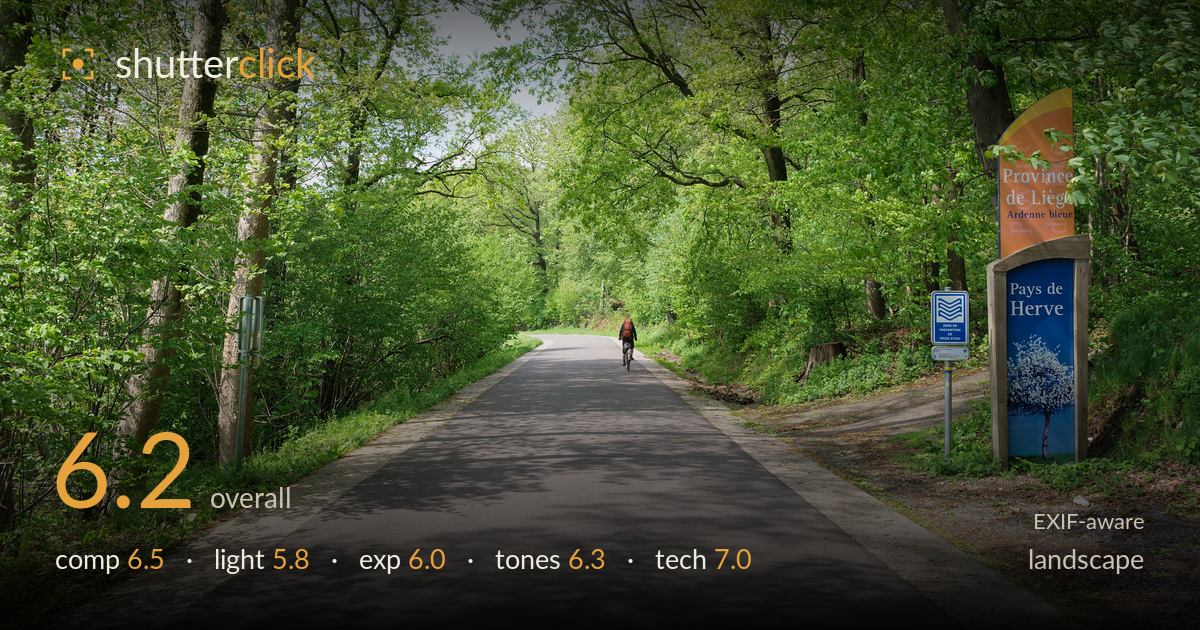
Cyclist on a shaded forest path
Photo by Trougnouf (Benoit Brummer)

| Focal length | 21 mm |
| Aperture | f / 11.0 |
| Shutter | 1/60 s |
| ISO | ISO 200 |
| Exp. comp. | 0.0 EV |
| Shot at | 14:12 · May 1, 2018 |
A pleasant greenway scene with a natural tree canopy framing the receding path, but the shot lacks a clear focal anchor to hold attention. The lone cyclist sits small and centred deep in the frame, offering some narrative but not enough presence to carry the composition. Harsh midday light through the canopy creates a busy, dappled quilt on the road that fragments the eye rather than guiding it. The colourful signage on the right competes for attention and pulls weight to that side. The greens are lush and the depth reads well; a better time of day and a stronger subject relationship would lift this considerably.
The arching canopy and converging path create genuine depth and a natural frame. The problem is the subject relationship: the cyclist is tiny, centred, and easily missed, so the eye wanders. The bright Pays de Herve sign on the right pulls significant visual weight away from the path and unbalances the frame. The road dominates the lower half without foreground interest to lead into it. Positioning the cyclist off-centre on a third, or timing them closer, would give the depth a payoff. As it stands the elements are present but not resolved.
Midday sun filtering through the canopy produces harsh, high-contrast dappling across the road surface. That patchwork of hotspots and shadow is the weakest element here, breaking the path into competing bright and dark patches rather than a clean leading line. The overcast-bright sky at top is blown and flat. Softer, lower light — early morning or an overcast diffusion — would even the tarmac, saturate the greens, and let the canopy read as a coherent tunnel rather than a scattered light show.
Exposure is a reasonable compromise for a difficult high-contrast scene. The sky at the top is clipped to near-white, though it occupies little of the frame. Shadow detail in the darker foliage holds acceptably and the road midtones sit about right. The dappled highlights on the tarmac approach clipping in the brightest patches. Nothing here is a gross error, but a slight negative compensation or a graduated recovery in post would rein in the hottest sunlit spots and the sky without crushing the shaded greens.
The spring greens are vibrant and varied, from lime new growth to deeper shade, which is the strongest tonal quality. White balance leans slightly cool but reads natural. Contrast is high by circumstance rather than choice, driven by the harsh light, and that hardens the transitions on the road. The blown sky offers no tonal gradation. A gentle lift of shadows and a pull on the green saturation would keep the foliage rich without letting the harsh sunlit patches feel garish against the shade.
The settings are well chosen for the scene. f/11 delivers deep front-to-back sharpness appropriate for a landscape, keeping both the near tarmac and the distant canopy acceptably crisp, and 21mm is a sensible framing focal length for this tree tunnel. ISO 200 keeps noise negligible with clean shadows. 1/60s is adequate for the static scene and comfortably handled by the OIS, though it is slow enough that the moving cyclist shows slight softness — not a problem given their small scale, but a faster shutter would have frozen them cleanly had they been a larger element. Focus appears set on the mid-distance road and holds well across the depth of field. The lens performs well stopped down, with good edge-to-edge resolution and controlled flare despite shooting toward a bright sky. Overall the execution is sound and the gear is used sensibly; the limitations here are timing and light, not technique or equipment choices.
What would elevate it
Tags
Shot something like this?
Expert photo critique, on demand — scored across six categories, EXIF-aware. Start with 3 free critiques, no credit card.
critique my photo — free