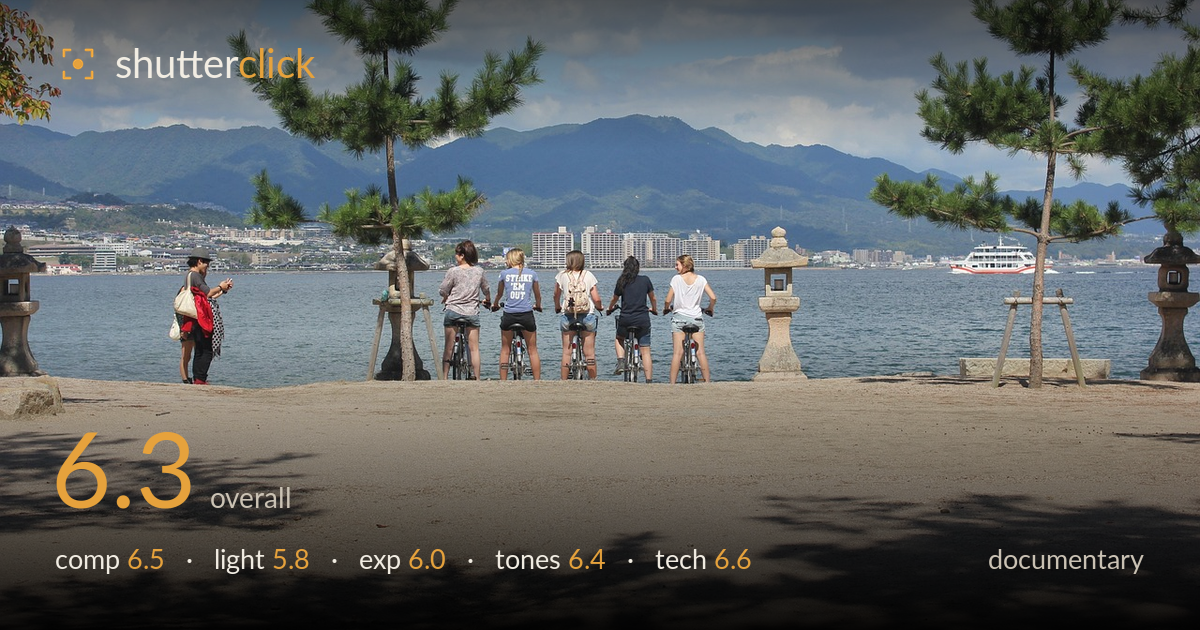
Cyclists resting by the bay
Photo by UniBay

No EXIF metadata in this file
Technical analysis based on visual assessment only.
A pleasant travel scene with genuine narrative potential — a row of cyclists paused at a scenic waterfront while a separate figure photographs, framed by stone lanterns and pines. What holds it back is a slack lower half: the vast expanse of foreground sand and shadow eats up nearly half the frame without contributing information, pushing the human interest into a thin strip. The lanterns and trees form a natural stage, but the moment itself is static — backs turned, little gesture reading. Tighter framing on the row of subjects and a moment with more interaction would lift this from record to story.
The stone lanterns and pines create a symmetrical natural frame around the cyclists, which is the strongest structural idea here. The separate figure taking a photo at left adds a nice secondary narrative beat. But the composition is bottom-heavy: the foreground sand and cast shadow occupy roughly the lower half and carry no information, compressing the subjects and horizon into a narrow band. The line of bicycles is arranged usefully, yet centred too tightly. Cropping much of the empty foreground would restore weight to the people and the bay.
This is bright midday light — high sun producing flat, top-down illumination with little modelling on the subjects and hard, sprawling shadows across the foreground. The overhead angle leaves faces and backs unshaped and the sand slightly glaring. The scattered cumulus adds some interest to the sky, but the timing works against the scene: there's no warmth or directional raking to bring out texture in the lanterns or depth in the mountains. Earlier or later light would give the whole frame the dimensionality it currently lacks.
Exposure is generally competent for difficult midday conditions. Highlights in the brightest clouds edge toward clipping but mostly hold, and the sand retains detail rather than blowing out. Shadow areas in the foreground stay open with recoverable detail. The subjects are correctly exposed against the brighter water and sky, no small feat given the range. Midtones sit a touch flat, and a small amount of highlight recovery in the sky would preserve the cloud structure. Overall a safe, deliberate-looking exposure that handles the dynamic range reasonably.
Colour is natural and believable — the teal of the bay, green pines, and neutral sand read accurately, and white balance looks correct with no obvious cast. Contrast is on the gentle side, typical of hazy midday atmosphere, which softens the distant mountains and city into a slightly washed layer. Saturation is restrained and pleasant rather than punchy. The overall palette is coherent but a little muted; a modest contrast and clarity lift in the midtones would separate the mountain layers and give the bay more presence.
Sharpness appears sound across the plane where it matters — the row of cyclists, the stone lanterns, and the framing pines all resolve cleanly, and depth of field is deep enough to hold both the near subjects and the distant skyline and mountains in acceptable focus, which suits a documentary landscape context. Focus looks accurately placed on the group. Noise is not a concern in this bright light. The lens choice gives a natural, undistorted field of view appropriate to the scene. The main technical question is framing discipline rather than optics: the wide inclusion of empty foreground dilutes the resolving power spent on the subjects. A slightly longer focal length or a tighter position would have filled the frame with the human element and the bay while keeping the lanterns and pines as anchors. Verticals on the lanterns and tree trunks read straight, so perspective is well controlled. Solid, unglamorous execution that captures the scene faithfully.
What would elevate it
Tags
Shot something like this?
Expert photo critique, on demand — scored across six categories, EXIF-aware. Start with 3 free critiques, no credit card.
critique my photo — free