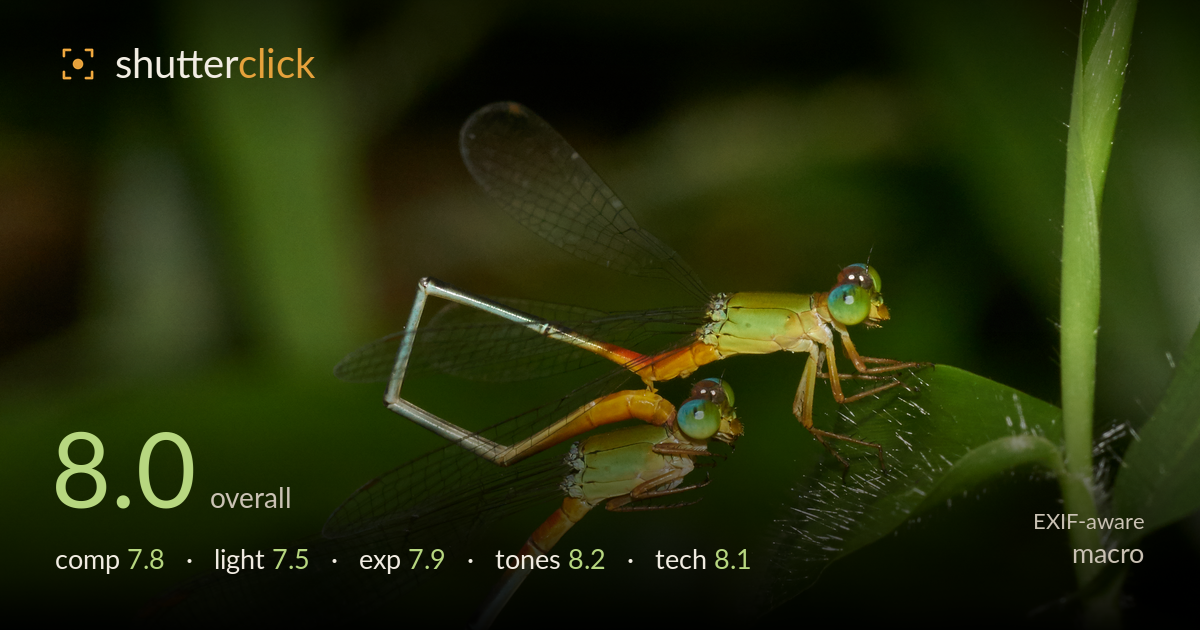
Damselflies paired on a grass blade
Photo by Jeevan Jose, Kerala, India

| Focal length | 150 mm |
| Aperture | f / 11.0 |
| Shutter | 1/160 s |
| ISO | ISO 400 |
| Exp. comp. | 0.0 EV |
| Shot at | 15:43 · Apr 11, 2016 |
A technically accomplished capture of two damselflies in the mating wheel, with both eyes rendered sharp and the classic heart-shaped tandem form clearly described. The dark, unbusy background isolates the subjects beautifully and lets the turquoise eyes and lime-green thoraxes glow. What holds it back is a slightly cramped right-side crop where the wing tips and grass blade press the frame edge, and the wings themselves fall progressively out of the plane of focus. The moment and behaviour are the strengths here — a documented pairing that reads instantly — and the colour and detail on the heads reward close viewing.
The interlocked tandem forms a strong, readable shape that anchors the frame, and the diagonal grass blade on the right adds a natural perch and counterweight. The dark negative space on the left gives the subjects room to breathe. However, the right side is tight — wing tips and the grass blade crowd the edge, and the lower damselfly's abdomen curls out near the bottom border. A touch more room on the right and below would let the whole shape sit within the frame rather than fighting its edges.
Soft, diffused light — likely overcast or shaded — flatters the delicate translucent wings and avoids blown highlights on the reflective eyes, while a small specular catchlight in each eye brings them alive. Direction is largely frontal, which keeps detail even but does little to model the bodies with dimensional shadow. A more raking side light would sculpt the segmented abdomens and add texture to the thorax. As it stands the light is clean and safe, well suited to the subject if not dramatic.
Exposure is well judged for a high-contrast scene against a dark background. The green thoraxes and eyes hold full detail, and the wings retain their fine venation without clipping the brighter membrane areas near the perch. Shadows in the background go deep but that serves the isolation rather than hiding needed detail. The wing tips catching light on the right stay just within range. No obvious blown highlights on the specular eyes — a genuinely tricky balance handled cleanly at 0 EV.
Colour is the standout: the turquoise-to-green eyes, lime thoraxes, and orange-red abdomen segments read vivid yet natural, with no oversaturation. White balance sits accurately, keeping the greens believable rather than pushed toward yellow. The dark background provides deep, rich blacks that make the subject colours pop. Tonal separation between the translucent wings and the murky backdrop is subtle but effective. Overall a controlled, pleasing palette that suits the natural subject without veering into candy-colour excess.
At f/11 on the 150mm macro, depth of field is stretched to cover both insects' heads and thoraxes, and focus lands accurately on the eyes of both — the priority in any insect macro. The 1/160s shutter was sufficient here given the subjects were static in tandem, though it leaves little margin for wind sway on such a fine perch; a faster speed or flash would add insurance. ISO 400 is a sensible compromise, keeping noise negligible while supporting the small aperture. Even at f/11, the plane can't hold the full sweep of the wings, which soften toward their tips — the physics of macro at this magnification, and a case where focus stacking would render the entire structure crisp. The 150mm focal length gives comfortable working distance for skittish subjects. Diffraction at f/11 slightly softens the finest detail, but the trade for depth is justified here. Solid, deliberate execution throughout.
What would elevate it
Tags
Shot something like this?
Expert photo critique, on demand — scored across six categories, EXIF-aware. Start with 3 free critiques, no credit card.
critique my photo — free