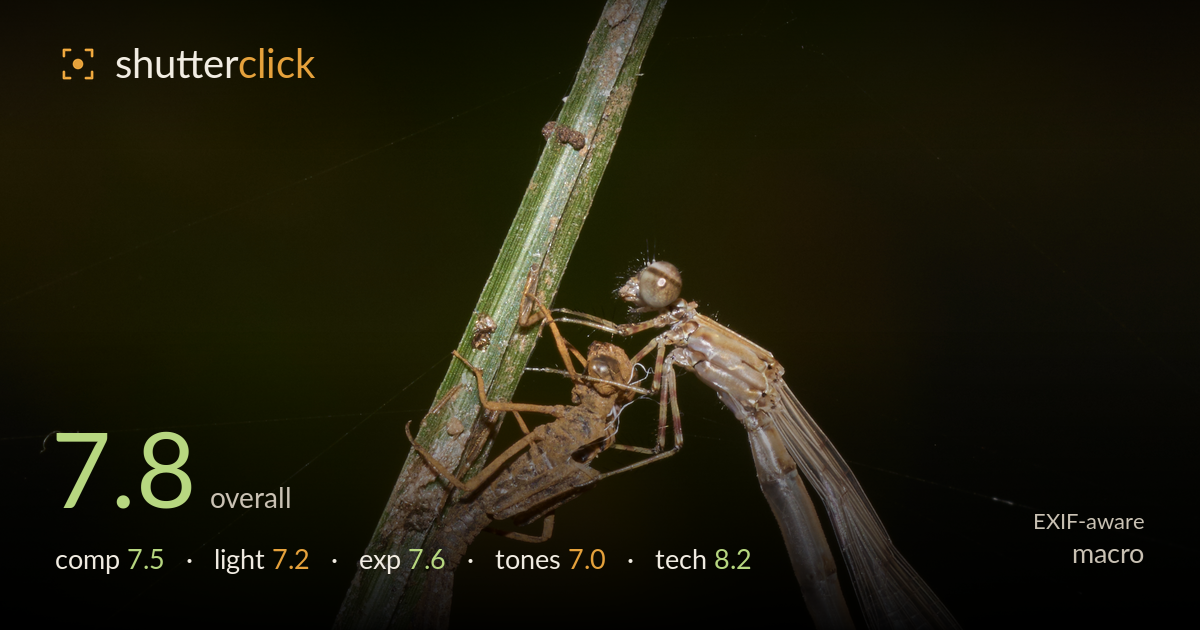
Damselfly beside its shed skin
Photo by Jeevan Jose, Kerala, India

| Focal length | 150 mm |
| Aperture | f / 14.0 |
| Shutter | 1/250 s |
| ISO | ISO 100 |
| Exp. comp. | 0.0 EV |
| Shot at | 09:35 · Oct 29, 2016 |
A freshly emerged damselfly beside its shed exuvia is captured with real narrative value — the pale, still-soft body and crumpled wings tell the story of a moment most never witness. The diagonal stem gives the frame energy, and the black background isolates the subject cleanly. What holds it back is the placement of the newly emerged adult toward the right edge, where its wingtips crowd the frame, and a slightly flat, cool cast across the pale abdomen. The eye and head detail carry the shot, and the storytelling earns forgiveness for the tighter margins.
The diagonal stem is the backbone here, splitting the frame with tension and carrying the eye from the empty larval case up to the fresh adult. The pairing of exuvia and emerged damselfly reads as a deliberate before-and-after. However, the adult's long abdomen and wings run right up against the frame edge, leaving little breathing room on the right while the left holds a large expanse of empty background. Rebalancing so the wingtips clear the edge, or shifting the subject leftward, would relieve that crowding without losing the diagonal.
The light is soft and even across the subject, likely from a diffused flash, which suits the delicate translucency of the fresh wings and keeps harsh speculars off the compound eye. Shadow rendering is gentle and the subject separates well from the near-black surround. The trade-off is a slightly flat, frontal quality — the pale abdomen lacks the raking dimensionality that would show its segmentation and sheen. A touch more directional side light would model the body's cylindrical form and reveal more surface texture on the exuvia.
Exposure is well judged for a high-contrast subject against a dark ground. The pale abdomen and translucent wings hold detail without blowing out, and the near-black background stays clean rather than muddy or noisy. The compound eye retains tonal information. The brightest wing membrane edges sit close to clipping but remain recoverable. The larval case keeps shadow detail in its brown surfaces. Overall the histogram appears controlled and deliberate, using the full range without sacrificing the delicate highlight roll-off the wings demand.
The tonal palette leans cool and slightly desaturated, which reads as accurate to a freshly emerged, still-teneral damselfly but drifts a touch grey across the abdomen. The warm browns of the exuvia and the green stem provide welcome contrast against the neutral subject. White balance sits marginally cool, giving the wings a bluish tint that flattens their natural warmth. A slightly warmer balance and a small saturation lift on the browns and greens would add vitality without pushing the pale body unnaturally.
The 150mm macro at f/14 is a sound choice for this working distance, giving enough depth of field to carry the head, thorax and near wing while the ISO 100 keeps the frame clean and noise-free. Focus lands accurately on the compound eye and head bristles, which is exactly where it needs to be — the fine hairs and eye facets are crisp. The 1/250s shutter is adequate here since the subject is stationary on the stem, though it relies on flash or steady support to avoid any shake at this magnification. The trade-off of f/14 shows in diffraction softening the finest wing venation slightly, and the far wingtips fall outside the plane of focus. A focus-stacked series, or a marginally wider aperture combined with careful plane alignment, would recover crispness across the full wing span without giving up the depth on the body. Execution is disciplined and the settings match the subject well.
What would elevate it
Tags
Shot something like this?
Expert photo critique, on demand — scored across six categories, EXIF-aware. Start with 3 free critiques, no credit card.
critique my photo — free