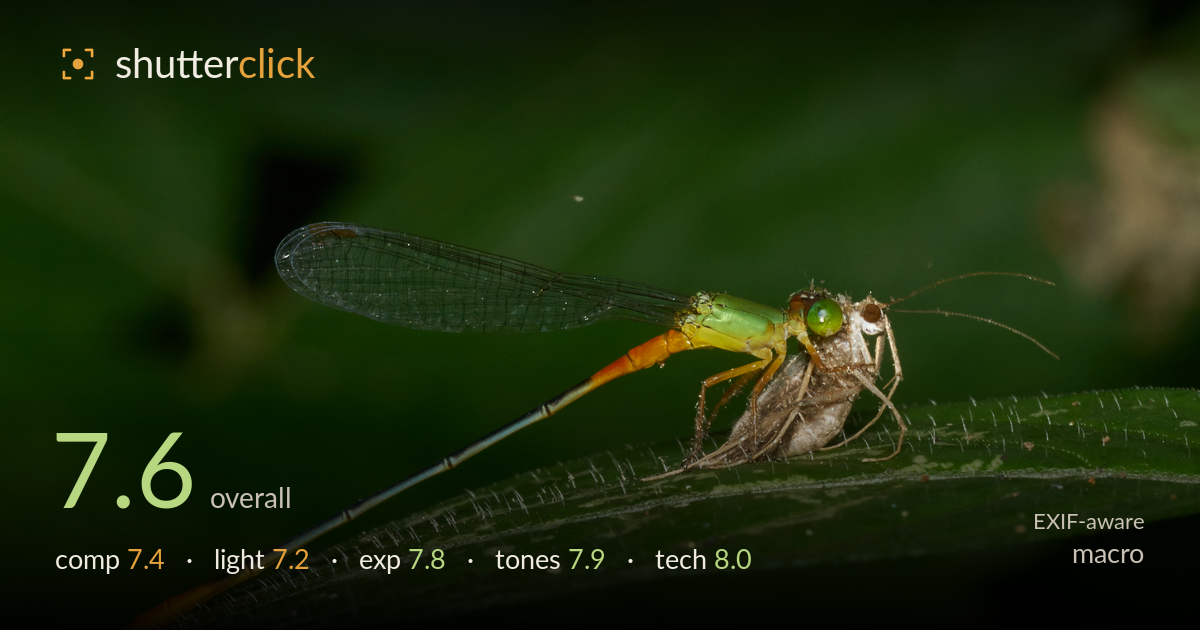
Damselfly feeding on a leaf
Photo by Jeevan Jose, Kerala, India

| Focal length | 150 mm |
| Aperture | f / 14.0 |
| Shutter | 1/250 s |
| ISO | ISO 250 |
| Exp. comp. | 0.0 EV |
| Shot at | 11:03 · Nov 28, 2016 |
A strong feeding-behaviour capture that documents a damselfly with prey, elevating this above a static portrait. The green eye reads sharp and the emerald thorax pops against a clean dark background. The long abdomen sweeping down to the lower-left adds graceful diagonal energy. What most holds the image back is a slightly flat, frontal flash quality that mutes texture on the wing and body, and a composition where the abdomen's tip runs close to the frame edge. The prey and forelimbs are the most cluttered, softest zone — a tighter focus plane there would sharpen the narrative.
The diagonal of the abdomen from upper-right head down to the lower-left is the strongest structural element, giving the frame movement and using the leaf's slope well. The damselfly sits in the right third with the wing arcing into negative space — a balanced arrangement. The head-and-prey cluster anchors the eye correctly. The abdomen tip crowds the bottom-left corner, though, and slightly more room there would let the sweep breathe. The dark upper-left is empty enough to feel slightly weighty against the busy right side.
Flash provides even, controlled illumination that isolates the subject cleanly from the shadowed backdrop and renders the eye's specular glint. The direction is broadly frontal, which keeps detail legible but flattens the modelling on the thorax and abdomen — a raking side angle would carve out more three-dimensional form. The wing catches light nicely, showing venation and faint iridescence. Highlights on the leaf hairs sparkle without blowing out. A touch more shadow shaping would add depth to the body.
Exposure is well judged for a flash macro against a dark field. The green eye and thorax hold saturation without clipping, and the leaf's bright specular hairs are controlled rather than blown. Shadow areas in the background go deep black, which suits the isolation but sacrifices any context. The subject's midtones sit at a readable brightness, and the pale prey retains detail rather than glaring. The histogram appears to lean dark by design, an appropriate choice here that keeps the insect the clear focus.
Colour rendition is a real strength — the emerald thorax, orange-and-black abdomen banding, and bright green eye all read vividly and naturally, with good separation from the deep green background. White balance sits believably neutral under flash. Contrast is punchy but not harsh, and the tonal range spans from the black backdrop to bright leaf highlights without feeling crushed at either end. The pale, mottled prey adds a useful neutral counterpoint to the saturated insect. Overall a clean, confident colour treatment.
The 150mm macro at f/14 is a sensible choice for the working distance and desired depth of field, and 1/250s with ISO 250 keeps noise negligible while flash freezes any subject motion. Focus lands accurately on the eye and forward thorax, which is the priority plane, and the wing venation resolves crisply. The trade-off shows in the depth of field: at this magnification even f/14 cannot hold the entire subject, so the prey and the tangle of forelimbs fall progressively softer, and the abdomen tip is off the focal plane. A slightly narrower aperture would risk diffraction softening across the whole frame, so a focus stack of two or three frames would be the cleaner route to render both the head and the prey sharply. Sharpness on the in-focus zone is excellent and the image is free of visible noise or motion blur. Solid, deliberate technical execution overall.
What would elevate it
Tags
Shot something like this?
Expert photo critique, on demand — scored across six categories, EXIF-aware. Start with 3 free critiques, no credit card.
critique my photo — free