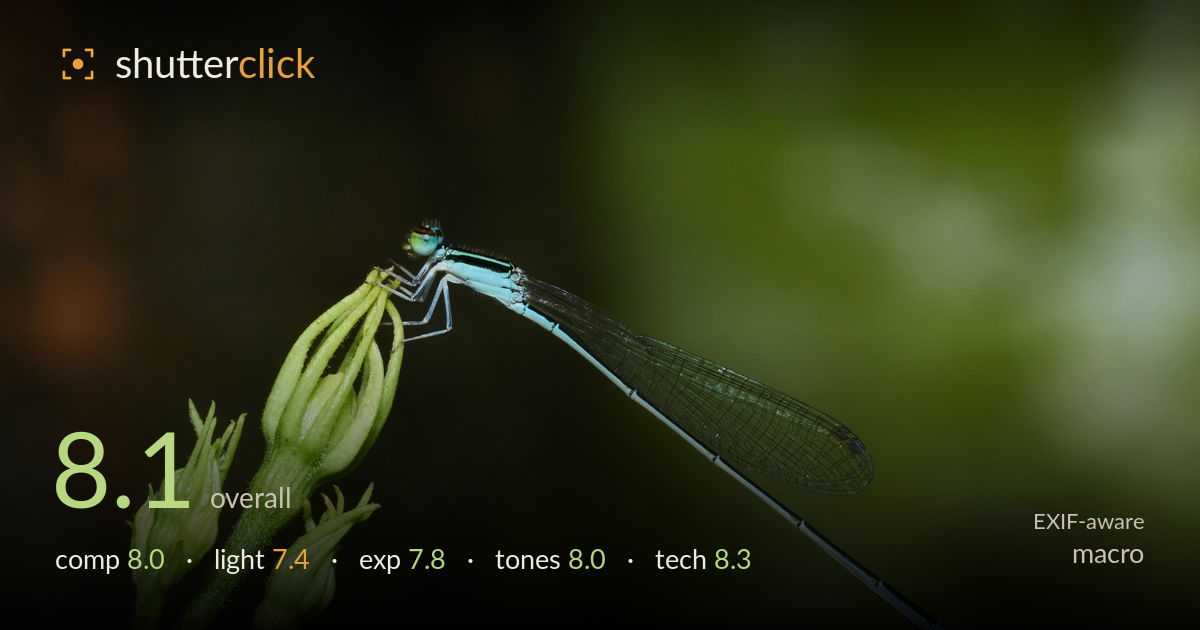
Damselfly perched on a green bud
Photo by Jeevan Jose, Kerala, India

| Focal length | 150 mm |
| Aperture | f / 14.0 |
| Shutter | 1/250 s |
| ISO | ISO 320 |
| Exp. comp. | 0.0 EV |
| Shot at | 07:55 · May 8, 2017 |
A clean, well-executed damselfly portrait that reads instantly and holds together. The insect is placed with room to lead into, the green bud perch adds context and colour contrast, and the dark, softly graded background isolates the subject beautifully. Focus lands where it matters — the head and thorax — and the extended abdomen is rendered with fine detail against clean negative space. What most holds it back is the light: flat and frontal, it leaves the eye's catchlight muted and the body lacking dimensional modelling. The tail tip drifts slightly soft as the plane of focus falls off, an inevitable trade at this magnification.
The damselfly's diagonal body sweeps from the bud perch at lower-left across to the tail at right, giving the frame a strong directional flow and generous negative space ahead of the head. Placing the perch in the lower-left third works well, and the dark background reads as depth rather than clutter. The tail extends far into empty space, which risks feeling isolated, but the taper holds interest. A touch more room beyond the tail tip would ease the slight edge tension on the right.
Light is soft and even, which flatters the translucent wings and avoids blown highlights on the pale blue thorax, but it is quite frontal and flat. The eye's catchlight is weak, robbing the head of the spark that gives macro insect portraits their life. Little cross-light means the abdomen segments and the fuzzy texture of the green bud stay under-modelled. A raking side light or a small reflector angled to add a catchlight would build dimensionality and lift the subject off the background.
Exposure is well judged for a tricky subject-and-background contrast. The pale blue thorax and the bright green bud hold detail without clipping, and the dark background retains subtle tonal variation rather than crushing to black. Shadow areas on the underside of the body keep enough information. The wings' delicate venation is preserved against the dark ground, which is the harder call to protect. Midtones sit comfortably. Nothing here looks accidental — the brightness placement supports the subject cleanly across a wide range.
Colour handling is a real strength. The turquoise thorax and blue tail-tip pop against the muted olive-and-brown background, and white balance reads natural without a colour cast. The green of the bud is saturated but believable, and the tonal separation between subject, perch, and backdrop is clean. Contrast is gentle, suiting the soft light, though a fraction more local contrast on the body would add snap. The gradation in the out-of-focus background, shifting from warm brown left to green right, adds quiet interest.
The technical execution is sound and well matched to the subject. At 150mm and f/14 on the APS-C 77M2, depth of field is stretched to cover the length of the damselfly, and it largely succeeds — the head, eye, and thorax are crisp, with wing venation resolved cleanly. Focus falls off toward the tail tip, which softens slightly, an expected consequence of the shallow plane at this magnification even stopped down; focus stacking would fully recover it. ISO 320 keeps noise negligible and detail clean. The 1/250s shutter froze the static subject without issue, though it would leave no margin for wind movement. f/14 introduces mild diffraction softening at pixel level, a fair trade for the depth gained. The 150mm macro lens is well chosen for working distance on a skittish insect. Overall a disciplined set of decisions; the only meaningful gain available is a focus-stacked sequence to carry sharpness the full length of the abdomen.
What would elevate it
Tags
Shot something like this?
Expert photo critique, on demand — scored across six categories, EXIF-aware. Start with 3 free critiques, no credit card.
critique my photo — free