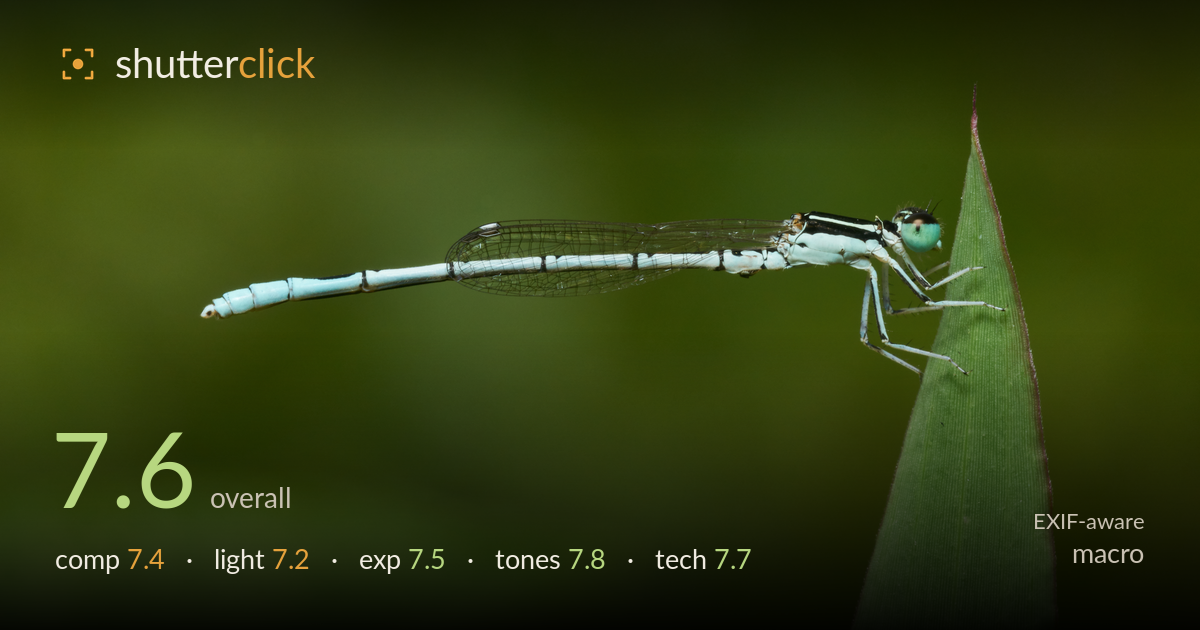
Damselfly perched on a leaf tip
Photo by Jeevan Jose, Kerala, India

| Focal length | 150 mm |
| Aperture | f / 14.0 |
| Shutter | 1/250 s |
| ISO | ISO 400 |
| Exp. comp. | 0.0 EV |
| Shot at | 14:17 · Nov 26, 2016 |
A clean, well-executed damselfly profile that reads clearly against a smooth green field. The lateral view keeps the entire insect on one focal plane, the diagonal grass blade anchors it, and the pale blue body pops crisply against the muted background. What holds it back most is the placement: the subject and its perch are crowded to the right, leaving a large expanse of unbroken green to the left with the abdomen tip nearly touching the frame edge. The head and eye are sharp, but a fraction more depth of field on the far wing and legs, plus more breathing room ahead of the abdomen, would elevate it.
The lateral profile is the right call, showing the full length of the damselfly cleanly, and the diagonal grass tip provides a natural perch and visual anchor. The problem is weight distribution: the insect sits far right with the abdomen tip almost kissing the left frame edge, while a vast field of green fills the left half doing little work. The eye leads left along the body but runs out of room. Repositioning so the abdomen has space to point into, or a tighter crop from the left, would balance the tension.
Soft, diffused light bathes the subject evenly, avoiding the harsh specular blowout that plagues shiny insect cuticle and wing membrane. This keeps the pale blue abdomen readable and the wing veins visible against the green. The tradeoff is flatness: there is little directional modelling to give the body roundness or to rake across the thoracic markings. A touch of side light would carve more dimension into the segments and add a catchlight to the eye, which currently reads slightly dull for a macro portrait.
Exposure is well judged. The pale blue body retains detail without clipping the highlights on the brightest segments, and the dark thoracic stripes and eye hold their density without blocking up. The green background sits at a pleasant mid-tone that neither distracts nor muddies. The near-transparent wings are handled gracefully, their veining preserved against the green. Nothing looks accidental here. If anything, a whisper more headroom in the brightest abdomen segments would guard against any highlight edge, but as rendered it is clean.
The colour relationship is the strongest element: cool pale blue against the warm-leaning green reads with real separation, and the teal eye ties the palette together. White balance is neutral and believable, the green free of yellow cast or oversaturation. Contrast is gentle and appropriate for macro, preserving the subtle gradations along the abdomen segments. The grass blade carries just enough tonal variation to feel three-dimensional. Overall a restrained, natural grade that lets the subject's colour do the work without pushing saturation into artificiality.
The 150mm f/2.8 macro at f/14 is a sound choice, and the lateral orientation maximises the benefit by keeping most of the body on one plane. Focus lands well on the eye, head and thorax, which is exactly where it needs to be. At f/14 there is enough depth to hold the near legs, but the far wing tips and the trailing wing soften slightly, and diffraction at this aperture starts to erode the finest cuticle detail on the sharpest areas. ISO 400 keeps noise negligible and gives clean shadows. The 1/250s shutter froze this still perch adequately, though it would be marginal for any wing movement. A focus-stacked pair, or f/11 with careful plane alignment, would recover both edge-to-edge sharpness and bite that single-frame f/14 sacrifices to diffraction. The result is technically competent and sharp where it counts, held back only by the softness at the wing extremities and the slight diffraction penalty.
What would elevate it
Tags
Shot something like this?
Expert photo critique, on demand — scored across six categories, EXIF-aware. Start with 3 free critiques, no credit card.
critique my photo — free