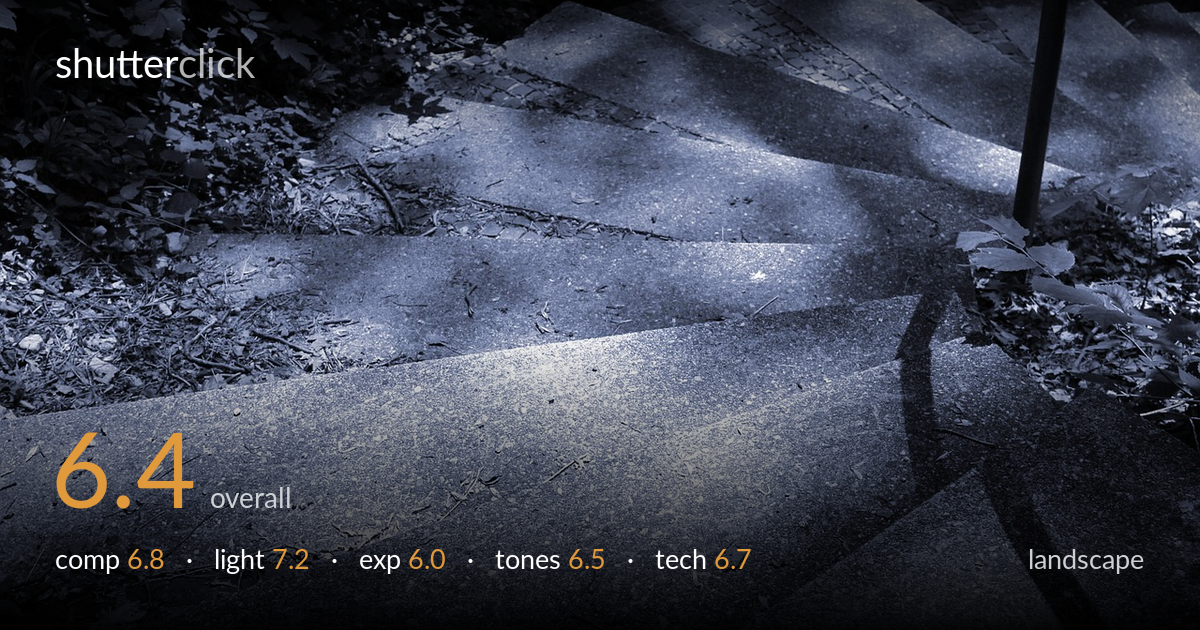
Dappled light on woodland steps
Photo by Antranias

No EXIF metadata in this file
Technical analysis based on visual assessment only.
Dappled light raking across descending stone steps is the real strength here — the diagonal cascade of treads pulls the eye downward and creates genuine depth. What most holds the frame back is the lack of a clear destination; the steps lead down and out of frame without resolving on a focal point, so the descent feels open-ended. The deep shadows on the left also swallow detail without serving the composition. A tighter relationship between the light pools and a defined end point would lift this from atmospheric study to fully realised image. The texture and mood are working.
The downward diagonal of the steps is the backbone of the frame, and the patches of light staggered across the treads build a satisfying rhythm and sense of descent. The handrail upper-right adds a useful vertical anchor. However, the eye travels down the steps and exits the bottom edge without landing anywhere — there's no resolving point. The dense foliage on the left is a heavy, undifferentiated mass that contributes little. A vantage that included where the steps lead, or a stronger foreground anchor, would give the composition somewhere to settle.
Broken light filtering through the canopy is the most compelling element — the bright pools scattered across the stone create texture, depth, and a quiet, almost cinematic mood. The direction reads as dappled overhead sun through trees, which suits the woodland-staircase subject well. The contrast between lit treads and shadowed risers gives the steps three-dimensional form. The trade-off is that the same light leaves large portions of the left side in near-total shadow, flattening that region. Slightly softer or more even illumination, or timing for fuller coverage, would balance the frame.
Exposure is a compromise driven by the high-contrast dappled light. The lit stone holds detail without serious clipping, which is well managed given the brightness range. The shadows, however, fall away into murky black on the left, losing the foliage detail that's clearly present. The midtones on the steps sit a touch low, giving the whole frame a heavy, underexposed feel. Lifting the shadows a stop in processing, or bracketing to recover the dark foliage, would open up the frame without blowing the highlights.
The cool blue toning gives the scene a moody, twilight character that suits the shadowy woodland staircase, though it reads as a deliberate split-tone rather than natural light. It works atmospherically but flattens the stone's warmth and can feel applied rather than organic. Contrast is strong, perhaps slightly heavy, crushing the darkest areas. The mid-tone gradation across the lit stone is the most successful tonal passage, showing fine texture. A less saturated, more neutral treatment would let the natural granite tones breathe while keeping the cool mood.
Focus appears accurate across the central steps, with the granite texture rendered crisply where light strikes it — the fine speckle and scattered debris are clearly resolved, suggesting a well-chosen aperture for front-to-back sharpness on a receding plane. There's no obvious motion blur, and noise is controlled in the lit areas, though the deep shadows show some muddiness that's hard to separate from the heavy toning. Depth of field looks sufficient to keep the staircase coherent from foreground to mid-ground. The main technical limitation is dynamic range: the single exposure can't hold both the bright dappled stone and the shadowed foliage, so the left collapses. Bracketing and blending, or shooting in flatter light, would resolve this. Lens choice and framing are reasonable for the scene, capturing the diagonal sweep without obvious distortion. Overall the capture is technically sound; the issues are more about light management and exposure decisions than execution.
What would elevate it
Tags
Shot something like this?
Expert photo critique, on demand — scored across six categories, EXIF-aware. Start with 3 free critiques, no credit card.
critique my photo — free