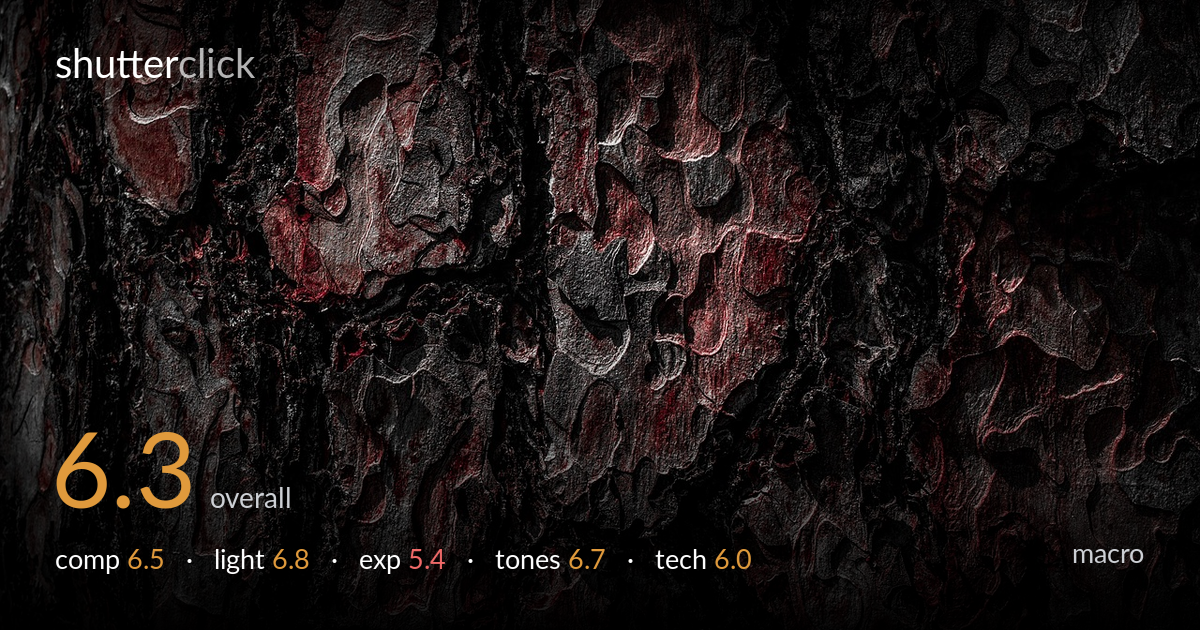
Dark red pine bark texture
Photo by Stufforge

No EXIF metadata in this file
Technical analysis based on visual assessment only.
A moody, near-abstract study of pine bark that succeeds as texture and pattern more than as a focused macro. The plate-like scales fill the frame with a strong overall rhythm, and the dark red-and-charcoal palette gives it an almost volcanic, ember-like quality. What most holds it back is the heavy shadow weighting: large areas at the edges fall into near-black with little recoverable detail, and the exposure reads more crushed than intentionally low-key. As a texture, there's no clear focal anchor, which is fine for abstract intent but leaves the eye wandering. More even light across the surface would let the relief read fully.
The frame is filled edge to edge with bark texture, which suits an abstract macro reading and creates a dense, allover pattern. There's no single focal point, so the eye roams the scale-like plates, finding rhythm in the repeated forms. The brighter, redder cluster left of centre offers a loose anchor, but the darkening corners pull weight away unevenly rather than framing it. A composition built around one stronger relief feature, or a more deliberate diagonal flow across the plates, would give the wandering eye somewhere to settle.
Raking light from the upper area catches the raised edges of the bark scales and brings out their three-dimensional relief, which is the image's strongest quality. That low, glancing angle is the right instinct for texture work. The fall-off into the corners is dramatic but uneven, plunging large zones into near-darkness where the surface detail disappears entirely. A more controlled, even raking light across the whole plane, or a fill to lift the shadowed edges, would let the texture read consistently rather than only in the central band.
The exposure leans heavily dark, and while a low-key treatment fits the mood, the shadows here are crushed past the point of recoverable detail across the corners and lower regions. The histogram would be stacked hard against the black point. The brighter central reds hold tone well and aren't clipping, so the highlight end is handled. The issue is the lack of mid-shadow gradation, the very tones that carry texture in bark. Lifting the blacks slightly in capture or post would restore relief without sacrificing the brooding atmosphere.
The dark crimson-and-charcoal palette is the most distinctive thing here, giving the bark an ember-like warmth against deep, cool shadows. White balance leans warm in a way that flatters the subject, and the red highlights in the scale crevices add depth. Contrast is high, which suits the drama but compounds the shadow crushing. Mid-tone gradation is thin between the lit reds and the black voids. A gentler tonal curve through the shadows would preserve the mood while recovering the subtle browns and greys that give bark its richness.
Focus appears accurate across the central band, where the raised edges of the bark are crisp and the fine fissures resolve cleanly, suggesting an aperture stopped down enough to hold the textured plane in acceptable focus. For a flat-ish subject shot near-parallel, depth of field looks adequate, though the corners may be falling soft as much from the steep light fall-off as from focus. Noise is well controlled in the brighter regions; the deepest shadows are too dark to assess but show no obvious smearing. The main technical limitation isn't sharpness or noise but the lighting and exposure choices that bury much of the surface. For a texture subject like this, a more frontal-raking light combined with a slightly brighter base exposure would let the whole frame carry the detail the centre already shows. Focus stacking isn't really needed here given the shallow relief, but ensuring the entire plane sits within the focused zone would tighten the edges.
What would elevate it
Tags
Shot something like this?
Expert photo critique, on demand — scored across six categories, EXIF-aware. Start with 3 free critiques, no credit card.
critique my photo — free