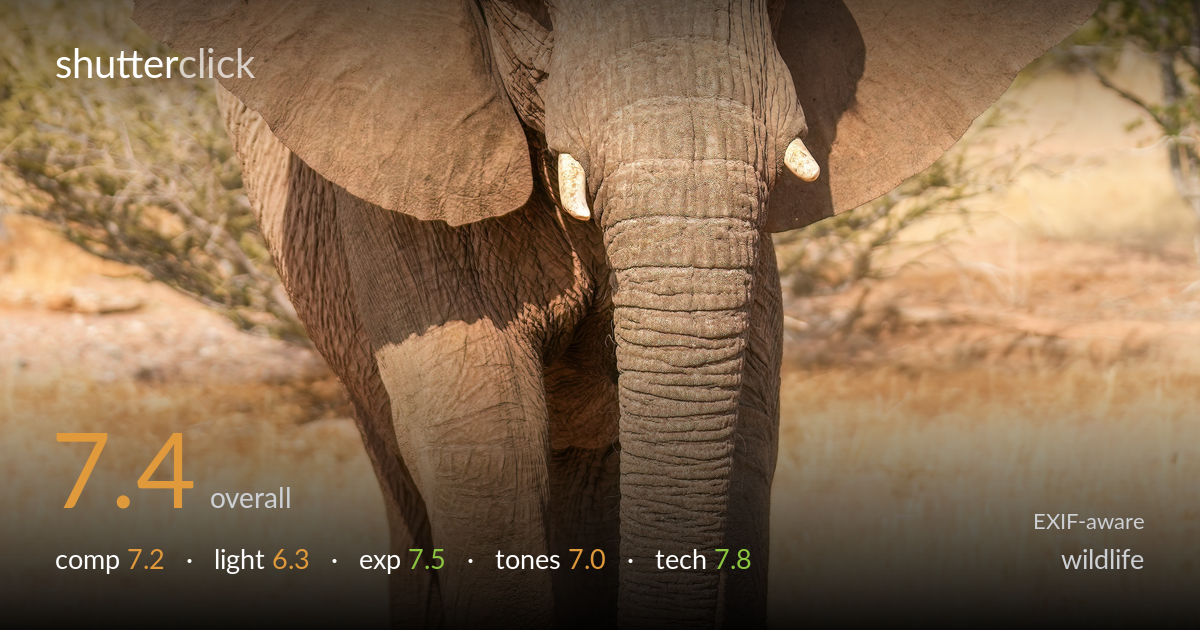
Desert elephant head-on
Photo by Giles Laurent

| Focal length | 74 mm |
| Aperture | f / 2.8 |
| Shutter | 1/5000 s |
| ISO | ISO 200 |
| Exp. comp. | 0.0 EV |
| Shot at | 08:31 · Jul 28, 2025 |
A commanding head-on portrait of a desert elephant, filling the frame with the ears spread wide and the trunk hanging in a clean vertical that anchors the composition. The pose carries genuine presence and the eye detail is sharp where it counts. What most holds the shot back is the light: harsh, high midday sun rakes across the face, blowing out the dome of the skull and casting heavy shadows under the body. The warm savanna palette is pleasant but a touch flat. The framing is strong but the trunk is clipped at the bottom edge — a small concession that costs the gesture.
The head-on stance with ears fully fanned is a powerful, symmetrical choice that maximises the animal's mass in the frame. The trunk drops as a strong central line, and the eyes sit near the upper third. The dry brush flanking both sides frames the subject without distraction. The main weakness is the bottom crop: the tip of the trunk and the curled end meet the edge, cutting off the gesture's resolution. A touch more headroom or floor would let the pose breathe. Overall a confident, balanced frame.
This is the limiting factor. Hard overhead midday sun flattens the textured skin where it could have revealed it, and blows the top of the head and trunk ridge toward pure white. The deep shadow pooling under the belly and behind the ears reads as a harsh tonal drop rather than shaping form. Front-on light fills the face adequately and the eyes stay legible, but the quality is unflattering for an animal whose appeal lies in wrinkle and texture. Early or late raking light would transform this same pose.
Exposure is handled well given the difficult midday contrast. The midtones of the body skin sit cleanly and retain wrinkle detail across most of the frame. There is some highlight clipping on the crown of the head and the upper trunk where the sun strikes directly, but it is contained to small areas rather than spreading. Shadow under the body holds enough information to read. No exposure compensation was dialled, which suits the bright neutral subject. A deliberate, accurate reading of a tricky scene.
The warm earth palette — tawny grass, red sand, grey-brown hide — is cohesive and true to the desert setting. White balance leans appropriately warm without tipping orange. Contrast is on the harder side courtesy of the midday sun, which suits the subject's heft but leaves the skin tones a little flat in the brightest passages. The tusks and pale dust on the skull provide useful tonal accents. A gentle highlight recovery and a slight lift in local contrast on the body would add dimensionality.
The Sony A1 with the 70-200mm f/2.8 GM is well chosen for this reach, and the execution is sound. At 1/5000s the elephant is frozen with no motion blur, and ISO 200 keeps the file clean with ample detail in the skin texture. Focus lands on the eye, which is exactly where it should be for a wildlife portrait — the lashes and eye socket read crisply. The choice of f/2.8 wide open is the one point worth questioning: on a subject this deep, head-on, with the trunk extending toward the camera, the shallow plane leaves the trunk tip and the rear of the body softening. Stopping down to f/5.6 or f/8 would hold the whole animal sharp, and at this light there was abundant shutter and ISO headroom to do so. The 74mm focal length gives a natural, undistorted perspective at this working distance. Strong technique with one aperture decision to revisit.
What would elevate it
Tags
Shot something like this?
Expert photo critique, on demand — scored across six categories, EXIF-aware. Start with 3 free critiques, no credit card.
critique my photo — free