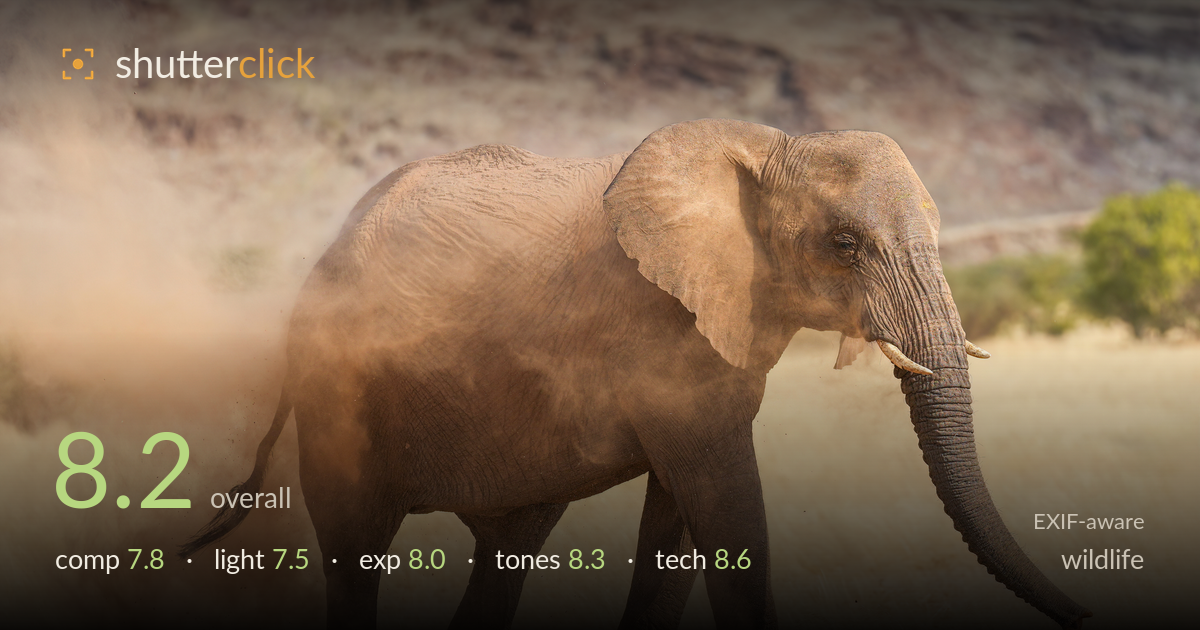
Desert elephant kicking up dust
Photo by Giles Laurent

| Focal length | 200 mm |
| Aperture | f / 2.8 |
| Shutter | 1/2500 s |
| ISO | ISO 100 |
| Exp. comp. | 0.0 EV |
| Shot at | 08:24 · Jul 28, 2025 |
A dust-kicking desert elephant caught mid-stride with atmosphere that lifts a straightforward side profile into something memorable. The swirling dust behind the animal adds motion and story, and the tonal harmony of dust, dry grass and grey hide is beautifully cohesive. The eye is sharp and expression readable. What most holds the shot back is a slightly tight frame at the trunk end and midday light that flattens the near flank. The full side-on pose is documentary-clean but not the most dynamic angle. Strong wildlife work with clear headroom to push composition and light timing further.
The elephant is well placed moving into the frame, with the dust cloud filling the left as balancing negative space and story. Front-heavy weighting toward the trunk works for direction of travel, but the trunk tip crowds the right edge, leaving no breathing room ahead of the animal — a touch more space there would ease the eye. The low, ground-level perspective is effective, keeping the horizon out and immersing the subject in its habitat. The dry-grass foreground grounds the scene without distraction.
The light reads as high, near-midday sun, which keeps the scene bright and reveals the dust well but flattens the modelling on the near flank and belly. The head and ear catch enough directional light to show the wrinkled texture, and backlight rims the dust particles attractively, giving the cloud its glow. Softer, lower-angle light near golden hour would have raked across the hide to bring out more three-dimensional form and warmed the dust into something more dramatic. As is, the light is functional and clean.
Exposure is well judged for a bright, high-key desert scene. Highlights in the pale grass and dust hold detail without clipping, and the darker hide retains shadow information across the legs and underbelly. The overall brightness suits the dusty, sun-washed mood without looking washed out. The histogram sits comfortably in the upper range while preserving texture in the brightest dust. No exposure compensation was needed and none was applied, which was the right call — the metering handled the reflective environment cleanly.
The tonal palette is the image's quiet strength — dust ochre, dry-grass gold and the warm grey of the hide all sit in the same restrained warm register, creating a cohesive, almost monochromatic desert feel. White balance leans warm and suits the arid setting. Contrast is gentle, appropriate for the dusty air, and saturation is held in check so nothing feels artificial. The distant green shrub on the right adds just enough tonal counterpoint without breaking the harmony. A very well controlled grade.
The settings are close to ideal for the situation. At 200mm on the Sony A1, f/2.8 delivers subject-background separation that softens the rocky slope behind into a pleasing wash while keeping the elephant distinct — though at this distance depth of field is deep enough that the whole animal stays acceptably sharp despite the wide aperture. 1/2500s comfortably freezes both the stride and the flung dust particles, catching individual grains suspended in air. ISO 100 keeps the file clean with maximum dynamic range for the bright scene. Focus is landed on the eye, which is critical for wildlife, and the wrinkled skin detail across the head and trunk resolves crisply. The 70-200 GM is a versatile choice here and its rendering is excellent. The only refinement would be that a slightly narrower aperture was available given the abundant light, buying a hair more depth for total front-to-back sharpness on the animal — but the execution is already high.
What would elevate it
Tags
Shot something like this?
Expert photo critique, on demand — scored across six categories, EXIF-aware. Start with 3 free critiques, no credit card.
critique my photo — free