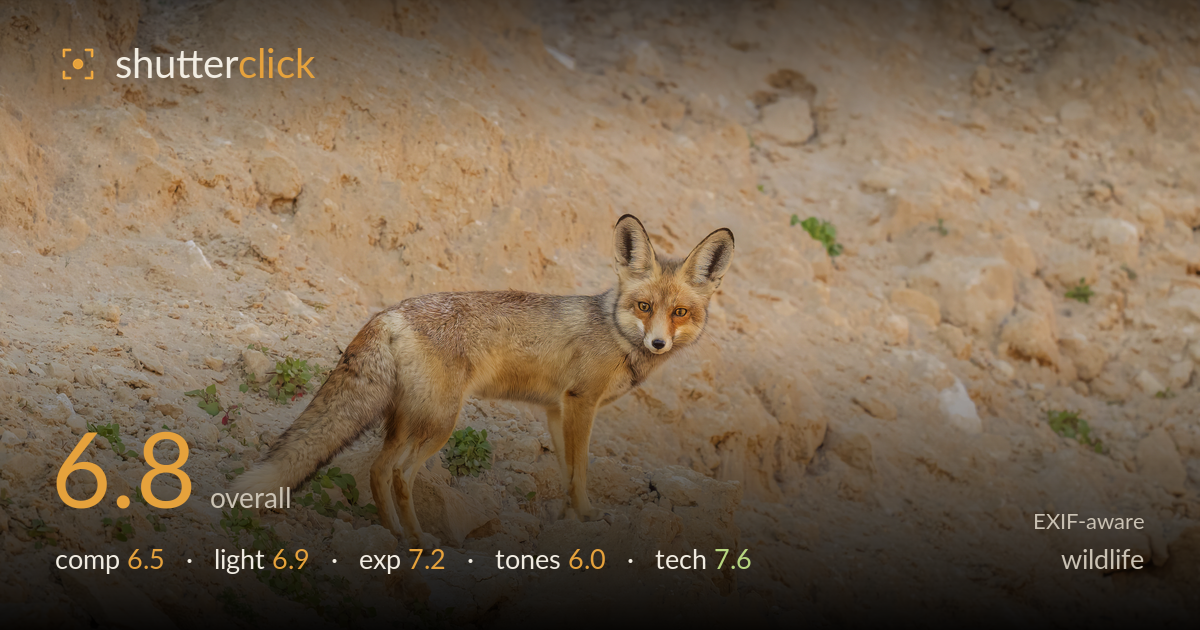
Desert fox on a rocky slope
Photo by Manojkiri photography

| Focal length | 800 mm |
| Aperture | f / 7.1 |
| Shutter | 1/1000 s |
| ISO | ISO 1400 |
| Exp. comp. | 0.0 EV |
| Shot at | 04:34 · Jan 16, 2026 |
A clean side profile of a desert fox caught with direct eye contact, sharp where it counts. The strongest asset is the alert head turn and engaged gaze; the greatest limitation is the near-monochromatic palette, where fox and terrain share nearly identical tones and the animal risks dissolving into the slope. Placement gives generous room ahead, which helps, but the animal sits slightly small in a busy, textured field. Sharpness on the eye and fur is excellent thanks to the long lens and fast shutter. Improved separation, whether through light, angle, or subtle post-processing, would lift this from a solid record to a striking portrait.
The fox is placed left of centre in profile, looking into open space to the right, which gives the gaze somewhere to travel. That works. The diagonal slope adds energy and a sense of habitat. Less successful is the subject scale: the animal reads fairly small against a large, uniformly textured field, and the busy rubble competes for attention. The tail is nicely contained, but the lower-right rocks are heavy and empty. A slightly tighter frame or a cleaner background band behind the head would sharpen focus on the subject.
Warm, low-angle light rakes across the scene, likely early or late in the day, and it flatters the fox's coat and catches a faint rim along the back and ears. The eye picks up a small catchlight, which sells the connection. The trade-off is that the same warm light bathes the terrain identically, flattening the tonal difference between animal and ground. Slightly more directional or side light would sculpt the fox's form and lift it off the slope. As it stands, the light is pleasant but doesn't separate the subject.
Exposure is well judged. The fox's coat holds detail across the mid-tones, the eye and darker facial markings retain information, and there's no obvious highlight clipping on the brightest pale rocks. The zero exposure compensation was a safe call given the reflective, sandy field, avoiding blown highlights while keeping the animal bright enough. Shadow detail in the fur and under the belly is preserved. Overall the histogram appears healthy with room in both directions. Nothing here needs rescuing; the exposure supports the image rather than fighting it.
This is the weakest link. The entire frame lives in a narrow band of warm ochre and tan, and the fox's rust coat is only marginally warmer than the earth, so the two blend rather than contrast. The scattered green sprigs are the only relief, and they're minor. Contrast is soft, which suits the gentle light but further reduces separation. A subtle boost to the fox's saturation and a slight cooling or desaturation of the surrounding rock in post would create the tonal gap the composition needs. The palette is authentic but visually monotonous.
Execution is strong and the gear was used well. The 800mm f/6.3 at f/7.1 gives enough depth to hold the fox sharp head to tail while gently softening the near and far rubble, and focus lands cleanly on the eye, which is exactly where it must for wildlife. At 1/1000s the standing pose is frozen without issue, with margin to spare had the animal moved. ISO 1400 is a sensible choice for the light and the Z9 handles it with minimal visible noise; the fur retains fine texture and there's no smearing from over-aggressive noise reduction. The long lens delivers the reach needed for a wary desert fox without crowding it. If anything, a marginally wider aperture would have blurred the background further to aid separation, but depth-of-field was a reasonable compromise for full-body sharpness. Autofocus, stabilisation, and shutter discipline all did their job. Technically, this is a clean, well-handled capture that leaves nothing significant to fix in-camera.
What would elevate it
Tags
Shot something like this?
Expert photo critique, on demand — scored across six categories, EXIF-aware. Start with 3 free critiques, no credit card.
critique my photo — free