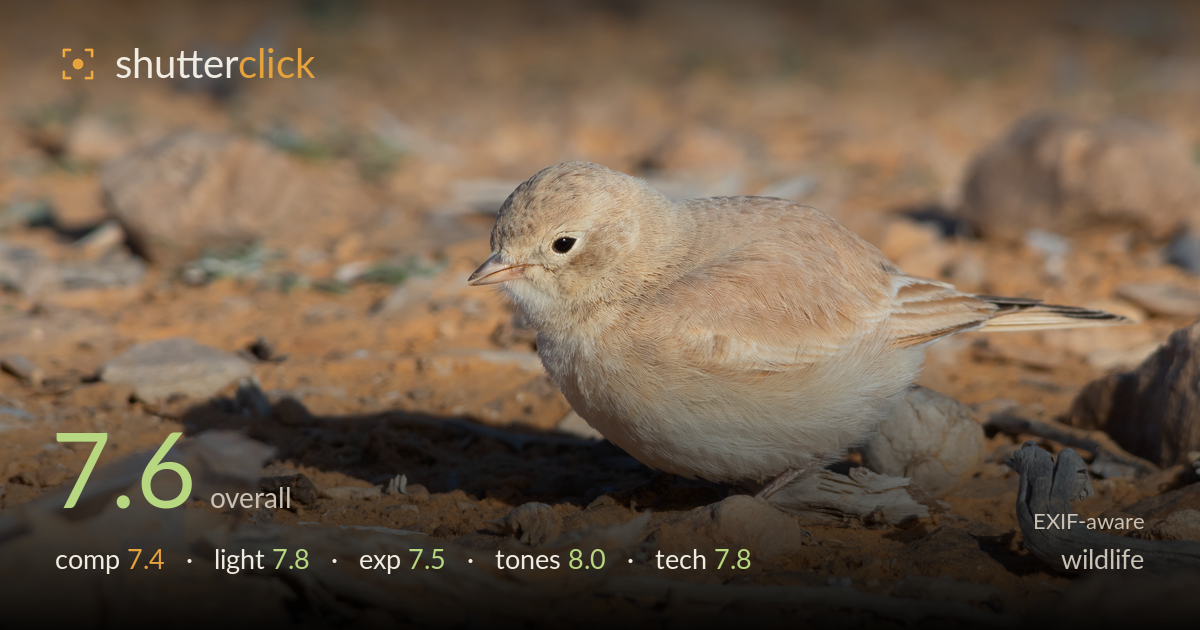
Desert lark at ground level
Photo by El Golli Mohamed

| Focal length | 500 mm |
| Aperture | f / 9.0 |
| Shutter | 1/640 s |
| ISO | ISO 200 |
| Exp. comp. | 0.0 EV |
| Shot at | 09:07 · Dec 27, 2016 |
A clean, low-perspective desert lark study with the eye-level camera position doing the heavy lifting — that ground-hugging viewpoint immerses the bird in its habitat and yields a beautifully soft background wash. The sharp, catchlit eye anchors the frame. What holds it back is the busy foreground: scattered twigs and pale debris right at the bird's feet compete for attention and clutter the lower frame. The bird also sits close to centre with limited room ahead of it. Warm early light and a tonal palette perfectly matched to the sand give the image cohesion. Small refinements to placement and foreground control would lift it.
The low, eye-level angle is the standout choice — it plants the viewer in the bird's world and melts the background into a soft wash. The bird faces left but sits near centre with only modest breathing room ahead, so the frame feels slightly tight in the direction of its gaze. The tangle of pale twigs and bright pebbles at its feet pulls the eye downward and competes with the subject. A cleaner foreground and a touch more space in front would let the bird lead the frame.
Warm, low-angled early light rakes across the scene, modelling the bird's plumage gently and producing a small but effective catchlight in the eye. The soft directional quality suits the muted subject and avoids harsh shadow on the face. There is a hint of specular brightness on some pale stones that draws attention, and the light is warm enough to push the whole scene toward orange. Overall the timing works well for this pale desert species, keeping detail in the delicate buff feathering without blowing highlights.
Exposure is well judged for a pale subject against pale ground — the bird's white underparts and buff back retain texture without clipping, which is the main risk here. Shadow areas under the belly and in the debris hold detail. A few bright stones edge toward the highlight limit but nothing critical is lost. The overall brightness reads as deliberate and controlled, and the histogram appears comfortably within range. Metering at 0.0 EV handled the reflective sand and light plumage cleanly.
The tonal palette is the image's strongest asset: the bird's soft buff and cream blend harmoniously with the warm ochre ground, creating a cohesive, monochromatic desert feel. White balance leans warm, appropriate to the early light, though it could be nudged slightly cooler to keep the whites of the belly from taking on too much orange cast. Contrast is gentle and suits the delicate subject, and the subtle gradations in the plumage are preserved. A very natural, unforced grade.
The 500mm reach at f/9 delivers a good compromise for a ground-level bird — enough depth of field to carry the full body sharply from bill to tail while still throwing the background into pleasant blur. Focus lands accurately on the eye, which is critical and well executed, and fine feather detail across the flank and wing is crisply resolved. At 1/640s the static, perched bird is frozen cleanly with no motion blur, and ISO 200 keeps noise negligible with clean shadows. The choices are all sound. The one consideration: at f/9 the near foreground debris renders sharp enough to distract, so a wider aperture would have softened it further at the cost of some tail sharpness, or a slightly different angle would have avoided it entirely. The lens and settings are well matched to the subject, and execution on the essential element — the eye — is textbook. Solid, disciplined technical work throughout.
What would elevate it
Tags
Shot something like this?
Expert photo critique, on demand — scored across six categories, EXIF-aware. Start with 3 free critiques, no credit card.
critique my photo — free