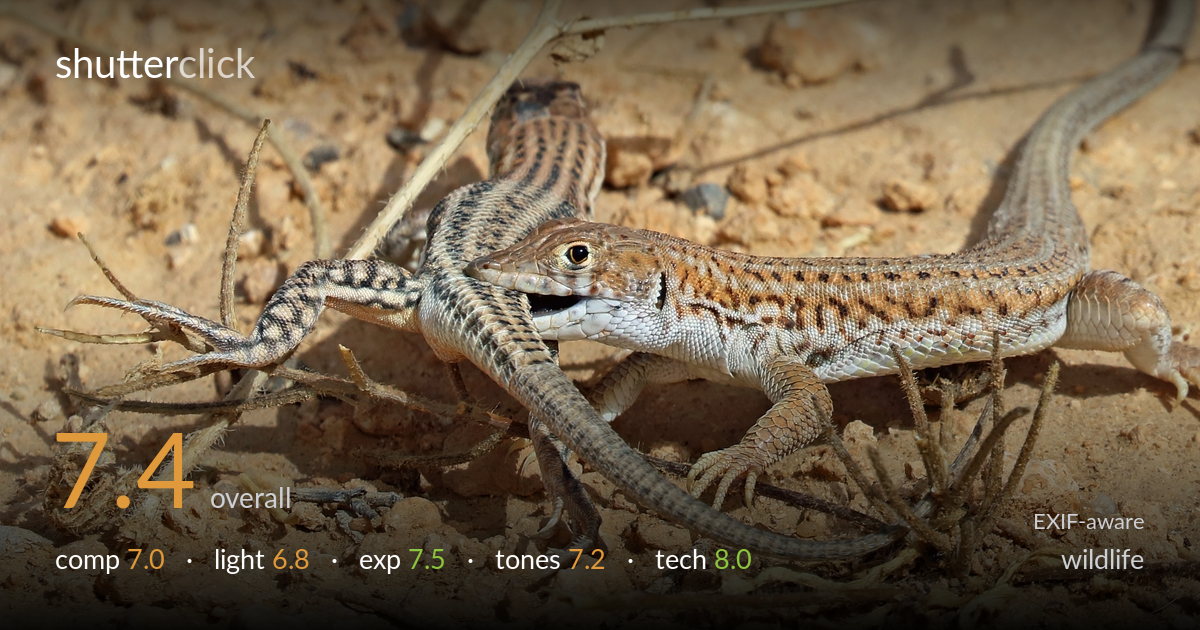
Desert lizard at eye level
Photo by Charles J. Sharp

| Focal length | 371 mm |
| Aperture | f / 10.0 |
| Shutter | 1/640 s |
| ISO | ISO 200 |
| Exp. comp. | 0.0 EV |
| Shot at | 09:19 · May 11, 2018 |
A crisp, eye-level capture of a desert lizard with the open mouth adding behavioural interest and the head rendered tack-sharp. The low shooting angle pays off, putting the camera into the animal's world. What most holds the image back is the busy, cluttered foreground of dry twigs and the lizard's own tail crossing back through the frame, which fragments the composition and competes for attention. Harsh near-midday light flattens some of the scale texture. The sandy background, while authentic, blends tonally with the subject and reduces separation. The technique is solid; the scene itself needed more refinement.
The eye-level perspective is the strongest compositional choice, placing the viewer in the lizard's plane and giving the head genuine presence. The subject fills the frame well with the head positioned slightly left of centre. However, the tangle of dry twigs in the foreground and the tail that loops back across the lower frame create distracting crossings that pull the eye away from the head. The discarded tail at far left adds clutter without purpose. A cleaner foreground or a slightly different angle would let the animal stand alone.
The light is hard and near-overhead, typical of an open desert midday, which produces strong contrast and small, harsh shadows under the limbs. It does carry enough side angle to model the scaly texture along the flank and bring out the head detail, and a clean catchlight sits in the eye. But the overhead quality flattens some of the back patterning and risks blown highlights on the pale belly. Softer, lower-angle light from early morning would render the scales with more dimensional texture and warmer tone.
Exposure is well managed for difficult bright conditions. The pale belly and lighter scales hold detail without clipping, and the eye retains information rather than blowing out. Shadow areas under the body keep some structure too. The histogram appears to sit comfortably in the upper-middle without sacrificing the highlights, which is the right call on a reflective sand substrate. At ISO 200 with no exposure compensation, the metering handled the bright scene cleanly. A touch more shadow lift in the limbs would be the only minor refinement.
The warm sandy palette is cohesive and true to the habitat, and the lizard's tans, ochres and cool grey-blue belly read naturally. White balance looks accurate for direct sun. The challenge is tonal separation: the animal's earthy tones sit very close to the background, so the subject doesn't pop as much as it could. Contrast is on the high side from the hard light, deepening the dark dorsal markings nicely but compressing some midtone gradation in the sand. A slight desaturation of the background would help.
Excellent technical execution. The EF 100-400mm L at 371mm delivers the reach needed for a wary reptile while keeping working distance, and focus is locked precisely on the eye and head scales, where it matters most. At f/10 the depth of field is deep enough to hold the head, body and near foreground sharp, a sensible choice for a low-angle ground-level subject where a wide aperture would have left parts of the animal soft. 1/640s comfortably freezes a stationary lizard, and ISO 200 keeps noise negligible with clean, detailed shadows. The only quibble is that f/10 also rendered the background twigs sharp enough to distract; opening up to around f/7.1 would have softened the clutter slightly while still keeping the animal sharp, though it would risk the far tail. Lens, shutter and ISO are all well matched to the subject. The combination of sharp focus, clean files and appropriate depth of field shows confident command of the gear.
What would elevate it
Tags
Shot something like this?
Expert photo critique, on demand — scored across six categories, EXIF-aware. Start with 3 free critiques, no credit card.
critique my photo — free