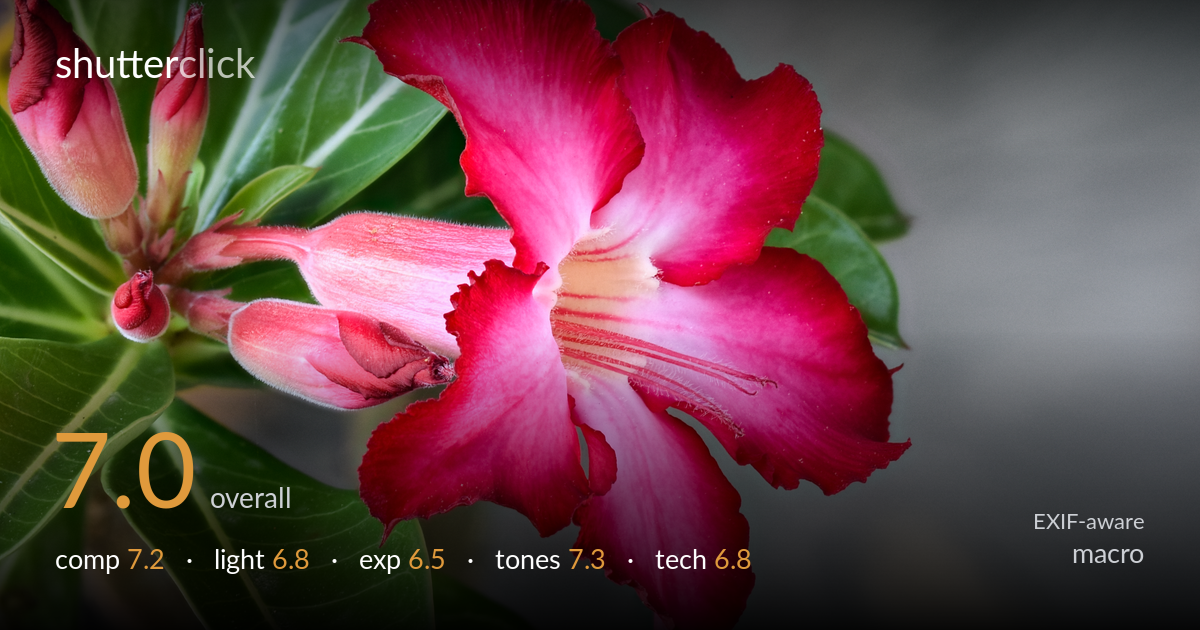
Desert rose in full bloom
Photo by This Photo was taken by Timothy A. Gonsalves. Feel free to use my photos, but pl

| Focal length | 90 mm |
| Aperture | f / 8.0 |
| Shutter | 1/8 s |
| ISO | ISO 160 |
| Exp. comp. | 0.0 EV |
| Shot at | 07:20 · Jul 27, 2022 |
A vivid, well-rendered desert rose with the open bloom anchoring the right of frame and a satisfying progression of buds trailing off to the left, telling a small story of the plant's flowering stages. The pink-to-red gradation and the throat detail are the strongest assets. What holds it back most is the bloom: the brightest petal tips and the white throat edge toward clipping, flattening texture where it matters most, and the open flower sits a touch large in the frame with cramped right-edge breathing room. The defocused grey background reads as muddy concrete rather than a clean complement.
The diagonal flow from the cluster of buds at lower-left up to the fully open bloom gives the frame a clear narrative line and good visual momentum. Placing the main flower right of centre works, but its outer petals crowd the right edge, leaving little room to breathe while the grey expanse on the far right sits empty and underused. The buds are a genuine strength, adding context and rhythm. A slightly wider framing or a shift left would relieve the edge tension and balance the negative space more deliberately.
The light is soft and fairly even, flattering for the colour but lacking direction to model the petals' form. Without a clear raking angle the bloom reads slightly flat, and the velvety texture of the buds and the fine hairs in the throat aren't fully revealed. Highlights on the upper petals suggest direct overhead sun that has pushed the brightest tones too hard. A softer, more directional side light — or a diffuser to tame the hotspots — would carve depth into the petals and protect the delicate gradients.
Overall brightness is reasonable but the saturated reds and the white throat are pressing against the upper limit, with the lightest petal tips and the central tube edging into clipping where detail is most valuable. The dark leaves and shadowed buds retain detail well, so dynamic range isn't the issue — it's the placement of the highlights. A third to half a stop of negative compensation, or exposing for the brightest petal, would preserve the gradients in the bloom that currently risk going chalky.
Colour is the highlight here: the crimson-to-magenta transition across the petals is rich without tipping fully into oversaturation, and the warm yellow-cream throat provides a welcome focal accent. The green leaves are saturated but believable, and white balance reads neutral. The grey background is the weak tonal note — flat and slightly dingy, it competes rather than recedes. Pulling red saturation back marginally and warming or darkening the background would let the flower's colour sing without the reds blocking up in the deepest petal folds.
At f/8 on the 90mm Tamron macro, depth of field is well chosen — enough to hold the open bloom and the nearest buds acceptably sharp while melting the background, which suits the subject. Focus appears placed on the throat and central petals, where it counts. The concern is the 1/8s shutter: that is slow for a flower likely subject to any breeze, and while the VC and the apparent sharpness suggest a tripod kept it steady, any petal movement at that speed risks softness in the finest detail. ISO 160 keeps noise negligible, which is exactly right. A faster shutter — pushing ISO to 400 or 800 to reach 1/60 or higher — would buy insurance against subject motion with no meaningful noise penalty on the D7200. A small focus stack would also extend critical sharpness across the deeper petals that currently fall just outside the plane. Solid execution overall, with shutter discipline the main area to tighten.
What would elevate it
Tags
Shot something like this?
Expert photo critique, on demand — scored across six categories, EXIF-aware. Start with 3 free critiques, no credit card.
critique my photo — free