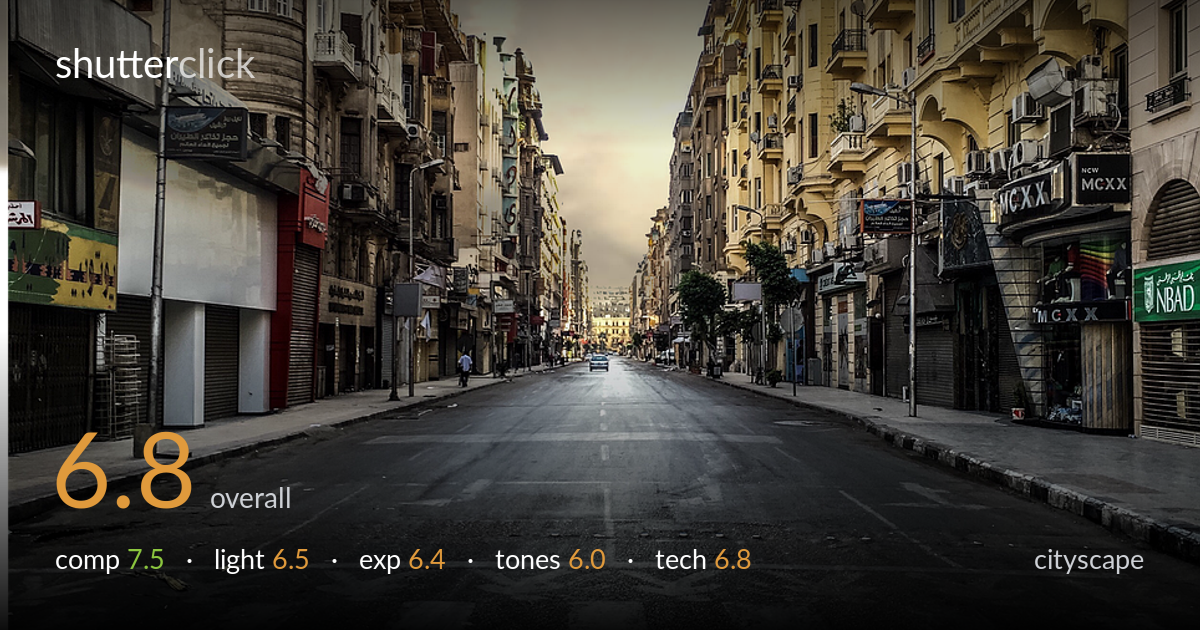
Deserted dawn boulevard
Photo by Pexels

No EXIF metadata in this file
Technical analysis based on visual assessment only.
A strong one-point perspective anchors this empty-street cityscape, with the converging building lines and crosswalk markings pulling the eye to a distant vanishing point and a hazy sunrise. The deserted boulevard carries real atmosphere and a sense of stillness. What most holds it back is the HDR-style processing: the tones feel muddy and over-cooked, with grey-flattened midtones in the road and a slightly grungy look across the buildings. The foreground asphalt dominates too much of the frame, and the sky's potential is undersold. Cleaner tonal handling and a tighter foreground would lift this considerably.
The one-point perspective is the photo's backbone — building edges and the painted crosswalk lines converge cleanly to a central vanishing point, and the low camera height emphasizes the road's sweep. The flanking buildings frame the corridor well, the warmer yellow block on the right balancing the weathered left. The lone distant car gives scale. The weakness is proportion: the empty foreground asphalt eats roughly the lower third without enough interest to justify it, and the central horizon and vanishing point sit very symmetrically, which flattens depth slightly.
The soft, hazy sunrise light glowing at the end of the street is the most evocative element, lending warmth and a quiet, deserted mood. The diffuse overcast quality keeps shadows gentle, suiting the empty-city stillness. However, the light is fairly flat across the buildings — there's little directional raking to model the facades' texture or carve depth. The brightest, most atmospheric pocket of sky is small and pushed to the centre distance, while the broad upper sky reads as a muted, undramatic grey.
Exposure is broadly serviceable — the distant sunrise glow holds without blowing out, and shadow detail survives in the building recesses. But the overall rendering leans dark and heavy through the midtones, particularly the road, which sits muddier than a clean sunrise scene calls for. The HDR-style tone mapping has compressed the dynamic range in a way that grizzles the asphalt and dulls highlights on the right-hand facade. A brighter, cleaner midtone placement would let the scene breathe rather than feeling weighted down.
This is the weakest area. The processing has a grungy, over-textured HDR character — localized contrast pushed hard so the asphalt looks grimy and the building surfaces gain an unnatural crunch. White balance drifts warm-yellow on the right and cooler-grey elsewhere, leaving the palette inconsistent. The sky's gradient from warm centre to grey edges could be lovely but reads slightly muddy. A subtler grade with reduced clarity, cleaner neutrals in the road, and a smoother sky transition would restore the natural dawn atmosphere the scene clearly has.
Without EXIF, judgement rests on visual evidence. Depth of field is deep and appropriate for a cityscape — both the near asphalt and the distant buildings hold reasonable sharpness, suggesting a small aperture and wide focal length suited to the corridor. Focus appears placed correctly along the central axis. The low shooting position is a deliberate, effective choice that maximizes the perspective pull. The most visible technical limitation is the aggressive tone-mapping pass, which introduces a gritty texture and haloing risk around the high-contrast building-to-sky edges, costing the image some perceived cleanliness. Verticals are reasonably controlled given the wide lens, though some convergence is visible on the tall right-hand block. Noise is not a problem here. Overall the capture is technically sound; the execution issues live almost entirely in post-processing rather than in the shooting decisions, which is the easier kind of problem to fix.
What would elevate it
Tags
Shot something like this?
Expert photo critique, on demand — scored across six categories, EXIF-aware. Start with 3 free critiques, no credit card.
critique my photo — free