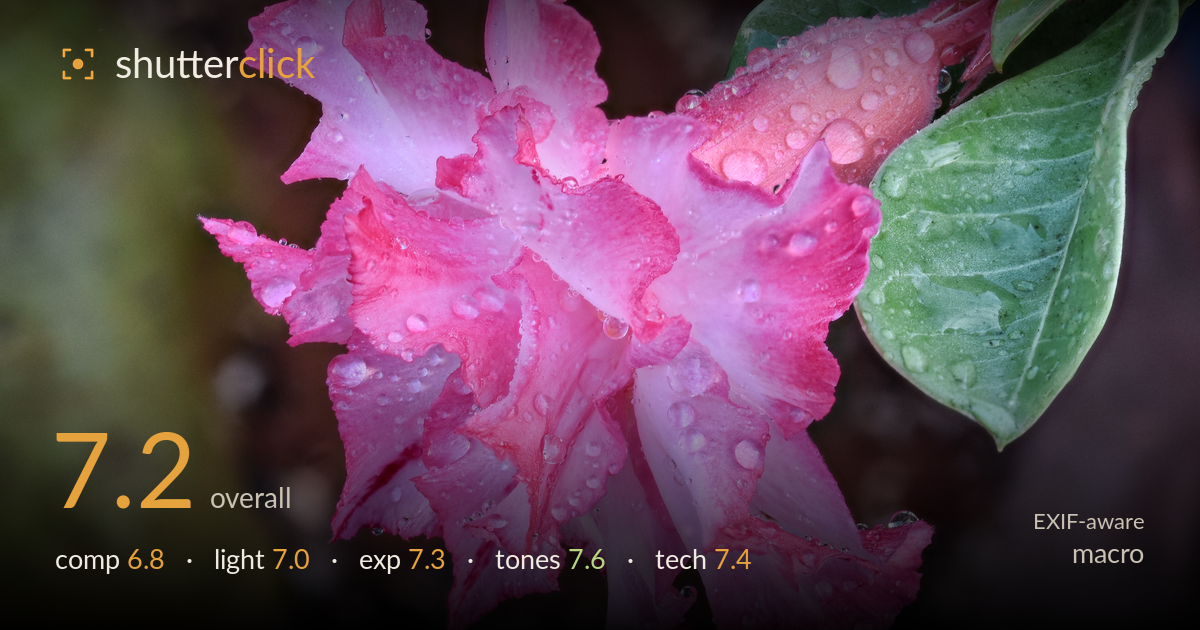
Dew-covered pink desert rose
Photo by This Photo was taken by Timothy A. Gonsalves. Feel free to use my photos, but pl

| Focal length | 90 mm |
| Aperture | f / 8.0 |
| Shutter | 1/60 s |
| ISO | ISO 200 |
| Exp. comp. | 0.0 EV |
| Shot at | 06:53 · Apr 9, 2022 |
A fresh, dew-laden desert rose rendered with rich pink-to-white petal gradation and a soft, complementary green-and-brown backdrop. The waterdrops are the star, adding sparkle and tactile detail across the bloom. What most holds the shot back is focus placement: the sharpest plane sits on the upper-right petals and the largest drops, while the central ruffled core drifts slightly soft, leaving the flower's true heart less crisp than it should be. The composition also crowds the frame, with the bloom pressed close to the left edge. Strong colour and detail; a touch more focus discipline and breathing room would elevate it.
The bloom fills the frame with energy, and the diagonal leaf and buds at upper right add balance and a sense of the plant beyond the flower. The soft green wash at left provides welcome breathing space and colour contrast. However, the flower sits tight against the left and bottom edges, clipping outer petals and cramping the arrangement. The ruffled centre is the natural focal point but competes with the busy petal edges. A slightly wider framing or a touch more negative space around the bloom would let the form read more clearly.
Soft, diffused light — likely overcast or shaded — suits this subject well, keeping the pale petals from blowing out and rendering the waterdrops with gentle, even highlights. The drops catch small specular points that give the image its sparkle. The trade-off is a slight flatness across the petals; the ruffled texture would gain dimension with a hint of directional light to rake across the folds. Shadow separation between the flower and the dark background works, keeping the subject distinct without harsh contrast.
Exposure is well judged for a bright pink subject. The palest petal areas hold detail rather than clipping, and the waterdrops retain their internal structure — a common casualty of over-exposure that is avoided here. Shadows in the background stay rich without crushing important detail. The overall balance reads deliberate at 0.0 EV. A few of the brightest drop highlights approach the limit but recover acceptably. Midtones sit comfortably, giving the petal gradients room to breathe across the tonal range.
The colour is the image's strongest asset: a convincing pink-to-white petal gradient with saturated magenta edges, set against cool greens and warm earth browns for pleasing complementary contrast. White balance looks neutral, and the pinks avoid the oversaturated, plasticky look these flowers often invite. The green leaves carry natural variation rather than a uniform block. Contrast is moderate and appropriate for the soft light. If anything, the darker background is slightly muddy in places, but it serves to isolate the bloom.
At f/8 on the 90mm Tamron macro, the depth of field is a sensible compromise for a subject this size, but the plane of focus landed on the upper-right petals and the large waterdrops there rather than the ruffled central core, which reads slightly soft. For a flower this deep, focus stacking — or stopping to f/11 with focus placed on the centre — would carry more of the bloom sharp. ISO 200 keeps noise negligible and tonal quality high. The 1/60s shutter is adequate for a static subject, and VC would have helped handheld, though at macro magnification even slight movement or breeze can soften edges — a hint of that may be present in the outer petals. Lens choice is ideal; the rendering and drop detail where focus lands are excellent. The core issue is focus precision on the intended plane, which is the single most valuable thing to nail in macro work.
What would elevate it
Tags
Shot something like this?
Expert photo critique, on demand — scored across six categories, EXIF-aware. Start with 3 free critiques, no credit card.
critique my photo — free