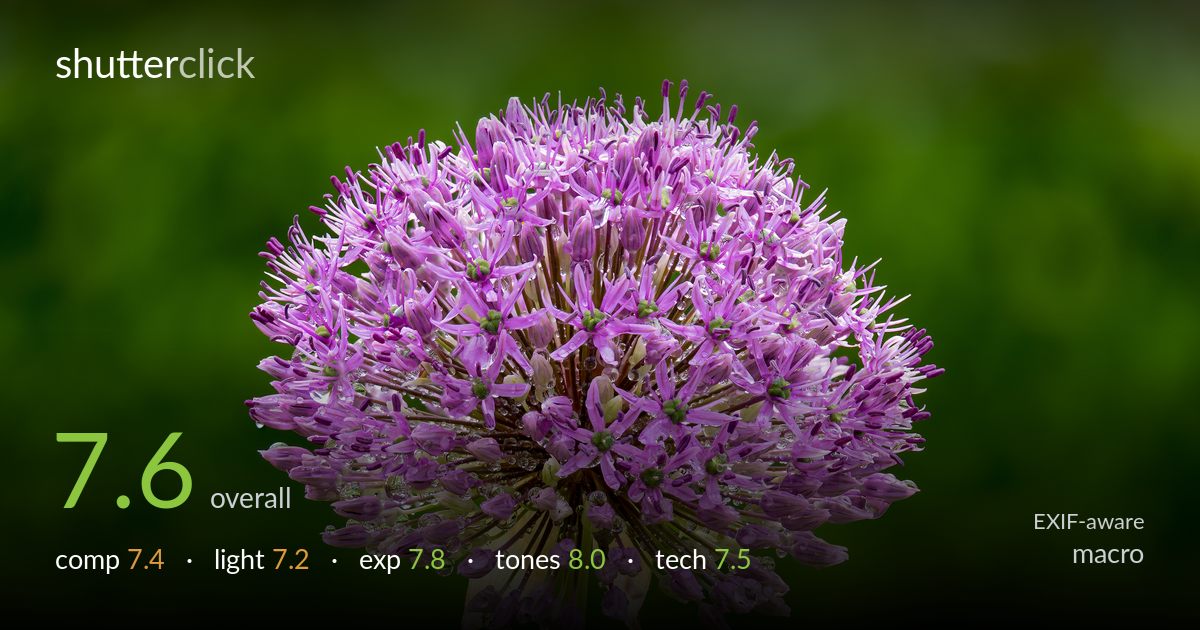
Dew-laden allium against green
Photo by Reinhold Möller Ermell

| Focal length | 90 mm |
| Aperture | f / 3.5 |
| Shutter | 1/500 s |
| ISO | ISO 200 |
| Exp. comp. | 0.0 EV |
| Shot at | 15:18 · May 3, 2025 |
A clean, well-isolated allium that reads beautifully against a soft green wash, with the dewdrops adding a welcome textural payoff. The spherical bloom is rendered crisply across its forward face, and the colour separation between magenta and green is the photo's strongest asset. What most holds it back is depth of field: at f/3.5 the back of the globe and the lower florets drift soft, so the sphere never resolves fully front-to-back. A near-centred subject and slightly bottom-heavy framing also leave the composition feeling static. Tightening focus depth and rebalancing the placement would lift this considerably.
The bloom sits almost dead-centre, which suits its radial symmetry but reads a touch static, and the long stem trailing to the bottom edge weighs the frame downward without adding much. The generous negative space on the left is pleasant but slightly uneven against the cramped right margin where flower nearly meets edge. The spherical form is the obvious anchor and it commands attention well. A placement nudging the head higher and a little left, giving the stem room to breathe below, would balance the mass more deliberately.
Soft, diffused light — likely overcast or open shade — flatters the delicate florets and keeps the magenta from blowing out, while the dewdrops still catch enough specular sparkle to register as highlights. The trade-off is flatness: there's little directional modelling to give the sphere a sense of roundness, so it reads slightly two-dimensional. A faint raking light from one side would carve out the individual stamens and deepen the globe's volume. As it stands, the lighting is safe and clean rather than sculptural.
Exposure is well judged for a high-key subject against a dark-to-mid green field. The magenta florets hold saturation without clipping, and the dewdrops retain detail in their specular cores rather than blowing to white. Shadow areas within the centre of the bloom keep enough information to read structure. The histogram sits comfortably mid-range with no alarming spikes. If anything, a touch more exposure on the recessed inner florets would open the densest central tangle, but the overall brightness placement is deliberate and clean.
The colour relationship is the photo's standout — cool magenta-violet against a deep, varied green creates strong complementary tension that does most of the heavy lifting. White balance looks accurate, with the greens reading natural rather than yellow-shifted or plastic. The pinks hold good gradation from pale buds to saturated open florets without sliding toward oversaturation. The background's tonal variation, from near-black lower left to brighter upper right, adds depth. Contrast is judged well for a delicate subject — present but never harsh.
The OM-1 with the 90mm f/3.5 macro is an ideal pairing here, and 1/500s at ISO 200 is well chosen — motion is frozen cleanly and noise is a non-issue. The core problem is the aperture choice: wide open at f/3.5, depth of field can't contain a subject this three-dimensional. The forward florets and dewdrops are tack-sharp, but the back of the globe and the lower-hanging florets fall progressively soft, so the sphere never fully resolves. Focus appears placed slightly forward of the bloom's centre, which is defensible but compounds the shallow-DOF falloff at the rear. Stopping down to f/8 or f/11, or focus-stacking a handful of frames, would carry sharpness through the whole sphere — the natural approach for a subject with this much depth. Exposure could absorb the smaller aperture at this ISO with only a modest shutter slowdown. Execution is otherwise clean and assured; the limiting decision is purely the depth-of-field call.
What would elevate it
Tags
Shot something like this?
Expert photo critique, on demand — scored across six categories, EXIF-aware. Start with 3 free critiques, no credit card.
critique my photo — free