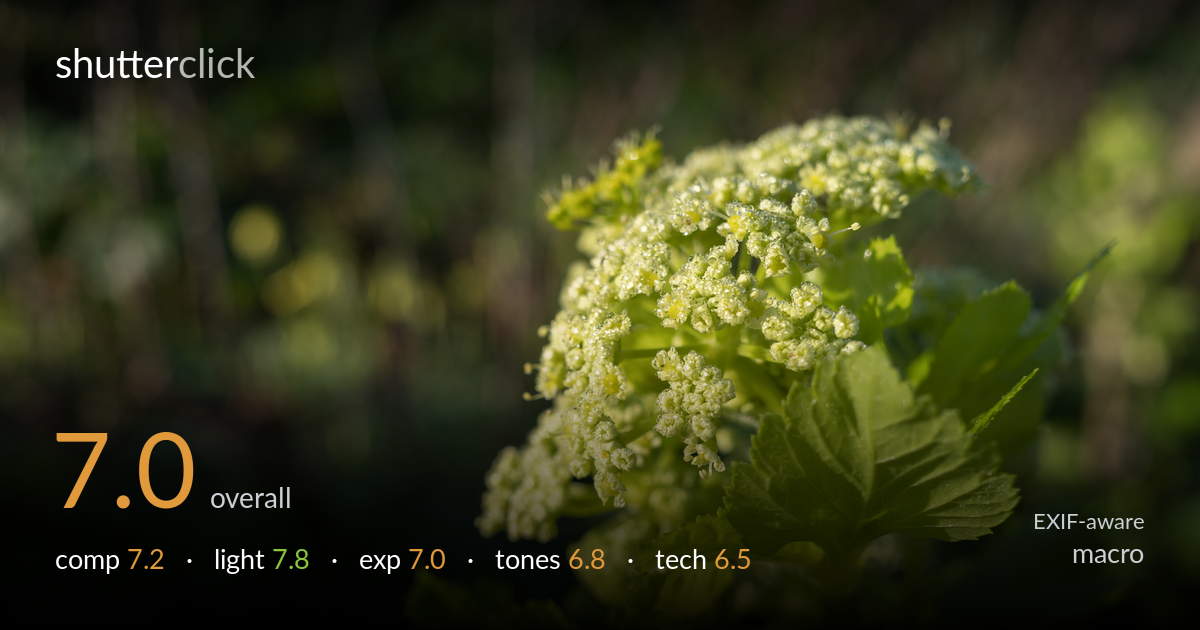
Dew-lit flowerhead in evening light
Photo by Jules Verne Times Two

| Focal length | 18 mm |
| Aperture | f / 4.0 |
| Shutter | 1/400 s |
| ISO | ISO 100 |
| Exp. comp. | 0.0 EV |
| Shot at | 09:38 · Feb 13, 2021 |
Warm backlight on a dew-flecked flowerhead carries this frame, with the glistening individual florets giving genuine macro reward against a softly thrown-out background. The placement on the right with negative space to the left works, and the dark backdrop isolates the subject cleanly. What most holds it back is focus placement and depth: the sharpest plane sits on the upper florets while the lower cluster and the leading leaf below soften, leaving no single anchored detail to lock onto. The green-on-green palette also limits tonal separation. A tighter focus discipline and a touch more chromatic variety would lift this from pleasant to striking.
The flowerhead anchored on the right third with open negative space to the left is a sound choice, and the dark background gives the pale blooms room to breathe. The supporting leaf and stem at lower right add structure and a sense of how the plant grows. The arrangement does feel slightly bottom-heavy, with the bright leaf below competing for attention against the florets. A marginally lower angle, or shifting the head higher in the frame, would let the cluster dominate more decisively and reduce the pull of the foreground leaf.
Low, warm side-back light is the strongest element here. It rakes across the florets and catches every dew droplet, giving the cluster sparkle and dimension while the unlit background falls into shadow for natural separation. The directional quality reveals texture on the leaf veins too. The trade-off is some harshness on the brightest florets where the light edges toward specular, and the foreground leaf catches enough light to glow distractingly. Slightly softer timing, or a position that kept the leaf shaded, would have balanced the emphasis better.
Exposure is largely well judged for a high-contrast backlit scene. The dark background is held without becoming muddy, and most of the floret highlights retain detail rather than blowing out, which is the harder achievement here. A few of the brightest dew-catching tips and the rim-lit leaf push close to clipping. The midtones on the shaded leaf sit a touch low. Pulling exposure compensation down a third of a stop would have fully protected those highlight peaks while leaving room to lift shadows in post.
The warm-to-cool gradient from the sunlit subject to the shadowed backdrop is appealing, and white balance reads natural for low evening light. The limitation is tonal monotony: the pale yellow-green florets, the lime leaf, and the dark green background all occupy a narrow hue band, so separation relies almost entirely on luminance rather than colour contrast. The result is pleasant but slightly flat in variety. A subtle nudge of the florets toward cream or a cooler background would broaden the palette and give the eye more to hold.
At 18.3mm and f/4 this is a wide-angle close-up rather than true macro, and that shows in the depth of field, which is shallow enough to soften the lower florets and the foreground leaf while the upper cluster sits sharpest. The critical issue is focus placement: the plane of sharpness landed on the back-upper portion of the head rather than the prominent forward florets, so the most eye-catching dew-laden blooms aren't crisp. ISO 100 keeps the file clean with no visible noise, and 1/400s froze any breeze-driven movement comfortably. f/4 was a reasonable compromise, but f/5.6 to f/8 would have carried more of the head into focus with this fixed wide lens, at no real cost given the bright conditions. A dedicated macro or close-focus setup would also yield higher per-floret detail. Focus-stacking two or three frames would have resolved the depth limitation entirely while keeping the lovely background blur intact.
What would elevate it
Tags
Shot something like this?
Expert photo critique, on demand — scored across six categories, EXIF-aware. Start with 3 free critiques, no credit card.
critique my photo — free