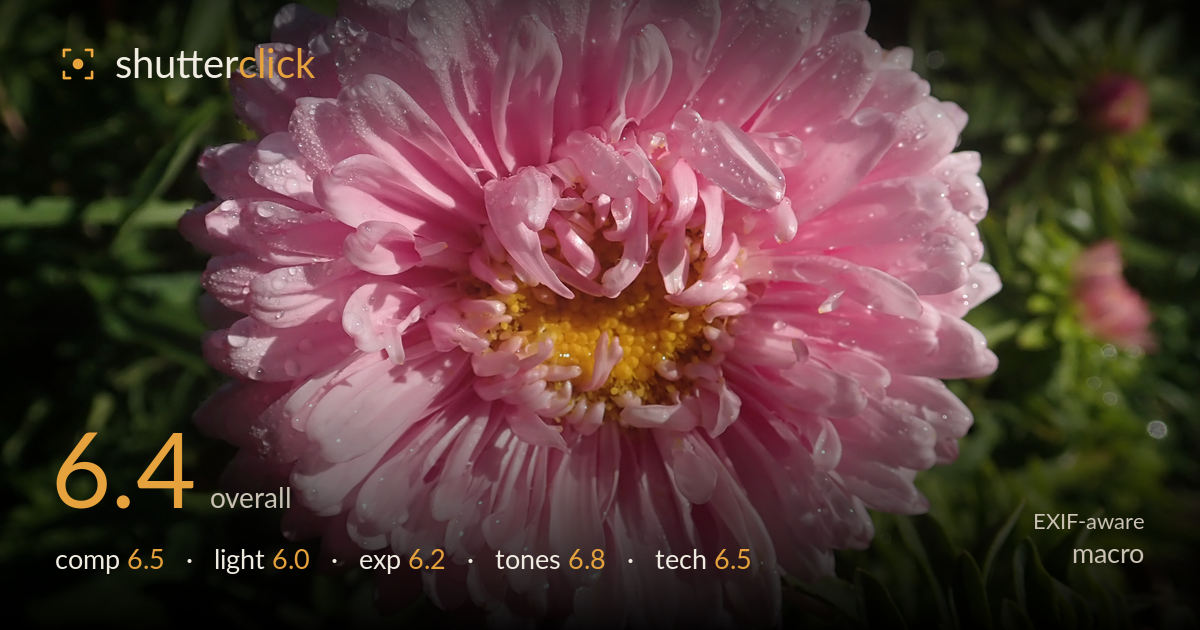
Dewy pink aster in bloom
Photo by Salicyna

| Focal length | 6 mm |
| Aperture | f / 9.0 |
| Shutter | 1/400 s |
| ISO | ISO 100 |
| Exp. comp. | -0.7 EV |
| Shot at | 07:42 · Aug 28, 2023 |
A healthy pink aster fills the frame with appealing dew detail on the petals, and the green surround gives good colour contrast. The main issue is the shallow band of critical focus: the yellow disc florets and the near petals are sharp, but the upper petals drift soft, so the eye never finds a fully resolved anchor across the bloom. Hard, directional sunlight also creates hot highlights on the petal tips and deep shadow in the background. Slightly more depth of field, softer light, and a cleaner background separation would lift this from a competent garden record to a compelling macro.
The bloom sits large and slightly left of centre, with the yellow core placed low-centre — a workable position that lets the petals radiate across the frame. The tight framing suits the subject and the dark green background isolates it reasonably. Bright magenta blooms at the edges pull the eye outward and slightly clutter the corners. Angling in on the core so the disc florets land nearer a thirds intersection, and cropping the distracting edge blooms, would tighten the read and give the composition a clearer focal hierarchy.
Direct, hard midday sun lights the flower from the upper left, which brings out the dew droplets but blows small highlights on the raised petal tips and drops the background into heavy shadow. The result is high contrast that flattens some petal texture on the sunlit side while burying detail on the shaded left petals. Softer light — an overcast sky or a diffuser held over the bloom — would even the range, hold the highlight sparkle, and reveal fuller petal gradation.
The -0.7 EV compensation was a sensible move to protect the pale pink petals under hard sun, and most of the flower holds detail. Still, a few specular highlights on the wet petal tips clip, and the background greens sit quite dark, compressing shadow detail. The overall midtone placement reads slightly dark for the subject. A touch more shadow lift in post, combined with the softer light suggested above, would open the background without risking the delicate highlight detail on the petals.
The pink-to-yellow transition in the bloom is pleasant and the complementary green background reinforces the colour appeal. White balance looks accurate, with the dew reading neutral rather than tinted. Saturation is a little punchy in the greens, which draws attention from the softer pinks. The contrast is on the high side from the hard light, deepening the shadows. Slightly dialling back green saturation and easing global contrast would let the petal tones breathe and keep the eye on the flower.
The TG-5 at f/9, 1/400s, ISO 100 is a reasonable macro setup — base ISO keeps noise negligible, and the fast shutter froze any breeze on the bloom. At this magnification, though, f/9 on this sensor still yields a shallow depth of field, and it shows: the disc florets and forward petals are crisp while the upper petals fall soft. Focus stacking, which this camera supports, would carry sharpness across the whole flower head. The 6mm (roughly 25mm equivalent) focal length forces a close working distance, which flattens perspective and can be why the background sits so close in tone; a longer working distance or the camera's dedicated macro mode would help separation. Diffraction is not yet a major concern at f/9, so a stack of a few frames rather than stopping down further is the better path to front-to-back sharpness. Focus accuracy on the core is good; the limitation is depth, not precision.
What would elevate it
Tags
Shot something like this?
Expert photo critique, on demand — scored across six categories, EXIF-aware. Start with 3 free critiques, no credit card.
critique my photo — free