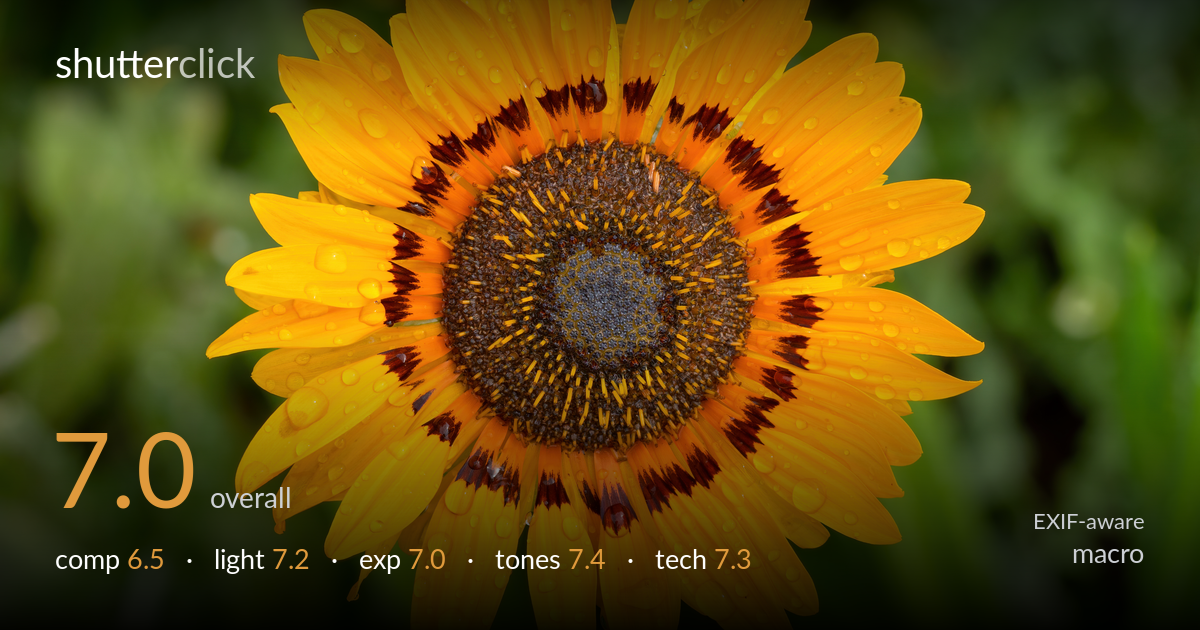
Dewy yellow bloom
Photo by Ermell

| Focal length | 60 mm |
| Aperture | f / 5.0 |
| Shutter | 1/500 s |
| ISO | ISO 200 |
| Exp. comp. | 0.0 EV |
| Shot at | 11:43 · Aug 14, 2020 |
A clean, vivid frontal portrait of a single bloom, lifted by waterdrops that add texture and freshness. The flat-on viewpoint and centred placement give it symmetry but also flatten the energy — a dead-centre subject this size leaves little tension or breathing room. The disc florets, deep maroon ring and saturated petals carry strong colour, and the green bokeh isolates the flower well. What most holds it back is the focus plane: the petals and waterdrops read sharper than the central disc, where the key detail of a flower like this should resolve crisply. Solid, attractive, and close to very good.
The bloom sits almost dead-centre, which suits the radial symmetry but drains tension from the frame — the flower fills space without a clear sense of direction. The surrounding green is generous and clean, giving good isolation, though the framing is tighter at top than bottom, leaving an uneven margin. A few petals at the upper edge come close to clipping. Placing the flower slightly off-centre, or angling the head so the disc faces partly toward the light, would add dimension to what is currently a flat, catalogue-style presentation.
Soft, diffused light — likely overcast or shaded — renders the petals evenly and keeps the saturated yellows from blowing out. It flatters the colour and lets the waterdrops sit clearly without harsh specular hotspots. The trade-off is a lack of modelling: the flat frontal light gives little shadow to shape the disc's three-dimensional dome or rake across the petal ridges. A lower, more raking side light would carve out texture in the central florets and give the bloom more sculptural depth rather than a uniform glow.
Exposure is well controlled for a saturated yellow subject, which easily clips. The brightest petals hold colour and detail rather than going to paper-white, and the dark central disc retains structure without crushing to black. Shadows in the background fall away cleanly. A touch of highlight is approaching the limit on the most lit petals near the top, but nothing distracting. The histogram is well placed for the mood, and the zero exposure compensation was the right call given the even, diffuse light.
Colour is the strongest element here — the gradient from golden-yellow petals through the orange-red maroon ring to the brown-and-blue disc is rich and cohesive. White balance is neutral and the greens read naturally without a colour cast. Saturation is pushed but stays just shy of garish, and the warm-cool contrast between flower and background gives the frame punch. The disc's blue-grey centre adds a welcome cool accent. Contrast is well judged; the petals retain subtle tonal variation rather than collapsing into a flat block of yellow.
At f/5.0 on the 60mm macro, depth of field is shallow for a subject this close, and the focus plane appears to favour the petals and the front waterdrops over the central disc — the florets in the middle look softer than they should be for a macro where the disc is the natural focal point. Stopping down to f/8–f/11, or focus-stacking a few frames, would bring the entire flower head into crisp resolution since it sits on a near-flat plane. The 1/500s shutter and ISO 200 are well chosen: motion is frozen, noise is negligible, and the files are clean. The lens delivers good sharpness where focus lands, with pleasing rendering of the waterdrops. The background blur is smooth and free of distracting edges. Overall execution is competent; the single weak link is focus placement on the most important detail. A flatter sensor-to-subject alignment plus a smaller aperture would resolve it.
What would elevate it
Tags
Shot something like this?
Expert photo critique, on demand — scored across six categories, EXIF-aware. Start with 3 free critiques, no credit card.
critique my photo — free