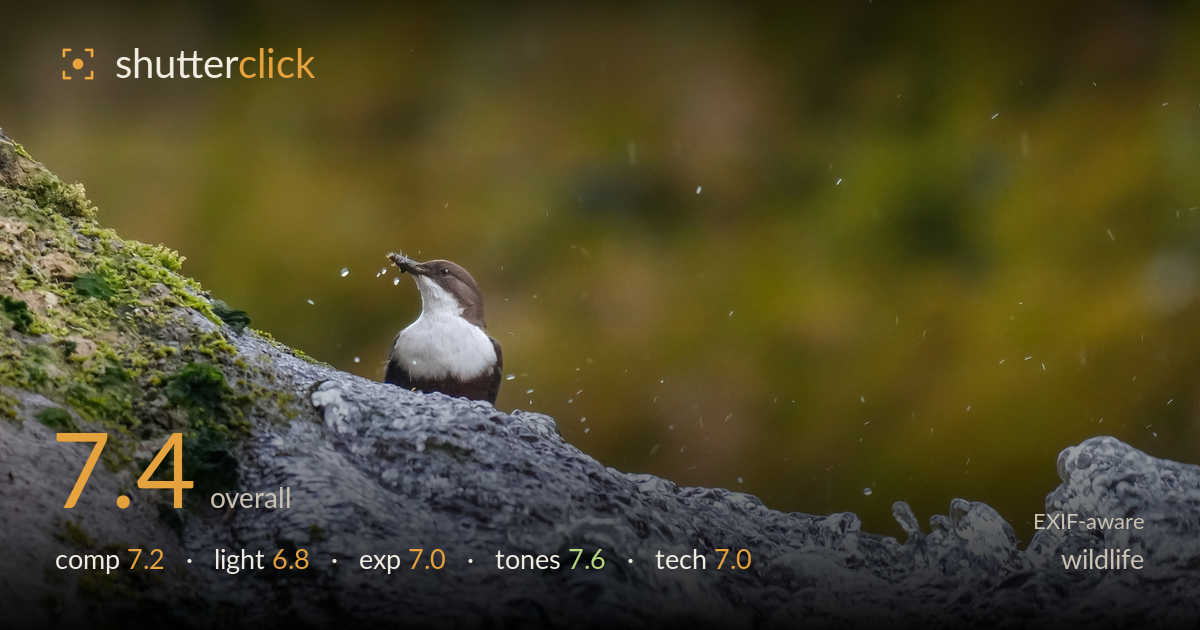
Dipper with prey by the falls
Photo by Giles Laurent

| Focal length | 800 mm |
| Aperture | f / 8.0 |
| Shutter | 1/250 s |
| ISO | ISO 6400 |
| Exp. comp. | 0.0 EV |
| Shot at | 11:18 · Apr 12, 2025 |
A white-throated dipper with prey and a beak dusted in insects, caught on a mossy ledge beside rushing water — a genuine behavioural moment that carries the frame. The story is here: the food item and the wet, textured setting speak to the bird's habitat. What most holds it back is sharpness at the critical point. At 1/250s on an 800mm lens with a shifting water backdrop, the eye and head fall short of tack-sharp, and the overall softness undercuts what could have been a standout capture. The composition breathes well and the environmental context is a real strength.
The bird sits left of centre with the frame opening to the right, giving it room to look into — a sound choice. The diagonal of the mossy rock and cascading water leads the eye up toward the subject, and the splash droplets add life. The white throat separates cleanly from the dark rock behind. The lower half is dominated by turbulent water, which competes slightly for attention; a fraction more space above the head would ease the tightness at the top and balance the busy foreground.
Soft, diffuse overcast light suits the wet setting and keeps highlights on the white breast from blowing out, but it is flat and gives little modelling to the dark head and back, which read as a near-featureless mass. There is no catchlight in the eye, which flattens the bird's presence. A touch of directional light or a lower angle would separate the dark plumage from the shadowed rock and bring the eye alive, the single most valuable improvement for a wildlife portrait like this.
Exposure is well judged for a tricky high-contrast subject: the white breast retains texture without clipping, and the dark plumage holds enough detail to read the head and bill. The bright, churning water on the right edges toward the highlights but stays recoverable. Shadow areas in the moss keep colour and detail. The 0.0 EV call was appropriate here — pushing brighter would have risked the whites. A balanced histogram given the wide tonal range in the scene.
The muted autumnal backdrop of olive and amber greens sets off the black-and-white bird nicely, and the colour harmony feels natural rather than pushed. White balance reads accurate in the neutral water and moss. The dipper's monochrome plumage renders with a clean tonal separation between the sooty head and crisp white throat. Contrast is gentle and appropriate to the overcast conditions. The greens in the background stay pleasantly desaturated, avoiding any garish cast. A well-controlled, cohesive palette throughout.
The FE 400-800mm at 800mm f/8 gives the reach and the creamy background separation this shot needs, and the framing distance is well managed. The limiting factor is shutter speed: 1/250s is too slow to reliably freeze a small bird's micro-movements at this focal length, and it shows — the head and eye lack the bite expected from the ILCE-1's sensor. The eye is not critically sharp, whether from motion or a focus plane sitting slightly behind. ISO 6400 is a reasonable trade for the low light and is handled cleanly, with noise well controlled in the shadows. On a reshoot, 1/1000s or faster would freeze the bird decisively; the f/8 aperture is unavoidable at this zoom's long end, so lifting ISO further to buy shutter speed would have been the right call. Focus acquisition on the eye, ideally with animal-eye AF locked, would secure the frame. The gear is more than capable; the exposure triangle just needed rebalancing toward motion.
What would elevate it
Tags
Shot something like this?
Expert photo critique, on demand — scored across six categories, EXIF-aware. Start with 3 free critiques, no credit card.
critique my photo — free