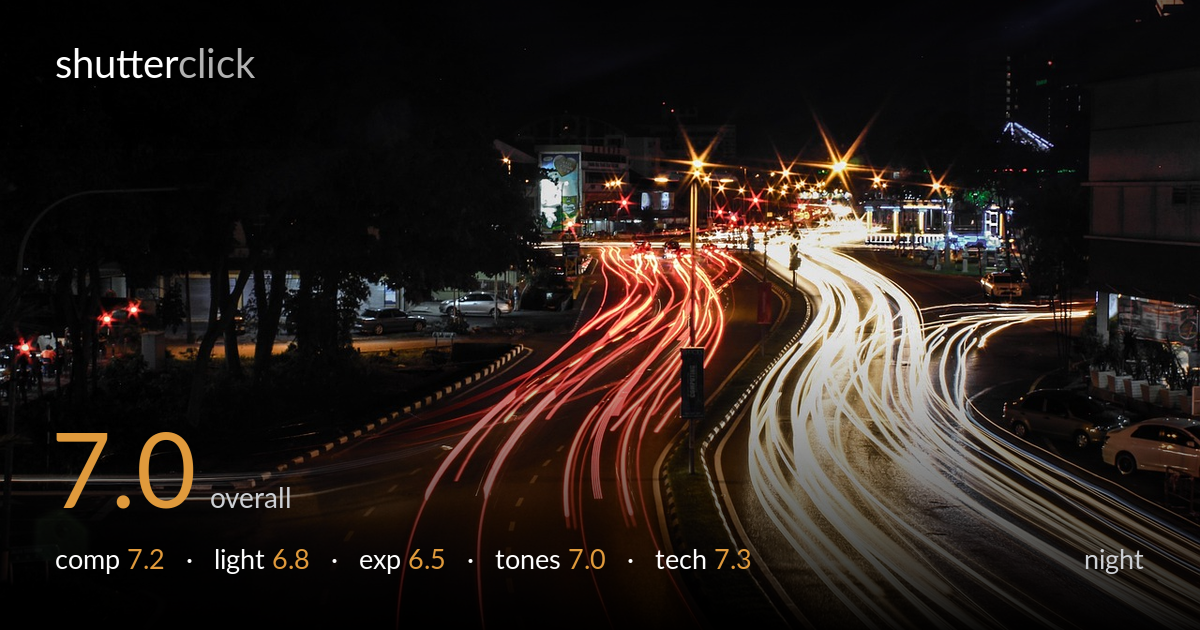
Diverging traffic trails at night
Photo by jievoyage

No EXIF metadata in this file
Technical analysis based on visual assessment only.
A clean, elevated long-exposure that uses converging red and white trails as natural leading lines toward a distant cluster of starbursts — the classic night-traffic vocabulary executed competently. The diverging streams, red on the left and white on the right, give the frame energy and direction. What most holds it back is the heavy dead space across the top half: an expanse of near-black sky that contributes little and leaves the trails feeling crowded into the lower frame. The distant skyline is too dim to anchor that void. Tighter framing and a touch more shadow lift would concentrate attention where the action is.
The S-curve of diverging light trails forms strong leading lines that pull the eye from the foreground into the lit cluster of starbursts — a textbook night-traffic structure that works. The split of red trails left and white right adds directional energy. The weakness is the upper half: a large block of featureless black sky that the dim skyline can't anchor, leaving the composition bottom-heavy. The dark tree mass on the left also swallows detail without adding much. A lower top edge would tighten the balance considerably.
The available light is almost entirely the traffic trails and street lamps, which is the point of the genre, and the starburst lamps add sparkle and a sense of place. The streaks have good luminous variety — warm reds against cooler whites. However, the scene lacks any ambient fill to separate buildings, trees, and sky, so much of the frame collapses into undifferentiated black. A slightly earlier blue-hour capture would have retained some sky tone and given the lit elements something to read against.
The exposure handles the bright trails reasonably — the white streaks hold without total blowout in most areas, though the hottest cores near the lamp cluster clip. The bigger issue is the shadow end: the sky and tree masses are crushed to near-pure black with no recoverable detail, so the dynamic range sits heavily at the dark extreme. Some of that is unavoidable at night, but a marginally longer exposure or a brighter capture would have salvaged the dim skyline and softened the heavy lower-foreground darkness.
The warm-cool split between red tail-lights and white headlights is the tonal backbone here, and it reads pleasingly. White balance leans neutral-to-warm, suiting sodium street lighting. Contrast is high, which suits the subject, but the deepest shadows have no gradation, flattening the upper frame into a single tone. The starburst lamps introduce welcome colour accents. A gentle midtone lift would reveal more of the road surface and surrounding structures without diluting the punch of the trails.
The long exposure is executed well — trails are smooth and continuous, indicating a stable tripod and no mid-frame bump, and the streaks render as clean ribbons rather than broken segments, suggesting a single well-judged exposure rather than stacked frames. Focus sits on the road and mid-distance lights, which is the right plane, and the lamp starbursts point to a small aperture that also kept the scene reasonably sharp front to back. Noise is well controlled in the lit areas, with the deep shadows hiding whatever grain exists. The main technical opportunity lies in exposure length: a longer duration would have extended the trails further across the frame and lifted the crushed shadows, while a marginally smaller aperture or careful focus check would sharpen the brightest lamp cores. Overall the capture is technically sound for the genre — the fundamentals of stability, focus plane, and aperture choice are in place.
What would elevate it
Tags
Shot something like this?
Expert photo critique, on demand — scored across six categories, EXIF-aware. Start with 3 free critiques, no credit card.
critique my photo — free