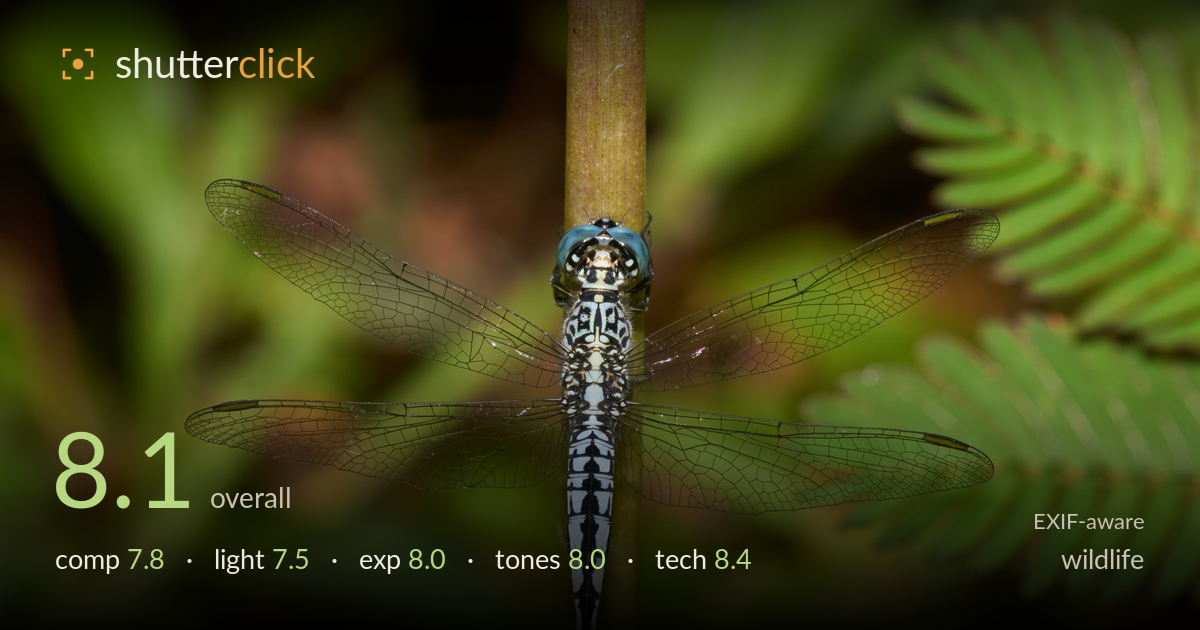
Dragonfly perched on a stem
Photo by Jeevan Jose, Kerala, India

| Focal length | 150 mm |
| Aperture | f / 14.0 |
| Shutter | 1/250 s |
| ISO | ISO 100 |
| Exp. comp. | 0.0 EV |
| Shot at | 17:31 · Sep 7, 2016 |
A crisp, textbook dorsal study of a dragonfly, saved by exceptional detail in the wing venation and a beautifully rendered patterned abdomen. The near-symmetrical spread of wings against a smoothly blurred green backdrop reads clean and deliberate. What most holds it back is the vertical stem cutting the frame in half and running straight through the subject — it anchors the insect but also flattens the composition into two mirrored halves. The lighting is even and workmanlike rather than sculptural. Still, the technical execution is strong and the specimen is impeccably captured; this is a well-made insect portrait.
The dragonfly sits almost dead-centre with its wings spread symmetrically, which gives a clean, specimen-like clarity. The diagonal stem provides a strong anchoring line, but running it vertically through the middle splits the frame into near-identical halves and reduces dynamism. The fern fronds at right add welcome context and break the symmetry slightly. Placing the head marginally higher and off-centre, or introducing a touch more negative space on one side, would give the composition more direction and breathing room while keeping the subject legible.
The light is soft and diffuse, wrapping the insect evenly and avoiding harsh blown highlights on the translucent wings — helpful for showing venation. Direction is fairly frontal and flat, however, so the abdomen and thorax lack the raking side light that would model their three-dimensional form. The catch of light on the blue eyes is pleasant. A slightly lower or side-angled light would add depth and reveal texture across the body without sacrificing the clean wing rendering that works so well here.
Exposure is well judged. The white and black banding on the abdomen retains detail at both ends of the range — no crushed blacks in the dark segments and no clipping on the pale scales, which is a genuine achievement given the high-contrast subject. The translucent wings hold their venation without glare. Shadows in the background stay rich without going muddy. Midtones on the thorax read cleanly. A touch more shadow lift in the darkest wing corners would be optional at most; the balance is essentially right.
White balance is accurate, with believable greens in the background and a natural blue on the eyes and body. The muted, mottled green backdrop complements the cool tones of the dragonfly and keeps attention on the subject. Contrast is well controlled — the black-and-white abdomen pattern pops without harshness. Saturation is restrained and true to life rather than pushed. The tonal range from the deep browns of the stem to the pale scales is handled cleanly, giving the image a calm, natural palette.
At f/14 on a 150mm macro, depth of field is stretched enough to hold the entire wingspan and the abdomen acceptably sharp while still melting the background into smooth bokeh — a sound choice for a subject this broad and flat. Focus lands precisely on the thorax and eyes, exactly where it should, and the wing venation resolves crisply across most of the spread. ISO 100 keeps the file clean with no visible noise, and 1/250s was sufficient here because the insect was perched and still. The tradeoff of f/14 is some loss of ultimate sharpness to diffraction, and the shutter would have been marginal had the subject moved. The Sony 77M2 sensor delivers plenty of detail, and the lens is well suited to the working distance. Overall a technically assured capture — the exposure triangle is balanced sensibly for the conditions, with the aperture prioritising the whole-insect sharpness that this dorsal view demands.
What would elevate it
Tags
Shot something like this?
Expert photo critique, on demand — scored across six categories, EXIF-aware. Start with 3 free critiques, no credit card.
critique my photo — free