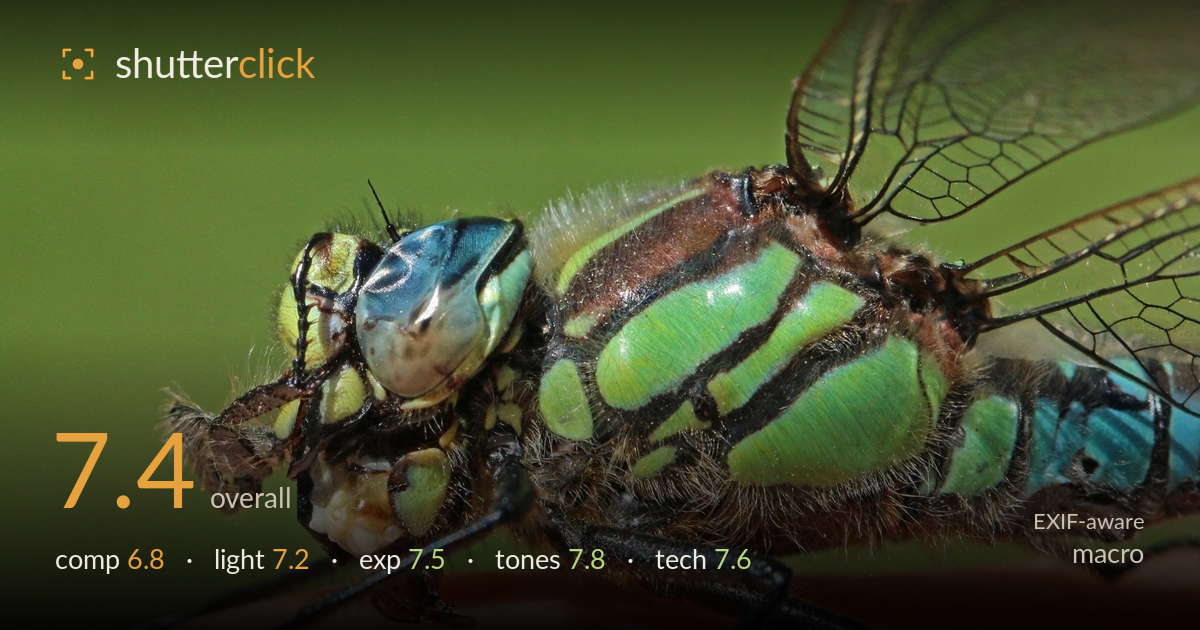
Dragonfly resting on a fingertip
Photo by Charles J. Sharp

| Focal length | 100 mm |
| Aperture | f / 10.0 |
| Shutter | 1/500 s |
| ISO | ISO 800 |
| Exp. comp. | 0.0 EV |
| Shot at | 10:21 · Jun 22, 2017 |
A striking close-up that delivers exactly what macro should — fine hair detail, iridescent eye rendering, and jewel-toned thorax and abdomen against a clean green wash. The colour separation between subject and background is excellent, and the near eye holds crisp focus. What most holds it back is the plane of focus falling off across the head and forelegs, leaving the mouthparts and closer eye slightly soft, and a frame that crowds the wings against the top-right edge. Tighter attention to the focus plane and a touch more room around the wingtips would lift a strong image to an outstanding one.
The diagonal thrust of the body from lower-left to upper-right gives the frame energy, and the smooth green background isolates the subject cleanly. The eye sits roughly on a thirds intersection, which anchors the composition well. However, the wings crowd hard against the top and right edges, clipping the wingtips and creating tension without payoff. The human finger the insect rests on adds context but also introduces a bright, distracting foreground band along the bottom. A little more breathing room around the wings would let the form resolve.
Soft, diffuse daylight suits the subject, wrapping around the fuzzy thorax and avoiding harsh specular blowout on the exoskeleton. The eye picks up a gentle gradient of blue-to-teal that reads as dimensional rather than flat, a sign of good light angle. Shadows under the legs stay open enough to retain detail. The main limitation is a slight flatness overall — a touch more directional raking light would carve the fine hairs and cuticle texture with more relief and separate the near legs from the body.
Exposure is well judged for a high-contrast subject. Highlights on the glossy eye and the pale mouthparts hold detail without clipping, and the shadow areas in the dark thoracic bands retain structure. The bright skin tone at the bottom edge sits near the top of the range but doesn't blow. Midtones on the green thorax are placed cleanly, giving the saturation room to breathe. Nothing here reads as accidental; the balance across a tricky tonal spread is handled with care and restraint.
The colour is the image's strongest asset — vivid greens, teal-blue abdomen, and the iridescent eye all render with rich, believable saturation and no oversaturation artefacts. White balance is neutral, letting the green background stay a natural leaf tone rather than drifting yellow or cyan. Contrast between the black bands and green plates is punchy without crushing. The skin tone at the base reads slightly warm and pink against the cool insect, but the overall palette is cohesive and the tonal range spans deep shadow to clean highlight gracefully.
At f/10 on the EF 100mm f/2.8L Macro, depth of field is inherently razor-thin at this magnification, and the plane of focus is placed on the near eye, which resolves sharply with visible ommatidia. That was a sound call. The trade-off shows in the mouthparts, forelegs, and the second eye sliding into softness — a focus-stack or a marginally smaller aperture would have carried more of the head sharp, though diffraction would begin to soften fine detail past f/13. ISO 800 is higher than ideal for static macro and introduces mild noise in the green background, visible on close inspection; base ISO with more light or a flash would have cleaned that. The 1/500 shutter comfortably freezes any subject or hand movement, sensible for a handheld living insect. Overall execution is confident and the sharpness where it lands is genuinely excellent; the limitation is depth-of-field coverage rather than technique.
What would elevate it
Tags
Shot something like this?
Expert photo critique, on demand — scored across six categories, EXIF-aware. Start with 3 free critiques, no credit card.
critique my photo — free