Duck mid-stride green
Photo by erwinbosman

No EXIF metadata in this file
Technical analysis based on visual assessment only.
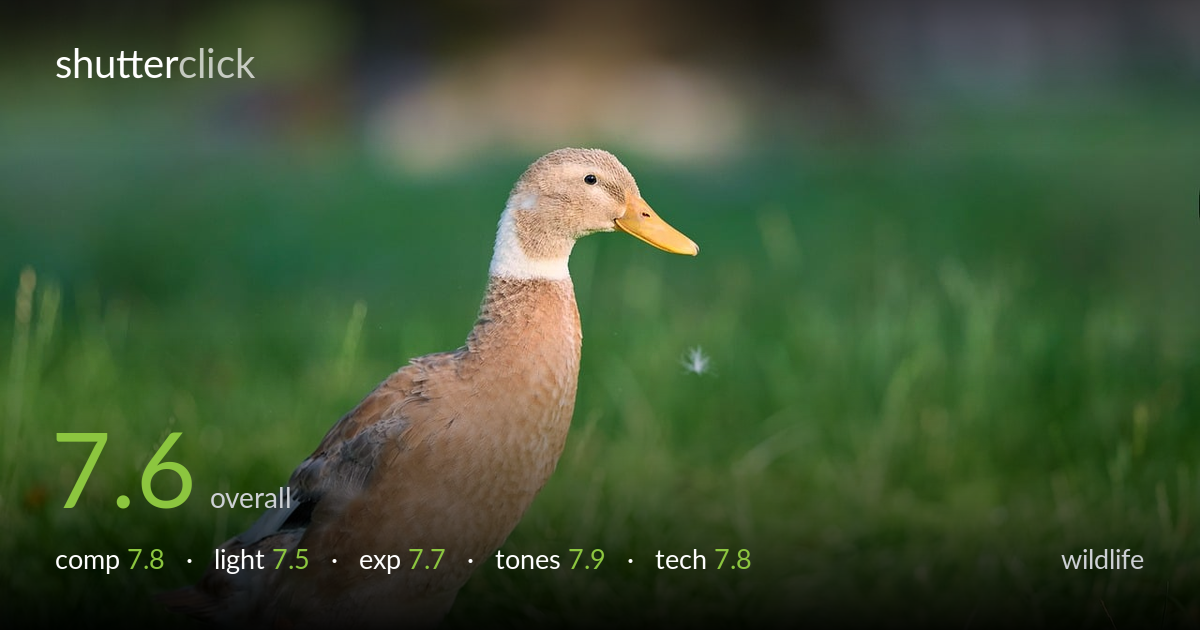
A clean, well-isolated portrait of a walking duck, lifted by a striking emerald background and a stride caught mid-step. The eye is sharp and the warm plumage reads beautifully against the green. What most holds it back is the placement: the bird sits left with its beak nearly crowding the centre, leaving a large expanse of empty grass into which it isn't quite walking. The floating feather adds a touch of incidental story, but the gesture and isolation are the real strengths. A small framing adjustment and a touch more separation between bird and grass would push this from pleasant to memorable.
Placing the duck in the left portion gives it room to move into, which suits the forward stride, and the low shooting angle puts the camera near eye level for an intimate read. The diagonal of the body and that lifted leg create good energy. The issue is balance: the right two-thirds is uniform grass with little to hold attention, and the head sits close to centre rather than benefiting fully from the space ahead. A slightly tighter crop or a foreground element on the right would resolve the emptiness.
Soft, diffused light wraps the bird evenly and avoids harsh shadows, flattering the plumage and rendering the grass in a clean, saturated green. A catchlight in the eye gives it life. The trade-off is that this even light is a touch flat — it does little to model the form or separate feather texture with directional shaping. A lower, raking side light, such as early-morning sun skimming across the body, would carve more dimension into the feathers and add warmth to the scene.
Exposure is well judged across a tricky bright-green field. The warm body retains detail in both the pale belly and the darker back feathers, and the eye holds its highlight without blowing. The grass is bright but not clipped, keeping its colour. Shadow areas under the body and on the legs stay readable. Nothing here reads as accidental — the brightness sits comfortably for the subject. If anything, the highlights on the lightest belly feathers ride slightly hot and could use a fraction more headroom.
The colour palette is the strongest element: warm caramel and buff tones on the duck play against the cool, vivid green, a clean complementary contrast that makes the subject pop. White balance looks accurate, with the orange beak and feet rendered naturally. The greens are saturated but not garish, and the tonal gradation across the body is smooth. The pale belly transitions softly into the warmer back. A touch of restraint on green saturation would keep the background from competing slightly with the bird.
Focus lands accurately on the eye and head, which is exactly where it needs to be for wildlife, and the plane of sharpness holds across the face and beak. The shallow depth of field melts the background into a creamy wash that isolates the subject cleanly — a long lens used well. Detail in the head and neck feathers is crisp, though sharpness falls off slightly toward the tail, suggesting the focal plane sat forward of the body's midpoint or depth of field was very thin. The stride appears frozen with no motion blur, indicating a shutter speed fast enough for a walking bird. Noise is well controlled in both the subject and the smooth background. The low angle and the choice to render the foreground grass slightly soft adds a pleasant framing veil at the base. Slightly more depth of field would have carried sharpness through the wing and tail without sacrificing the background separation.
What would elevate it
Tags
Shot something like this?
Expert photo critique, on demand — scored across six categories, EXIF-aware. Start with 3 free critiques, no credit card.
critique my photo — free