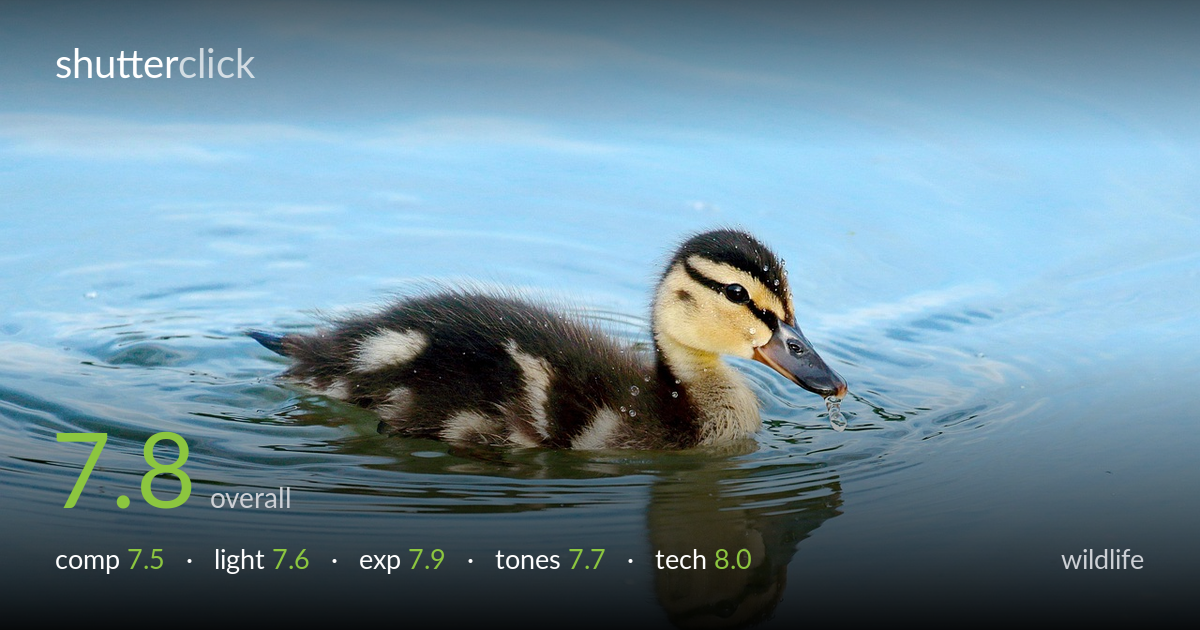
Duckling with a falling water drop
Photo by Pixamio

No EXIF metadata in this file
Technical analysis based on visual assessment only.
A charming duckling image carried by a moment of behaviour — the single water drop falling from the bill turns a simple portrait into a small narrative. The eye is tack-sharp with a catchlight, the water beading on the down reads beautifully, and the reflection anchors the subject. The soft blue water gives clean, uncluttered separation. What most holds it back is the framing: the subject sits low and the vast upper expanse of water, while pleasingly minimal, tips toward empty rather than intentional negative space. A touch more headroom weighting toward the drop's trajectory would sharpen the storytelling.
The duckling is placed on the lower-right third with the bill and water drop leading the eye down-right, which reads well. The reflection below adds a nice vertical anchor. The concentric ripples create gentle radial lines toward the subject. The upper half of the frame, however, is a large sweep of empty water that feels more like excess than deliberate negative space. Cropping down from the top, or shifting the bird slightly left to give the drop room to fall into, would tighten the balance and strengthen the sense of motion.
Soft, even light — likely overcast or open shade — wraps the duckling without harsh shadows, which flatters the fine down and keeps the yellow-and-brown markings readable. A clear catchlight sits in the eye, giving it life. The directionality is gentle enough that the water beads and drop are clearly modelled without blown speculars. The trade-off is a slight lack of dimensional contrast; a lower, more raking light would carve more texture into the feathers and add sparkle to the water surface. For this subject, though, the gentle light suits the softness.
Exposure is well judged. The pale blue water is held bright without clipping, and detail survives in both the dark crown and the cream cheek patch — a tricky tonal spread handled cleanly. Highlights on the water beads retain their shape rather than burning out. Shadow areas in the darker plumage keep enough separation to read structure. Nothing looks accidentally under- or overexposed; the bright, airy key appears deliberate and supports the light, clean mood. Perhaps a hair more midtone punch on the bird itself would lift it further from the water.
The cool blue water plays nicely against the warm yellows and browns of the duckling, a pleasing complementary balance. White balance sits slightly cool overall, which reinforces the fresh, watery feel but risks the whole frame reading a touch flat and monochromatic in the blues. Contrast is gentle and appropriate to the soft light. The tonal range on the subject — dark crown to pale down — is well preserved. A subtle warmth added to the bird, or a mild reduction of the blue's dominance, would give the tones a little more separation and vitality.
Focus is placed accurately on the eye and bill, the most important plane for wildlife, and the sharpness there is convincing — individual down fibres and the beaded water are crisply resolved. The depth of field appears well matched: enough to hold the near flank and face in focus while the far water softens into a clean wash, giving good separation. The shutter clearly froze both the duckling and the falling drop, which is the technical highlight — catching that suspended droplet requires timing and a fast enough exposure. Noise is not evident, suggesting a sensible ISO under the available light. The shooting angle is low and near water level, which is exactly right for intimate wildlife work and produces the flattering reflection. If anything, marginally more depth of field would bring the tail and rear body fully into focus without sacrificing the background, but the current rendering is a reasonable balance. A longer reach or tighter crop would fill more of the frame with the subject.
What would elevate it
Tags
Shot something like this?
Expert photo critique, on demand — scored across six categories, EXIF-aware. Start with 3 free critiques, no credit card.
critique my photo — free