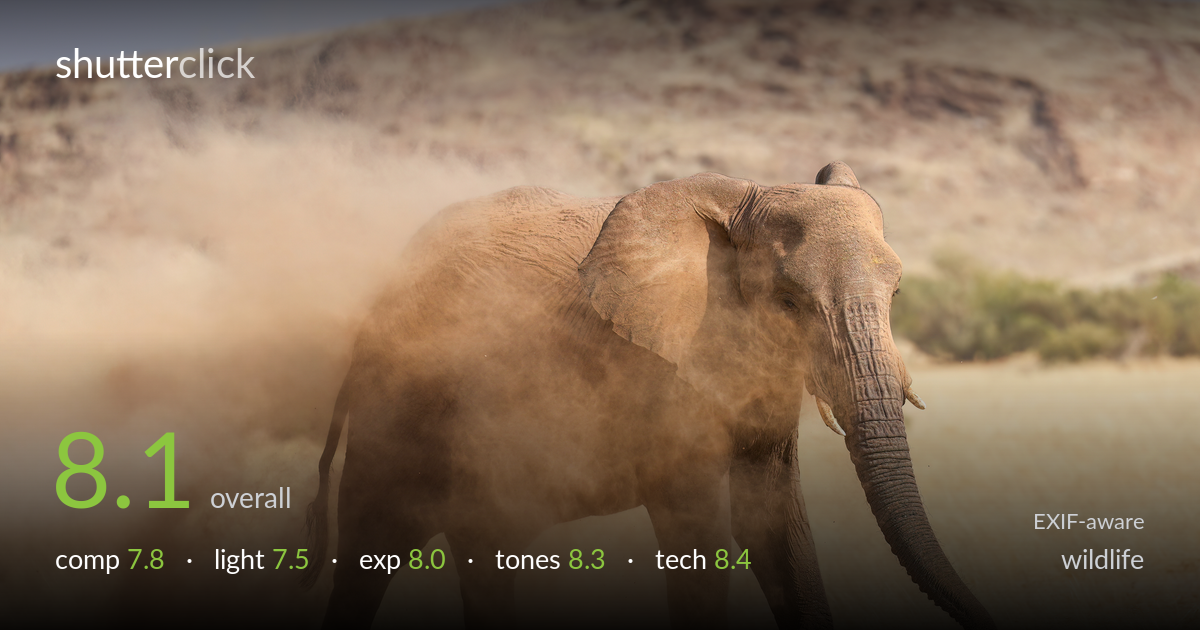
Dusty desert elephant
Photo by Giles Laurent

| Focal length | 200 mm |
| Aperture | f / 2.8 |
| Shutter | 1/2500 s |
| ISO | ISO 100 |
| Exp. comp. | 0.0 EV |
| Shot at | 08:23 · Jul 28, 2025 |
A genuine moment, well executed — a dust-bathing desert elephant rendered with strong behaviour and atmosphere. The swirling dust wraps the animal in mood and gives the frame its sense of place, with the eye and trunk sharp where it counts. The monochromatic palette of dust, dry grass, and rock is cohesive and evocative. What holds it back most is the eye reading slightly soft against the haze, and the foreground grass partly obscuring the front legs. The mid-frame placement leaves the leading dust trail a touch compressed. Still, this is confident, atmospheric wildlife work with real narrative pull.
Placing the elephant on the right with its trunk and gaze sweeping into open space gives the frame good directional flow, and the dust cloud trailing left balances the visual weight. The mountain backdrop adds scale and context without competing. The tall foreground grass adds immersion but partly swallows the front legs, weakening the subject's grounding. A fraction more space below would have let the trunk's downward reach breathe. The horizon sitting high keeps the focus on the action, which works well here.
Soft, diffused light — likely high overcast or the haze of the dust itself — flattens contrast and suits the dusty palette, keeping detail readable across the elephant's hide. It lacks the directional raking light that would carve out the skin texture and give the dust dramatic backlit glow, which is the shot this scene was begging for. The even illumination is safe and clean but undersells the atmosphere's potential. Backlight catching the airborne dust would have transformed the mood entirely.
Exposure is well judged for a tricky high-key dust scene. The bright airborne particles and pale grass retain highlight detail without clipping into white, and the elephant's mid-tones sit cleanly with the eye and skin folds holding texture. At ISO 100 there is ample shadow latitude, and the darker hide areas keep detail. Nothing reads as accidental — the overall brightness preserves the delicate tonal separation between dust, grass, and rock. A confident, restrained reading of a scene that could easily have blown out.
The warm, monochromatic palette is the image's strongest asset — dust, dry grass, and rust-toned rock unify into a coherent desert mood. Saturation is restrained and believable, with the elephant's grey hide warmed by the clinging dust. White balance leans appropriately warm without tipping orange. Tonal gradation through the dust haze is smooth, and contrast is gentle, matching the diffused light. The result feels atmospheric and earthy rather than punchy, which is the right call for the subject and conditions.
The Sony ILCE-1 with the 70-200mm f/2.8 at 200mm is well matched to the subject and reach. The 1/2500s shutter comfortably freezes the elephant and most of the drifting dust, and ISO 100 keeps the file clean with full tonal latitude. Focus lands on the head and eye region, though the eye reads slightly soft — partly the dust veil between lens and subject, partly the shallow f/2.8 plane at this distance. Stopping down to around f/5.6 would have deepened the plane of sharpness across the head and trunk while still separating the subject from the mountain. The wide aperture does soften the background pleasingly, but for an animal of this depth, a touch more front-to-back sharpness would strengthen the rendering. Sharpness on the trunk's leading edge holds well. Overall a strong technical execution that capitalised on the camera's speed and low-noise sensor; the only refinement is the depth-of-field choice for the subject's bulk.
What would elevate it
Tags
Shot something like this?
Expert photo critique, on demand — scored across six categories, EXIF-aware. Start with 3 free critiques, no credit card.
critique my photo — free