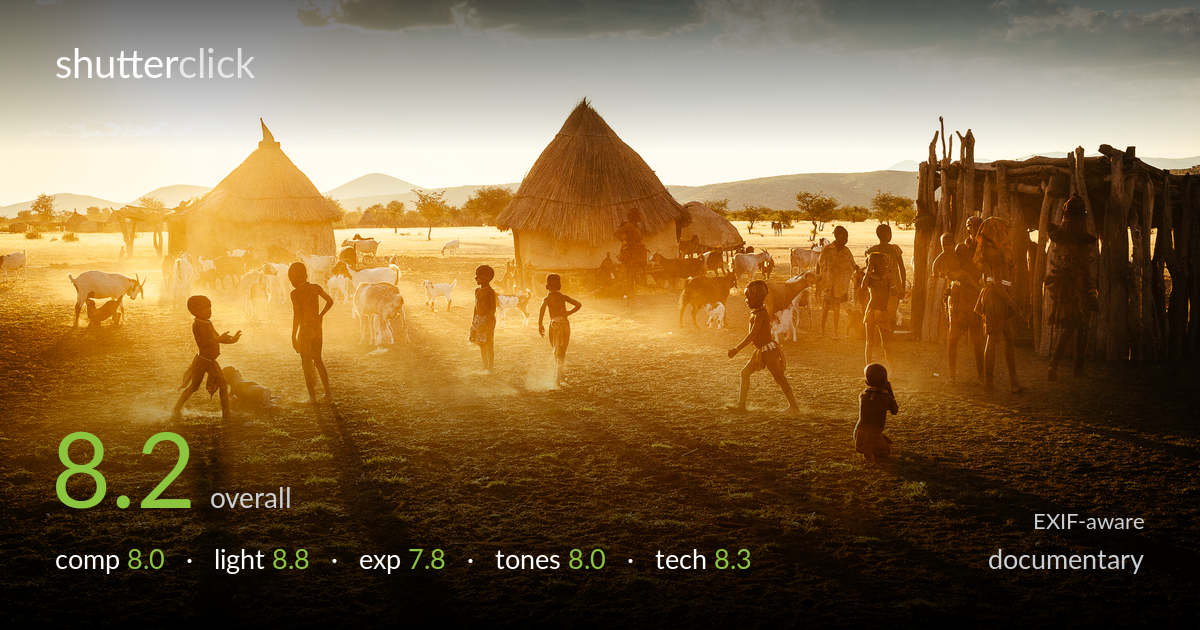
Dusty village sunset
Photo by Martin Sojka

| Focal length | 35 mm |
| Aperture | f / 11.0 |
| Shutter | 1/250 s |
| ISO | ISO 200 |
| Exp. comp. | -0.67 EV |
| Shot at | 15:12 · Apr 24, 2012 |
A richly atmospheric village scene where dust, low sun, and silhouetted figures combine into a genuine sense of place and daily life. The backlight is the photograph's engine, raking through airborne dust to separate the children, goats, and huts into legible layers. The 35mm framing keeps context intact without flattening the spread. What holds it back is a slightly scattered foreground: the many figures don't quite resolve into a single decisive gesture, and the lower portion of the frame reads dark and empty. A stronger anchoring moment and marginally more shadow detail would lift this from a beautiful environmental document to an unforgettable one.
The two huts anchor the midground while the stockade on the right balances the open space at left, and the scattered children give scale and life across the frame. The horizon sits low enough to let the dust-filled sky breathe. The weakness is that the many figures compete rather than building to one decisive gesture — the eye wanders without a clear path. The dark lower third reads as dead weight. A tighter grouping or one dominant action would give the busy scene a focal anchor.
This is the photograph's strongest element. Low backlight pours through suspended dust, rim-lighting the goats and children and turning the huts' thatch translucent. The long shadows raking toward the camera add depth and reinforce the time of day. Atmosphere reads as palpable rather than incidental — the haze sells the heat and activity. The trade-off is that backlighting renders the human figures as near-silhouettes, sacrificing the faces and expressions that documentary work often depends on. The mood, however, is fully earned and difficult to capture.
The -0.67 EV decision protects the bright sky and the sun's flare reasonably well, holding cloud detail rather than blowing it to paper white. That choice, however, pushes the foreground figures and the lower ground into deep shadow with little recoverable detail. Given the dynamic range of the scene this is a defensible compromise, and the silhouettes read as intentional. A graduated approach or a touch of shadow lift in post would reveal more texture in the children's forms without compromising the luminous sky.
The warm amber cast is consistent with the golden-hour light and dust, lending the whole frame a unified, nostalgic glow. The transition from cool sky to hot ground is handled gracefully, and the thatch picks up a pleasing honey tone. The risk is that the saturation in the oranges edges toward heavy-handed, and the deep shadows lose tonal gradation, flattening into solid black. Slightly cooling the warmest highlights and easing the orange would keep the mood while restoring some neutrality and depth.
The f/11 choice on the Zeiss Distagon 35mm keeps the entire scene — from foreground children to distant huts and hills — acceptably sharp, the right decision for a documentary scene with subjects spread across multiple planes. ISO 200 keeps the file clean, and 1/250s is fast enough to arrest the walking children and the drifting goats, though the dust itself benefits from a touch of motion suggestion. The Zeiss optic handles the strong backlight admirably, with veiling flare controlled and contrast holding up better than most lenses manage shooting into the sun. Focus appears accurately placed across the midground figures. The -0.67 EV protects highlights at the cost of shadow detail, a sound exposure strategy here. The one technical limitation is the 5D Mark II's older sensor, which has limited shadow-recovery latitude — the deep foreground blacks would resist lifting in post. Overall the execution is deliberate and well-matched to the conditions; the gear was used to its strengths.
What would elevate it
Tags
Shot something like this?
Expert photo critique, on demand — scored across six categories, EXIF-aware. Start with 3 free critiques, no credit card.
critique my photo — free