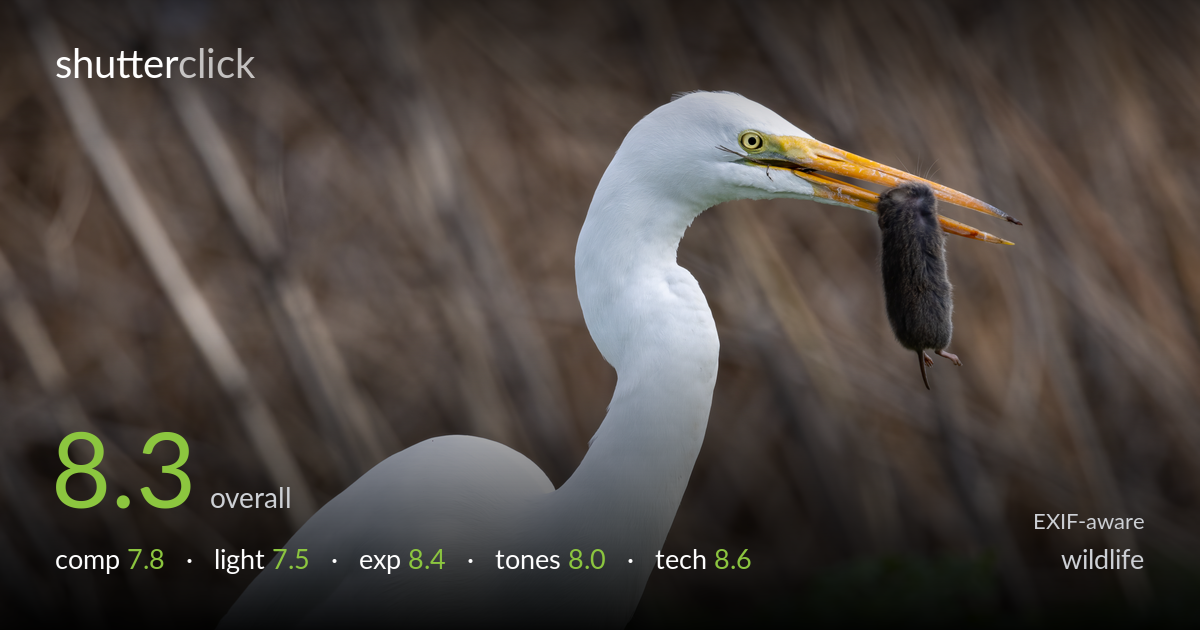
Egret with its catch
Photo by Frank Schulenburg

| Focal length | 472 mm |
| Aperture | f / 7.1 |
| Shutter | 1/640 s |
| ISO | ISO 250 |
| Exp. comp. | -0.33 EV |
| Shot at | 10:28 · Dec 26, 2021 |
A clean, behaviour-rich capture of a great egret with prey held aloft — the kind of feeding moment that elevates wildlife work beyond a portrait. The white plumage retains detail without blowing out, the eye is sharp, and the green foreground separates the bird cleanly from a muted reed background. What most holds it back is the negative space on the right: the gap between beak and frame edge is generous while the bird sits left of centre, leaving the composition slightly weighted to one side. The reed background, though diffused, carries diagonal lines that compete subtly with the subject. Strong, publishable, and worth refining.
Placing the egret left and angling the head with prey across the frame creates a natural diagonal that carries the eye through the action. The right-side breathing room gives the gesture somewhere to go, though the gap is a touch too generous — a slightly tighter frame on the right would tighten the tension between predator and prey. The green foreground anchors the bird and adds context. The bottom legs run close to the lower edge; a fraction more room beneath the feet would steady the stance within the frame.
Soft, even light renders the white plumage smoothly and avoids harsh specular hot-spots on the feathers — no small feat with bright white subjects. The catchlight in the eye is present and adds life. Direction is fairly flat and frontal, which keeps detail safe but flattens the modelling on the neck and body; a lower, more raking side light would carve more dimension into the curved neck and the prey's fur. The overcast quality suits the subject and keeps the background recessive.
Exposure is well judged for a difficult subject. The white feathers hold texture across the breast and wing without clipping, and the -0.33 EV compensation reads as a deliberate guard against blown highlights. Shadow detail in the dark legs and the prey's fur survives, and the green foliage sits at a natural midtone. The histogram appears well-controlled with no significant loss at either end. A touch more shadow lift on the prey would reveal slightly more of its form, but the balance struck here is sound.
The palette works in three clean registers: pure white bird, vivid green foreground, and muted brown reeds behind. White balance is neutral, the plumage reading clean white rather than blue or cream. The orange bill provides a welcome accent against the white. The greens are saturated but stop short of looking artificial. Contrast is gentle and suits the soft light. The brown background is slightly muddy in tone; a hair more separation in its hues would keep it from feeling flat behind the subject.
Strong technical execution throughout. At 472mm on the RF100-500, the reach pulls the egret in tight while f/7.1 — near the lens's sweet spot at this focal length — renders both bird and prey acceptably sharp while melting the reed background into smooth bokeh. Focus is locked on the eye, which is critical for wildlife, and the bill and prey fall within usable depth. ISO 250 is admirably low, keeping the file clean and noise-free with full tonal latitude in the whites. The 1/640s shutter freezes the largely static subject cleanly; given the bird is holding still, this is sufficient, though a faster speed would be insurance against any sudden head movement during a feeding sequence. The hand-holdable focal length is well supported by the lens IS, evident in the lack of blur. Overall the gear choices align well with the subject: long reach, moderate aperture for depth across the prey, and a low ISO that preserves the delicate white detail.
What would elevate it
Tags
Shot something like this?
Expert photo critique, on demand — scored across six categories, EXIF-aware. Start with 3 free critiques, no credit card.
critique my photo — free