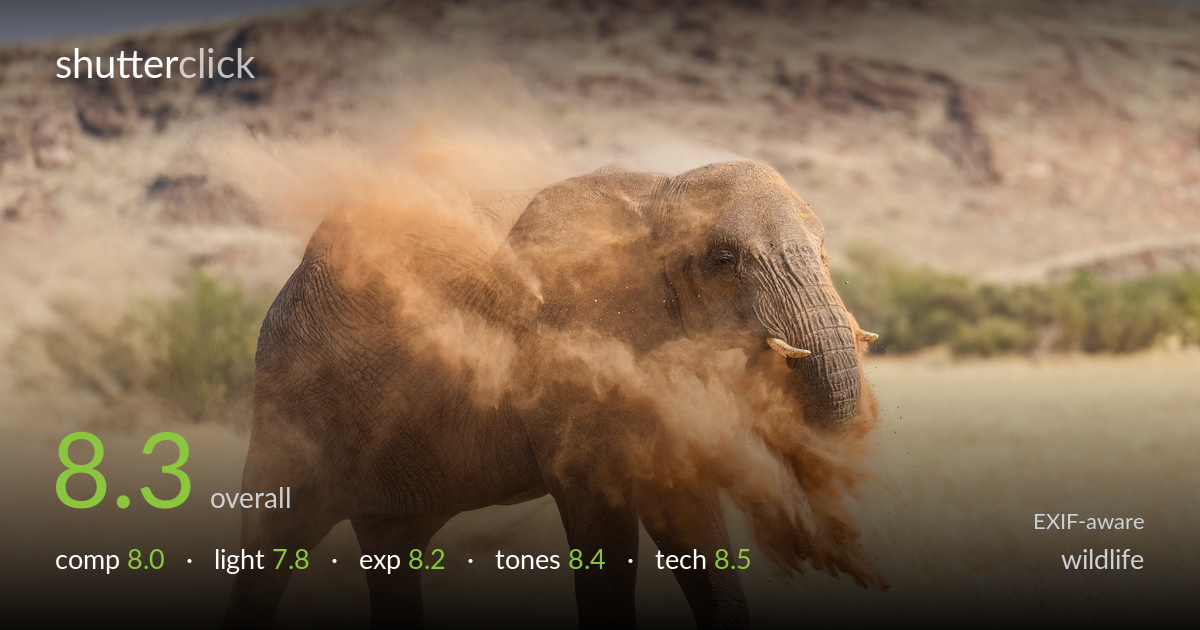
Elephant dust bath
Photo by Giles Laurent

| Focal length | 200 mm |
| Aperture | f / 2.8 |
| Shutter | 1/2500 s |
| ISO | ISO 100 |
| Exp. comp. | 0.0 EV |
| Shot at | 08:23 · Jul 28, 2025 |
A dust-bathing elephant caught at the peak of action — the great arc of ochre dust thrown from the trunk is the kind of behavioural moment that elevates wildlife work above a static portrait. The warm desert palette, sharp eye, and clean shutter give it real impact. What holds it back most is that the dust partially obscures the head and trunk, softening the moment's clarity, and the background, while pleasingly blurred, carries a slightly muddy band where hill meets scrub. A frame either side of this one might have caught the dust in a cleaner arc.
The elephant sits left-of-centre with the dust plume sweeping into the open right side of the frame, giving the gesture room to read — a sound choice. The low desert grass anchors the base and the blurred ridgeline adds depth without distraction. The animal is large in the frame yet retains breathing space. The main reservation is that the dust cloud overlaps the head and tusks, so the focal point competes with the very element that makes the image dramatic. A marginally wider framing would have let the plume resolve more fully.
Hard, high desert sun rakes across the scene, modelling the wrinkled hide and lighting the airborne dust into a glowing ochre veil — the backlit edge on the plume is the strongest lighting element here. Direction is largely frontal-to-side, which keeps the eye and trunk readable. The flat overhead quality typical of midday flattens some of the body's form on the near flank, and shadows are short. Softer, lower-angled light would have lent more sculptural depth, but the dust catches the harshness usefully.
Exposure is well managed for a bright, high-contrast desert scene. The sunlit dust and pale grass hold their highlight detail without clipping into white, and the elephant's shaded underside and legs retain visible texture rather than blocking up. At ISO 100 the tonal range is clean and full. Midtones sit comfortably, letting the hide's detail show. The brightest dust near the trunk edges toward the upper limit but stays just within range. A deliberate, accurate exposure that handles the dynamic range of harsh sun well.
The warm ochre-and-gold palette is the image's signature — dust, grass, and hide unify into a coherent desert key that feels authentic to the Namib-type setting rather than over-graded. White balance leans warm, which suits the subject. Contrast is healthy without crushing shadows, and the dust's gradation from dense core to thin haze is rendered smoothly. The background hills carry a slightly muddy, desaturated band that dulls the upper third. A touch more separation between the warm foreground and cooler distance would lift it.
The settings are well matched to the subject. At 1/2500s the action is cleanly frozen — individual grit and the leading edge of the dust read crisply, and there is no motion smear on the body or trunk. ISO 100 delivers a noise-free, detail-rich file with full tonal latitude, exactly right in this light. The 70-200 GM at 200mm and f/2.8 isolates the elephant from the ridgeline with a creamy, non-distracting background, and focus is placed accurately on the eye, which is sharp with detail in the surrounding wrinkles. The only caution is f/2.8 on an animal this size at this distance: depth of field is shallow enough that the far flank and rear leg soften slightly, and the dust plane sits a touch ahead of the focal plane. Stopping to around f/5.6 would have held more of the body sharp while still blurring the background, at a still-ample shutter speed given the low ISO headroom. A confident, competent execution overall.
What would elevate it
Tags
Shot something like this?
Expert photo critique, on demand — scored across six categories, EXIF-aware. Start with 3 free critiques, no credit card.
critique my photo — free