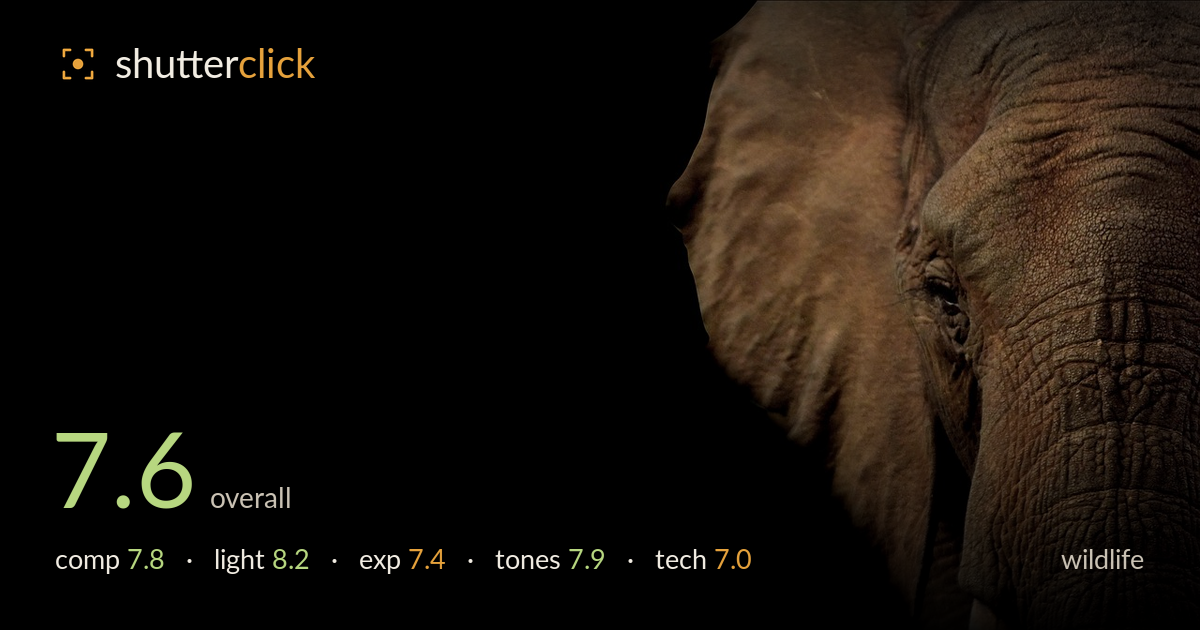
Elephant emerging from the dark
Photo by bisakhadatta

No EXIF metadata in this file
Technical analysis based on visual assessment only.
A low-key half-portrait that trades full context for intimacy and texture, and largely earns the trade. The elephant emerges from black on the right, its wrinkled skin, tusk tip, and ear detail carrying the frame while the vast negative space to the left holds the composition in tension. The mood is genuinely strong. What holds it back is the eye: the animal's eye sits in deep shadow and reads as a soft, murky pocket rather than the sharp anchor a wildlife portrait wants. Slightly more light or detail there would lift this from atmospheric to arresting. As it stands, evocative and confidently executed.
The decision to place the animal hard right and let a wide field of black fill the left half is bold and mostly works — the negative space amplifies the sense of mass and mystery. The tusk and trunk create a downward diagonal that grounds the frame. The crop through the ear and top of the head reads as deliberate rather than accidental. The one hesitation is how much is cut: a fraction more of the tusk and trunk at the bottom would complete the gesture that the current edge clips.
The single-side, low-key light is the image's biggest strength. It rakes across the trunk and cheek, carving out every wrinkle and fold with real dimensionality, and the fall-off into pure black feels controlled rather than crushed by accident. The skin texture reads beautifully where light lands. The weakness is that the light never reaches the eye, leaving the animal's most expressive feature in shadow — a touch of fill or a shooting angle catching a catchlight would have completed what the rest of the lighting sets up so well.
Exposure is deliberate and well judged for a low-key treatment — the highlights on the trunk ridges and the tusk tip hold detail without clipping, and the blacks are genuinely black rather than muddy grey. The midtones on the skin are placed to reveal texture. The compromise is the eye and the deeper ear folds, which fall so far down the tonal scale they lose all detail. That's defensible as mood, but a wildlife portrait usually wants the eye to retain some information rather than merge into shadow.
The warm brown palette against black is cohesive and flattering to the subject, with a rich, earthy rendering that suits the animal. Contrast is high but controlled, and the highlight roll-off on the tusk is smooth. The muted saturation keeps it from feeling processed. If anything, the deep shadows carry a slightly heavy, uniform blackness — a hint of tonal separation in the darkest ear region would add depth without breaking the low-key mood.
Focus appears to land on the near skin of the trunk and cheek, where the fine wrinkle detail is crisp and rewarding at this scale. Depth of field seems sufficient for the plane in play. The critical issue for a wildlife frame is that the eye — the feature that should be the sharpest point — sits in shadow and does not read as clearly resolved, so it's impossible to confirm the eye is tack sharp. Whether that's focus placement or simply the light not reaching it, the effect is the same: the anchor a wildlife portrait depends on is weak. Noise is well controlled in the shadows, which suggests a clean capture rather than heavy underexposure lifted in post. The image resolves texture well and shows no obvious motion blur. Prioritising a lit, sharp eye — even at the cost of some of the dramatic shadow — would be the single biggest technical gain here.
What would elevate it
Tags
Shot something like this?
Expert photo critique, on demand — scored across six categories, EXIF-aware. Start with 3 free critiques, no credit card.
critique my photo — free