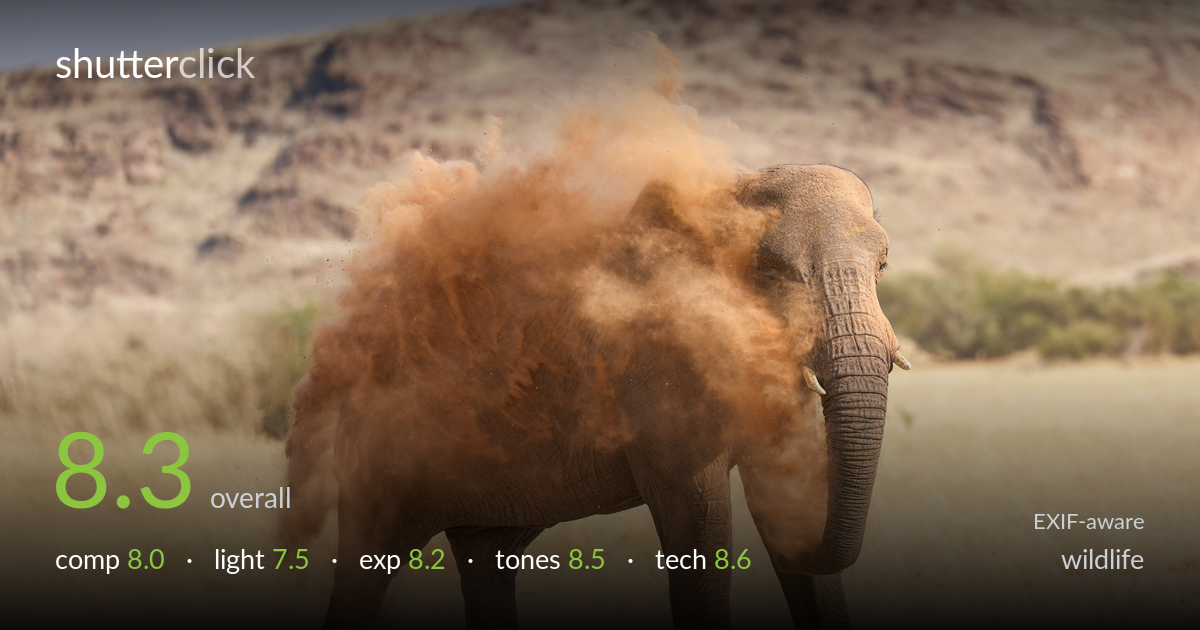
Elephant in a dust bath
Photo by Giles Laurent

| Focal length | 200 mm |
| Aperture | f / 2.8 |
| Shutter | 1/2500 s |
| ISO | ISO 100 |
| Exp. comp. | 0.0 EV |
| Shot at | 08:23 · Jul 28, 2025 |
A genuine behavioural moment caught at its peak — the dust cloud erupting over the back, frozen mid-throw, gives this real energy and storytelling weight. The desert palette unifies elephant, dust, grass, and hill into a cohesive warm wash. What holds it back most is that the dust obscures the entire forehead and upper body, and the eye, while present, sits in shadow without much sparkle. The midday light is functional but flat across the subject. Strong frozen action and clean execution carry it; a moment with the eye more readable and the head clearer would lift it further.
Placing the elephant right-of-centre with the dust plume billowing into the open left works well, giving the action room to breathe and a natural sense of direction. The low-textured hill provides scale and context without competing. The grass foreground anchors the animal in its environment. The trunk and front leg reaching toward the bottom edge feel slightly cramped, and a touch more room beneath the feet would settle the stance. Overall the balance between subject mass and the dust's negative space is judged confidently.
The light is high and fairly hard, typical of an arid midday, which renders the dust beautifully — it catches the suspended particles and gives the cloud its glowing volume. That same overhead quality, however, flattens the elephant's flank and leaves the eye and trunk in subdued shadow with little modelling. Side or lower-angle light would have raked across the wrinkled hide and made the dust even more luminous. Functional and atmospheric for the dust, less flattering on the animal itself.
Exposure is well controlled across a tricky scene. The bright dust and pale dry grass retain detail without blowing out, while the elephant's darker hide holds shadow information in the legs and face. The histogram appears to sit comfortably to the right, exploiting the high-key palette without clipping the highlights in the cloud. The eye region is slightly dark but recoverable. A deliberate, accurate exposure that protects the most fragile tones — the backlit dust — which is exactly where the risk lay.
A cohesive, warm desert palette is the photo's strongest aesthetic asset — the ochre dust, golden grass, and dusty grey-brown hide all sit in the same family, creating unity. White balance leans warm, which suits the heat and dryness of the scene. Contrast is gentle and appropriate, letting the dust read as soft volume rather than harsh clumps. The grass could risk feeling monochrome, but the subtle blue-grey hill behind and the green shrubs add just enough relief to keep it from flattening.
Excellent technical execution for the conditions. At 1/2500s the dust is frozen crisply mid-flight, preserving the individual streaks and clumps that make the throw legible — slower and it would have smeared into a soft haze, losing the impact. ISO 100 keeps the file clean with no noise penalty, entirely achievable in this bright light. The 70-200 at 200mm and f/2.8 yields a pleasantly soft hill and bush, separating the subject without the background going to mush. Focus appears to be on the trunk and front of the head, which is the right call given the rest of the body is veiled in dust; the eye sits just within acceptable sharpness. The shallow depth of field is a slight gamble at this distance with a large animal, but the key plane holds. The Sony A1 and this lens are ideally matched to the moment, and the settings extract the most from the situation.
What would elevate it
Tags
Shot something like this?
Expert photo critique, on demand — scored across six categories, EXIF-aware. Start with 3 free critiques, no credit card.
critique my photo — free