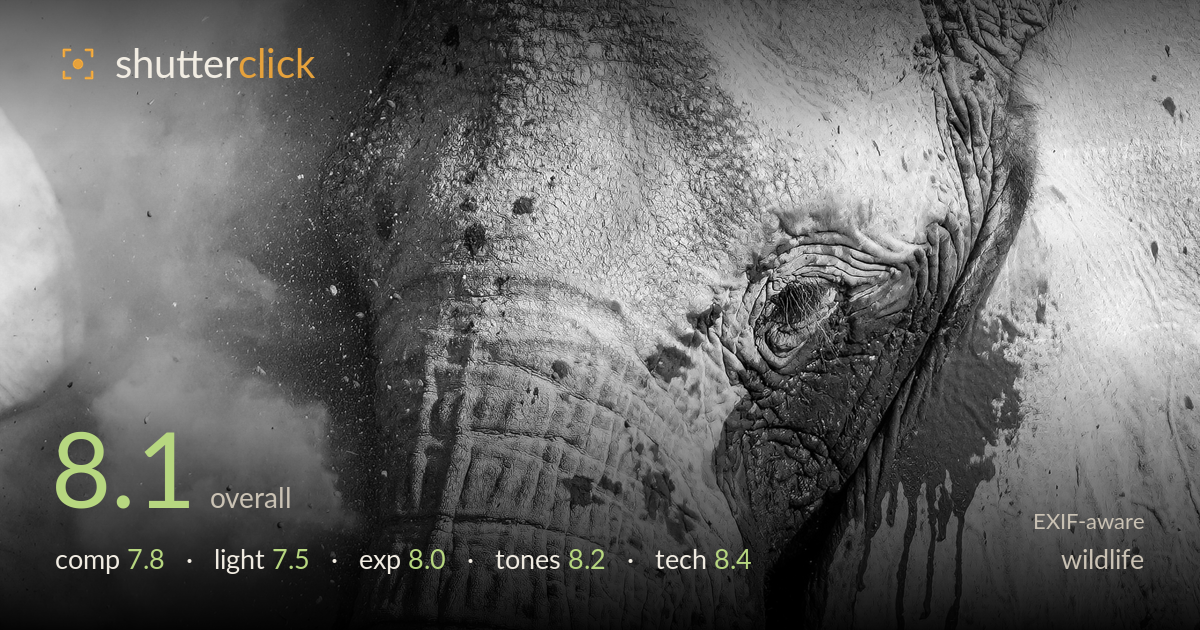
Elephant in the dust
Photo by Giles Laurent

| Focal length | 94 mm |
| Aperture | f / 2.8 |
| Shutter | 1/5000 s |
| ISO | ISO 400 |
| Exp. comp. | 0.0 EV |
| Shot at | 14:07 · Jul 30, 2025 |
A powerful, intimate frame-filling portrait of an elephant with the dust cloud adding real atmosphere and drama. The tight crop on the head, trunk, and broken tusk emphasises texture and scale, and the eye holds the viewer immediately. The monochrome treatment suits the dust and hide texture well. What holds it back most is the eye being clean but not razor-sharp at f/2.8 with the plane favouring the cheek, and the dark foreground trunk and leg falling into near-featureless shadow that swallows some detail. Tightening focus on the eye and lifting those shadows slightly would push this from strong to excellent.
The frame-filling crop is the right call for this subject, letting the wrinkled hide, trunk, and dust dominate. The eye sits close to the upper-right third and anchors the gaze well, while the curling trunk leads the eye down and across. The dust cloud on the left provides breathing room and separation from the pale background. The trunk tip is slightly cramped against the bottom-left edge, and the very dark leg mass in the lower right is a heavy, detail-poor block. A hair more room beneath the trunk would help the composition breathe.
The light is diffuse and fairly flat, softened further by the surrounding dust, which suits the mood but limits the modelling on the hide. There is enough directional quality to reveal the deep wrinkle texture across the trunk and around the eye, which is the strength here. The eye area catches a subtle roundness. The overall softness means the elephant lacks a strong sculpting highlight or shadow to lend three-dimensional punch. Shooting with slightly more raking side light would carve the skin folds with greater depth and drama.
Exposure is well judged for a tricky high-key dust scene. The bright background and dust are held just below clipping, preserving the swirling texture rather than blowing it to paper white. The mid-tones on the hide are placed nicely, showing detail across the forehead and trunk. The main compromise is the deep shadow in the lower trunk and front leg, which reads as a near-solid black and loses form. That may be intentional for graphic weight, but a touch more shadow recovery would restore some structure without flattening the contrast.
The black-and-white conversion is a strong choice, unifying the dust, hide, and mud streaks into a coherent tonal story. Contrast is confident, with clean whites in the dust and the tusk, deep blacks in the trunk shadow, and a broad mid-tone range that renders the skin texture beautifully. Highlight roll-off on the dust is smooth. The mud running down the cheek adds tonal variation and interest. The darkest areas verge on blocking up entirely; slightly opening the deepest shadows would preserve gradation while keeping the punchy, dramatic feel intact.
The Sony ILCE-1 with the 70-200mm f/2.8 GM at 94mm is an ideal pairing for this reach and subject. 1/5000s comfortably freezes the elephant and any flung dust, and ISO 400 keeps noise negligible with clean shadows to work in. The concern is the f/2.8 aperture on a subject this close: depth of field is razor-thin, and the plane of focus appears to favour the cheek and mud streak rather than sitting precisely on the eye, which reads sharp but not tack-critical. For a head-on wildlife portrait at this distance, stopping down to f/4 or f/5.6 would have brought the whole eye and trunk ridge into crisp focus while still separating from the background, since the background is already soft dust. The exposure discipline holding the dust highlights is excellent, and the shutter choice was more than sufficient. Focus placement is the one execution point that would elevate this from very good to exceptional.
What would elevate it
Tags
Shot something like this?
Expert photo critique, on demand — scored across six categories, EXIF-aware. Start with 3 free critiques, no credit card.
critique my photo — free