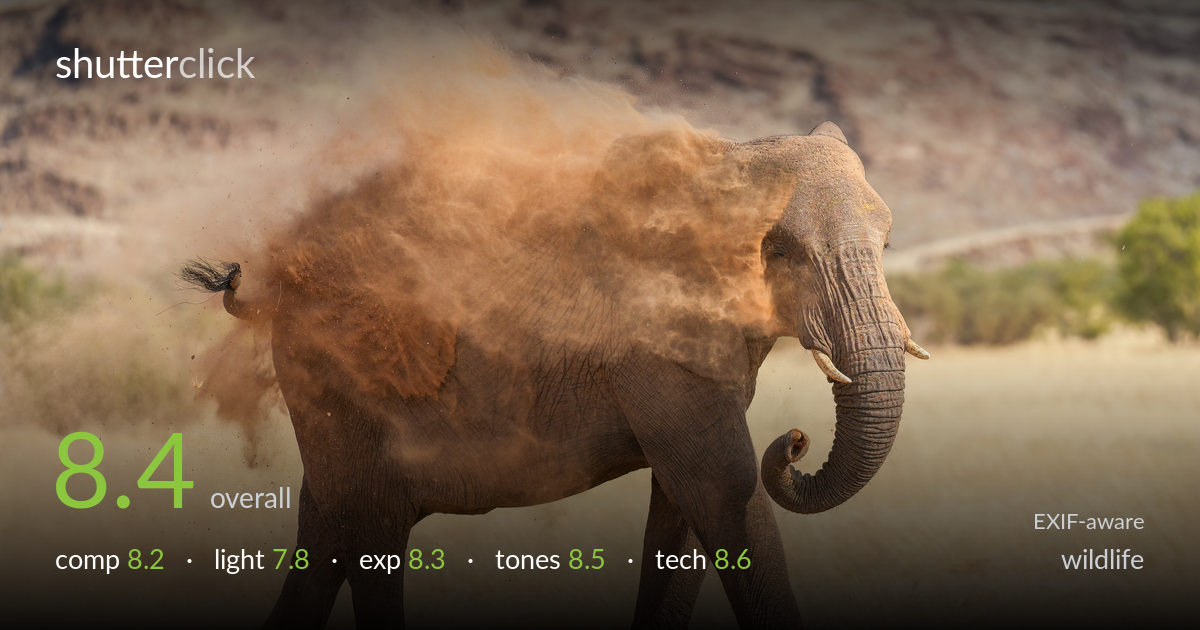
Elephant throwing a dust bath
Photo by Giles Laurent

| Focal length | 200 mm |
| Aperture | f / 2.8 |
| Shutter | 1/2500 s |
| ISO | ISO 100 |
| Exp. comp. | 0.0 EV |
| Shot at | 08:24 · Jul 28, 2025 |
A dust bath captured at its peak, with the swirling plume cloaking the elephant's shoulder while the curled trunk and clear eye anchor the moment — exactly the behaviour-driven storytelling wildlife rewards. The warm dust against the dry savannah grass is beautifully unified in tone. The biggest limiting factor is that the dust obscures the entire front-to-rear arc of the body, hiding part of the subject; a frame a fraction of a second earlier or later might balance plume against form. The blurred desert backdrop sets place without distraction. Strong, atmospheric work that needs only minor timing refinement.
The elephant is placed well right-of-centre with space for the dust plume to throw left, giving the action somewhere to go — a sound directional choice. The mountainous backdrop adds scale and context without competing, and the dry grass foreground grounds the animal. The eye and curled trunk sit at a natural reading point. The plume does swallow much of the body's near side, so the form reads slightly incomplete. A touch more room above the dust crest would let the plume breathe rather than brushing the top edge.
Warm, low-angled light rakes across the scene, catching the dust and rim-lighting the trunk and tusks nicely. The directionality gives the plume body and translucence, which is the whole point of this image. Shadows on the legs and underbelly stay open enough to hold detail. The light is a little flat across the face itself, leaving the eye and ear without strong modelling. Catching this same behaviour with the sun a touch lower and more behind the dust would make the plume glow more dramatically.
Exposure is well judged for a high-key, dusty scene — the bright grass and airborne dust avoid clipping while retaining texture, and the elephant's shadowed flank keeps detail without muddiness. At ISO 100 the file is clean and the dynamic range is used confidently. The lit dust crest is the brightest area and holds just short of blowing out. Nothing reads as accidental here. A marginally darker rendering of the highlights would add a touch more punch to the plume's brightest curls.
The colour palette is the image's quiet strength: rust-orange dust, ochre grass and warm hide all sit in a tight harmonious band, broken only by the cool grey of the trunk and legs. White balance leans warm, which suits the arid setting and golden hour. Contrast is gentle and appropriate, letting the dust read as soft and atmospheric. Saturation is handled with restraint — the oranges are rich without tipping into garishness. The overall tonal cohesion makes the frame feel like a single unified moment.
The settings are well matched to the subject. At 1/2500s the elephant's body and the curling trunk are frozen cleanly while the suspended dust still reads as motion-textured rather than smeared — a good compromise for this kind of action. Focus lands accurately on the head and eye, which is exactly where it needs to be for a wildlife frame, and the eye is sharp despite the surrounding haze. f/2.8 on the 70-200 GM at 200mm renders the mountain and bushes into a soft, non-distracting wash, isolating the animal well; the shallow depth does mean the far rear leg falls slightly off the focal plane, but the key plane is secure. ISO 100 keeps the file clean with ample latitude. The 200mm reach gives a natural, undistorted perspective on the elephant. The only refinement worth noting: a slightly smaller aperture, perhaps f/4 to f/5.6, would have carried sharpness through the full length of the body without sacrificing the background separation.
What would elevate it
Tags
Shot something like this?
Expert photo critique, on demand — scored across six categories, EXIF-aware. Start with 3 free critiques, no credit card.
critique my photo — free