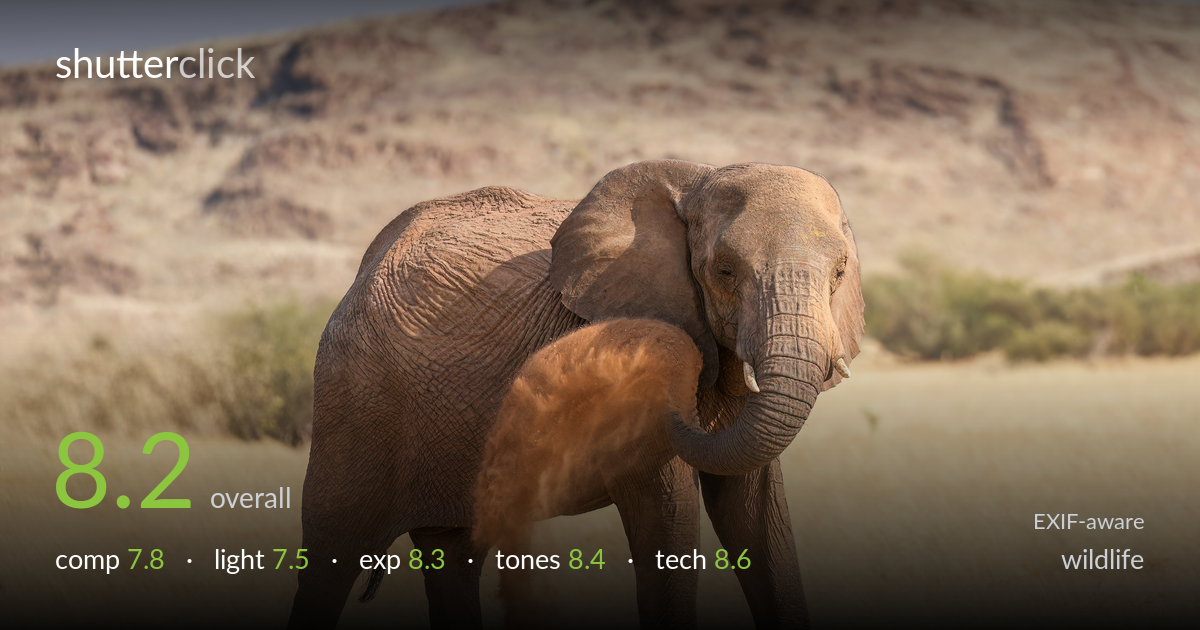
Elephant throwing dust on the plain
Photo by Giles Laurent

| Focal length | 200 mm |
| Aperture | f / 2.8 |
| Shutter | 1/2500 s |
| ISO | ISO 100 |
| Exp. comp. | 0.0 EV |
| Shot at | 08:23 · Jul 28, 2025 |
A dust-bathing elephant caught mid-throw, the arc of orange dust giving the frame genuine behaviour and energy that lifts it above a static portrait. The warm tonal palette ties animal, grass and dust together into a cohesive desert-adapted feel. The eye is sharp and the moment is well timed. What holds it back most is the flat midday light, which softens the elephant's musculature and leaves the scene without strong modelling, and a slightly tight crop on the trunk. A lower angle and softer light would push this from very good to memorable, but the action and craft are already strong.
The elephant sits comfortably right of centre with the dust plume filling the lower-left negative space, balancing the frame nicely. The diagonal of the dust adds dynamism and leads the eye toward the head. The receding hillside provides scale and context without competing. The trunk curls into the bottom-right corner a little tightly, and a touch more room beneath the feet would settle the animal in its habitat better. The eye-level perspective is workable, though a lower angle would heighten the subject's presence.
Light here is high and frontal, typical of midday desert conditions, which keeps the elephant evenly lit and free of harsh blown shadows but flattens its considerable texture and form. The dust catches the sun and glows, which is the lighting's strongest payoff. The hillside and grass share the same warm cast, lending unity. Earlier or later light raking across the wrinkled hide would have revealed far more dimensionality and separated the animal from its similarly toned surroundings.
Exposure is well controlled across a tricky high-key scene. The bright grass and sunlit dust retain detail without clipping, and the elephant's hide holds shadow information in the creases and underbelly. The 0.0 EV decision at ISO 100 was correct here — the histogram looks full without crushing or burning. Highlights on the dust plume sit right at the edge but stay textured. A faint loss of contrast in the brightest grass is the only quibble, easily recovered in post.
The warm, dusty palette is the image's signature — ochre grass, rust-coloured dust and the grey-brown hide all sit within a harmonious earthy range. White balance reads accurate for desert conditions without an artificial push. The dust plume's saturated orange provides a welcome accent against the muted hillside. Contrast is moderate, fitting the flat light, though the shadows could take a slight deepening to add punch. Overall a pleasing, naturalistic grade that suits the Damaraland setting.
The Sony A1 paired with the 70-200mm GM at 200mm and f/2.8 was a sound choice for the reach and subject isolation needed here. Focus is locked precisely on the eye, which is exactly where it must be for wildlife, and the detail in the hide and tusks confirms sharp execution. The 1/2500s shutter froze the flung dust into discrete particles while keeping the animal tack sharp — generous but appropriate given the unpredictable motion. ISO 100 keeps the file clean with full tonal latitude. The f/2.8 aperture renders the hillside softly without losing legibility, giving good subject separation. One consideration: at this distance, stopping down to f/4 or f/5.6 would have carried slightly more of the elephant's near-to-far depth in sharp focus, since the trunk and far hindquarter sit on different planes. As executed, depth of field is adequate but shallow. The technical command on display is high — fast, decisive, and well-suited to the moment.
What would elevate it
Tags
Shot something like this?
Expert photo critique, on demand — scored across six categories, EXIF-aware. Start with 3 free critiques, no credit card.
critique my photo — free