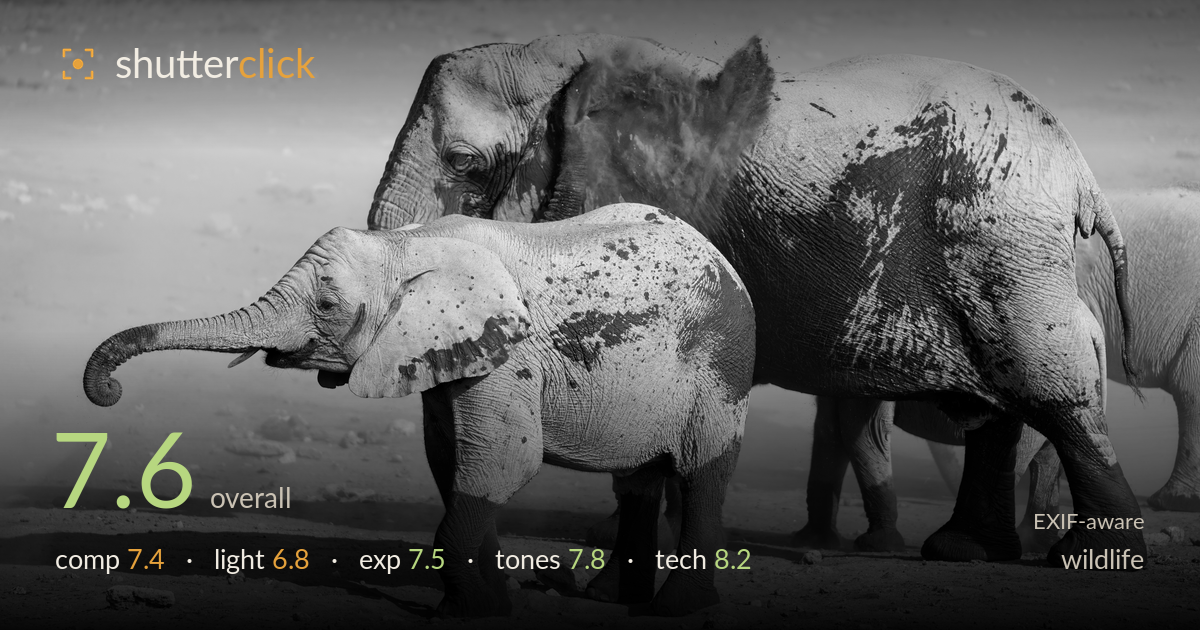
Elephants dust bathing on the pan
Photo by Giles Laurent

| Focal length | 126 mm |
| Aperture | f / 2.8 |
| Shutter | 1/5000 s |
| ISO | ISO 320 |
| Exp. comp. | 0.0 EV |
| Shot at | 14:08 · Jul 30, 2025 |
A well-captured dust-bathing sequence with strong behaviour and a satisfying interplay of ages and mud patterns. The mid-ground elephant tossing dust over its back is the true moment here, yet compositional weight sits on the foreground youngster, splitting the story. The monochrome treatment suits the dusty, desaturated environment and renders the mud splashes as graphic texture. Focus and shutter execution are excellent. What most holds the image back is the overlap of the two main animals, which flattens separation, and the flat midday light. A cleaner arrangement or a moment where the dust plume reads more distinctly would elevate a solid frame to a memorable one.
The frame layers three elephants with the calf foremost, an adult behind, and a third cropped at right. The younger animal's curled trunk and extended tusk anchor the left, balanced by the mass of the mud-streaked adult. But the two principal animals overlap heavily, merging their bodies and reducing the sense of individual form. The dust-throwing action of the rear adult, arguably the strongest gesture, competes for attention rather than leading it. Generous ground foreground with scattered rocks adds base weight, though the horizon sits comfortably high.
Light is high and hard, consistent with midday in an open pan. It flattens the elephants' modelling and leaves the dust plume less luminous than a lower, back-lit angle would render it. Shadows beneath the bodies are dense but not distracting, and the diffuse haze on the horizon softens the background naturally. The mud patterns read well because they hold their own tonal contrast rather than relying on directional light. Softer or raking side light would have given the hides and the dust far more dimension.
Exposure is well judged for a bright, reflective pan. The pale dust and sky retain detail without blowing out, and the dark undersides and mud hold shadow information rather than blocking to pure black. The histogram sits weighted toward the high end, appropriate to the scene, with headroom preserved in the brightest ground. The mud splashes carry a full tonal spread. Nothing here reads as accidental; the metering handles a tricky high-key environment cleanly with no compensation needed.
The black-and-white conversion is a strong choice for this dusty, near-colourless setting. Mid-tones are handled with a smooth gradation across the elephants' hides, and the mud reads as bold graphic patterning against the pale skin. Contrast is moderate and honest to the hazy light rather than forced. Shadow depth under the bellies gives the frame grounding, while highlight roll-off in the sky stays gentle. A touch more local contrast on the dust plume would help it separate from the background haze.
The Sony A1 with the 70-200mm f/2.8 at 126mm is well matched to this subject and distance. At 1/5000s the shutter comfortably freezes both the elephants and the airborne dust, which reads crisply grain by grain rather than smearing. ISO 320 keeps noise negligible and preserves clean tonal transitions in the mud and hide. Focus falls accurately on the foreground calf's eye and trunk, which are sharp with visible skin texture. The choice of f/2.8, however, is worth questioning: with three animals stacked in depth, the wide aperture leaves the rear adult and the dust plume slightly soft, undercutting the action that most deserves sharpness. Stopping to f/5.6 or f/8, easily affordable given the bright light and fast shutter, would have carried critical detail across all the animals without any noise penalty. Lens selection, reach, and stabilisation are all appropriate; the aperture decision is the one lever that would have improved this frame.
What would elevate it
Tags
Shot something like this?
Expert photo critique, on demand — scored across six categories, EXIF-aware. Start with 3 free critiques, no credit card.
critique my photo — free