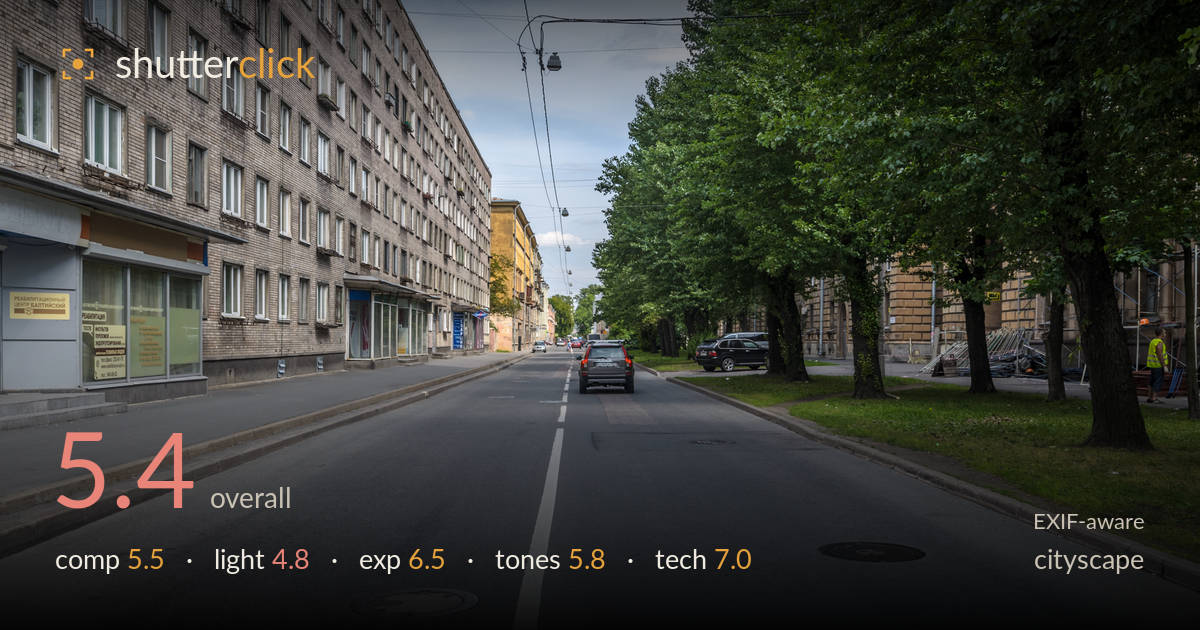
Empty street toward the vanishing point
Photo by Florstein (Telegram:WikiPhoto.Space)

| Focal length | 20 mm |
| Aperture | f / 8.0 |
| Shutter | 1/125 s |
| ISO | ISO 100 |
| Exp. comp. | -0.67 EV |
| Shot at | 15:06 · Jul 15, 2014 |
A competent, documentary-style street record that reads more as a snapshot than a composed cityscape. The strongest element is the receding perspective — the road, the long apartment block on the left, and the tree line on the right all converge toward a distant vanishing point, giving genuine depth. What holds it back most is flat midday light that drains the scene of mood and modelling, plus a wandering focal point: the eye is pulled between the parked SUV mid-frame, the road markings, and the buildings without a clear anchor. The overhead wires cut awkwardly across the sky. Serviceable, but waiting for better light and a stronger subject.
The one-point perspective works — road, kerb lines, and building faces drive the eye to a distant vanishing point, and the split between hard architecture on the left and soft foliage on the right gives useful contrast. But the frame lacks a clear subject; the SUV in the centre-right is the default anchor by elimination, not by design. The sagging tram wires slice across an otherwise empty upper sky, and the large expanse of foreground asphalt carries little interest. A stronger foreground element or a moment of activity would give the geometry something to serve.
This is the weakest area. The overcast-to-hazy midday light is flat and directionless, so the brick facade — which could carry rich texture under raking light — reads as an even grey wall with little relief. The foliage looks dull rather than luminous, and shadows are shapeless and unhelpful. The sky is a muted, low-contrast wash that adds nothing. Early or late light raking down the street would model the buildings, warm the brick, and separate the tree masses from the sky, transforming a flat record into a scene with atmosphere.
Exposure is well controlled and clearly deliberate — the -0.67 EV compensation protects the bright sky, which holds cloud detail without clipping, while the shadows on the shaded building faces and under the trees retain workable information. The asphalt sits at a believable mid-grey and the histogram looks balanced with no crushed blacks. Nothing is fighting the sensor's dynamic range here. If anything the overall result is a touch flat, but that stems from the light itself rather than any metering error. Technically clean and defensible.
The palette is muted and slightly cool — greys of brick and asphalt against subdued greens, with a pale, desaturated sky. White balance leans neutral to cool, which suits the overcast conditions but reinforces the drab feel. Tonal range is compressed in the midtones, contributing to the flatness. The greens of the trees lack vibrancy and separation from one another. A gentle contrast lift and selective warmth in the foliage and brick would add life without pushing into a false, oversaturated look. As it stands the grading is honest but lifeless.
The settings are sound for the situation. At 20mm on the 10-20mm (a 30mm-equivalent ultra-wide on the DX D5100), f/8 is the sensible sweet-spot aperture, delivering front-to-back sharpness that suits a deep street scene, and the results confirm it — detail holds from the near asphalt to the distant vanishing point. ISO 100 keeps noise negligible and tonal gradation clean. 1/125s comfortably freezes the slow-moving SUV and there is no motion blur. Focus appears accurately placed with generous depth of field covering any error. Notably, the verticals are kept close to true despite the wide lens, so keystoning is minimal — a real credit given how easily ultra-wides splay converging lines. One small technical note: the ultra-wide has stretched the near foreground road, exaggerating the empty asphalt, and the lens's edge performance is doing a lot of work on the left building. Execution is not the problem here; the choices are all reasonable and cleanly carried out.
What would elevate it
Tags
Shot something like this?
Expert photo critique, on demand — scored across six categories, EXIF-aware. Start with 3 free critiques, no credit card.
critique my photo — free