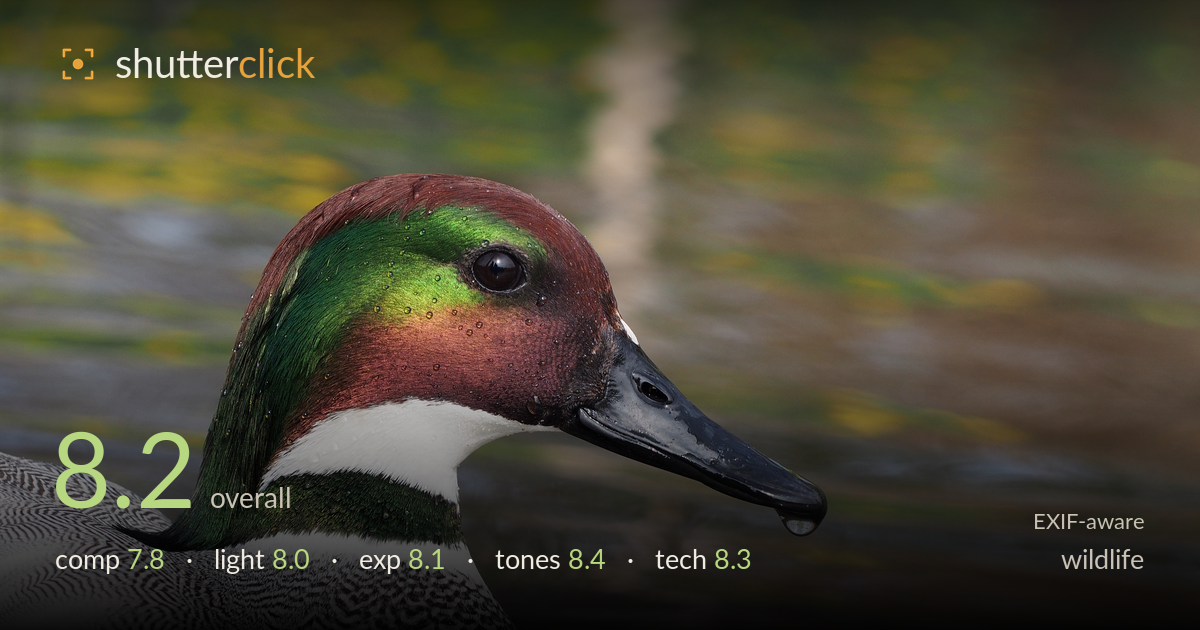
Falcated duck with a water droplet
Photo by Francis C. Franklin

| Focal length | 60 mm |
| Aperture | f / 4.0 |
| Shutter | 1/640 s |
| ISO | ISO 200 |
| Exp. comp. | 0.0 EV |
| Shot at | 14:27 · Mar 30, 2014 |
A crisp, intimate portrait of a falcated duck that captures the iridescent green-and-copper head with real fidelity, plus a lovely water droplet clinging to the bill tip that adds a moment of life. The eye is sharp, the plumage vermiculation is beautifully resolved, and the soft green-gold background sits well behind the subject. What holds it back is composition: the bird faces frame-right with almost no space ahead of it, so the gaze runs into the edge while the left side sits heavier with body. More breathing room in the direction of travel would settle the balance.
The head sits high and left with the bill pointing toward the right edge, leaving little space ahead of the gaze — the eye wants somewhere to travel and finds the frame border instead. The heavy body anchoring the lower-left is well seen, and the diagonal reflection line in the background adds subtle structure. The profile presentation reads cleanly against the soft backdrop. Shifting the subject left or cropping to open room in front of the bill would relieve the crowding and let the direction of view breathe.
Soft, slightly directional light works in the subject's favour, glancing across the head to ignite the green-to-copper iridescence without blowing the white throat. Shadows are gentle, keeping detail in the darker green nape and the black bill. The lighting is flattering and even, avoiding the harsh midday specular hits that flatten iridescent plumage. A touch more angle from the side could have deepened the modelling on the breast vermiculation, but the timing here serves the colour play on the head very well.
Exposure is well judged for a subject with a demanding tonal range — the bright white throat and neck hold texture without clipping, while the dark bill and shadowed nape retain detail. The intricate grey-and-white vermiculation on the flank is exposed to show its full tonal separation, which is the technically harder task here. Midtones on the head sit comfortably. Nothing reads accidental; the histogram appears to use the full range with the highlights kept just in check.
The colour rendering is the standout — the metallic green and burnished copper on the head are saturated but believable, and the white throat stays neutral rather than drifting warm. White balance is well judged against the greenish water. The finely patterned flank shows clean tonal gradation from bright white to near-black. Background greens and golds are muted enough to keep attention on the bird. Contrast is nicely controlled, holding both the iridescent sheen and the delicate vermiculation without crushing either end.
The 60mm macro is an unconventional wildlife choice, and at 60mm equivalent to 120mm on this Micro Four Thirds body it demanded a close approach — which paid off in resolution. Focus lands accurately on the eye, which is critical, and the plane carries through the iridescent head sharply. f/4 gave enough depth to hold the head and near flank crisp while still throwing the background into pleasing blur, though the bill tip and far body soften slightly as the plane falls off. 1/640s froze the subject cleanly, including the hanging water droplet, with no motion blur. ISO 200 keeps noise negligible and the vermiculation detail is rendered with excellent micro-contrast, a real strength of the macro lens. The main technical limitation is reach: getting this close is impressive but not always feasible in the field, and a longer lens would offer more working distance and background compression. Execution here is clean and deliberate throughout.
What would elevate it
Tags
Shot something like this?
Expert photo critique, on demand — scored across six categories, EXIF-aware. Start with 3 free critiques, no credit card.
critique my photo — free