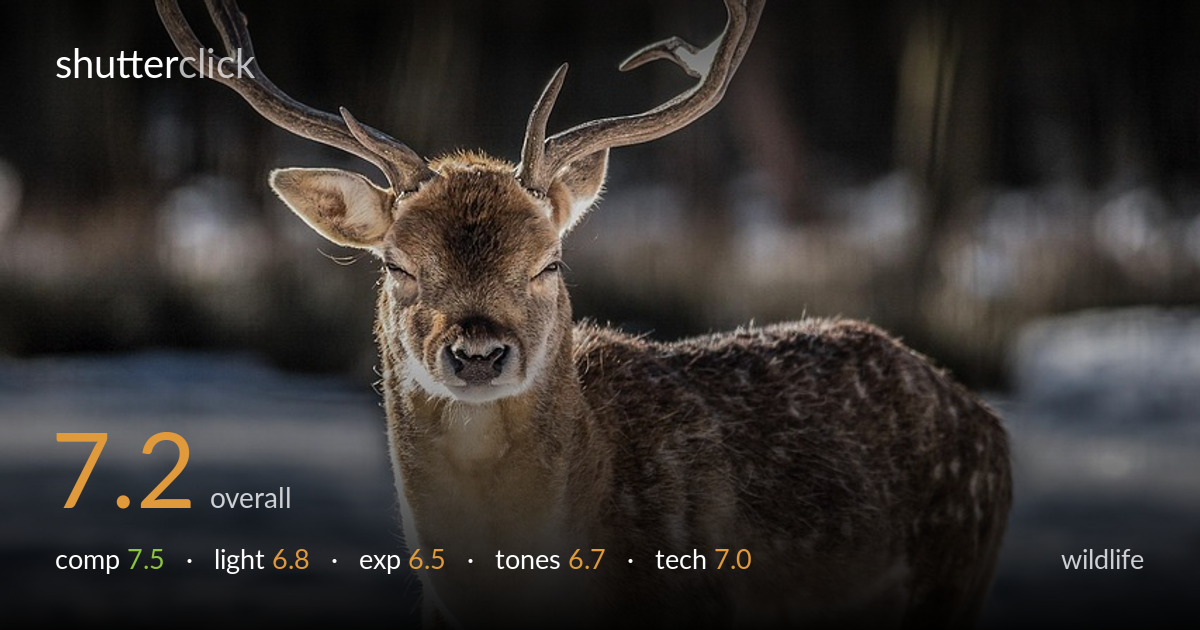
Fallow deer in the snow
Photo by R_Winkelmann

No EXIF metadata in this file
Technical analysis based on visual assessment only.
A clean, full-frame portrait of a fallow deer with the antlers held complete inside the frame — a strong, classic wildlife result. The animal sits slightly left of centre with a near-symmetrical stance and the magnificent rack reading clearly against a dark, muted backdrop. What most holds it back is the eye: the near eye appears half-closed and soft, robbing the frame of the sharp catchlight a portrait like this lives on. The dark vignette around the edges is heavy and reads as a post-processing addition rather than natural falloff, and the snow shadows have gone slightly muddy. The pose and antler rendering carry it.
The vertical frame suits a standing deer well, and keeping the full antler spread inside the borders is the hardest part of this shot — handled cleanly. The slight left-of-centre placement gives the animal room to face into the frame, and the snow foreground anchors the base. The legs do crowd the bottom edge a little, and a touch more space beneath the hooves would settle the stance. The dark treeline behind isolates the subject without distraction, which serves the portrait well.
Low winter side light models the body and rim-lights the legs and chest attractively, separating the deer from the snow. The antlers catch enough light to read their texture against the dark background. The trade-off is the face: the light skims it without filling the eye sockets, so the eyes fall into shadow and lose life. Softer frontal fill or a head turn into the light would have lifted the expression. The directional quality is genuinely good for revealing form.
The deer is exposed about right, holding detail across the brown coat and the white chest without blowing the highlights. The snow, however, sits darker and greyer than it should, and the surrounding shadow areas have been pulled down hard, crushing texture in the lower corners. The heavy edge darkening reads as an applied vignette rather than light falloff. A brighter, cleaner snow rendering and lifted shadows would feel more honest and give the frame more air.
The warm coat tones contrast nicely against the cool, desaturated snow and the near-black background. White balance leans slightly cool overall, which suits the winter mood. The muted, low-saturation grade is intentional and works, but the snow has drifted toward a dull grey-blue that flattens the brightness it should have. The dark background is rich but borders on blocked-up, losing the subtle separation between trunks. Recovering a little shadow detail and warming the snow would balance the palette.
Focus appears placed on the head and antlers, and the rack is rendered sharply with good detail in the bony texture — exactly where a wildlife portrait needs critical sharpness. The shutter has clearly frozen the stationary animal without motion blur, and noise is well controlled, suggesting a sensible ISO for the conditions. The background falls into a smooth, even blur that isolates the subject cleanly, indicating a wide aperture and a moderate telephoto reach that gave working distance without disturbing the deer. The main shortfall is the near eye: it reads soft and half-closed, so the single most important point of focus in any animal portrait lacks the bite and catchlight that would make the frame sing. Whether that is the animal blinking or a focus plane sitting slightly forward on the muzzle, the result is the same. A frame caught with both eyes open and a crisp catchlight would elevate the whole image considerably.
What would elevate it
Tags
Shot something like this?
Expert photo critique, on demand — scored across six categories, EXIF-aware. Start with 3 free critiques, no credit card.
critique my photo — free