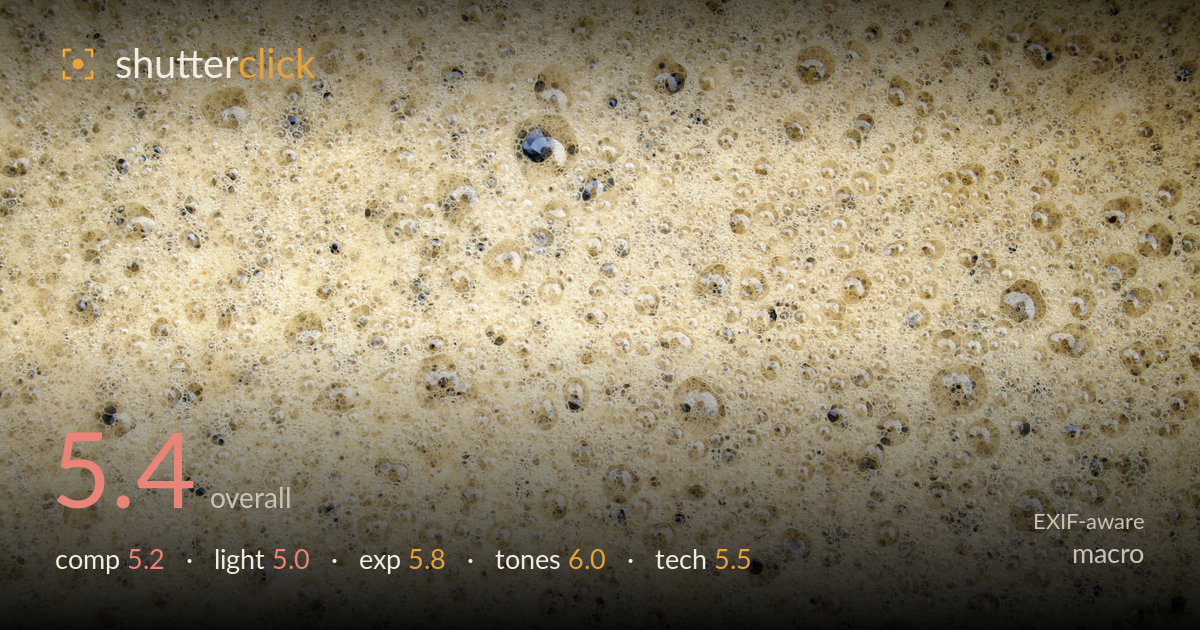
Field of foam bubbles
Photo by Ildar Sagdejev (Specious)

| Focal length | 38 mm |
| Aperture | f / 5.6 |
| Shutter | 1/250 s |
| ISO | ISO 200 |
| Exp. comp. | 1.0 EV |
| Shot at | 17:16 · Mar 21, 2009 |
This is a texture study of foam or bubbles — an all-over pattern with no anchoring focal point, and that is what most holds it back. The frame reads as an even field of similar-scale bubbles from edge to edge, so the eye drifts without landing. The warm amber palette is pleasant and cohesive, and the small dark cavities add welcome tonal variety, but the pattern lacks a rhythm or a dominant element to organize it. As a seamless texture it functions; as a photograph it needs a point of emphasis — a cluster, a scale contrast, or a diagonal flow — to give the eye a reason to travel.
The frame is a uniform, edge-to-edge field of bubbles with no dominant subject or hierarchy, so the eye wanders without settling. For an abstract or texture image that can work, but here the bubbles are too consistent in scale and spacing to build visual rhythm. The large dark bubble upper-center offers a faint anchor but sits awkwardly rather than commanding the frame. A stronger scale contrast — a few large forms against fine froth — or a diagonal drift of clusters would give the composition direction and a reason to hold attention.
The light is flat and frontal, coming from a soft, diffuse source that renders the surface evenly with little modeling. That keeps detail across the frame but flattens the three-dimensional structure of the bubbles — the domes and cavities read as tone rather than shape. A lower, raking side light would catch the rims and cast tiny shadows inside each bubble, revealing form and adding sparkle to the wet highlights. As shot, the lighting documents the texture rather than sculpting it, which limits the sense of depth in a subject that lives on relief.
Exposure is competent and reasonably safe. The +1 EV compensation lifts the pale foam nicely without blowing the brightest highlights, and the small wet speculars stay just under clipping. Shadow detail holds inside the dark cavities, preserving the tonal contrast that gives the frame its little accents. The midtones sit a touch high, contributing to the slightly washed feel, but nothing is lost. A hair less exposure would deepen the amber and add snap. Overall the histogram looks well controlled for a bright, low-contrast subject.
The warm amber-to-cream palette is cohesive and appealing, and the scattering of dark blue-grey bubble interiors provides useful counterpoint against the dominant yellow. White balance leans warm, which suits the organic subject. Contrast is on the gentle side — the overall impression is soft and slightly hazy, which mutes the texture. A modest boost in local contrast or clarity would separate the bubble rims from the froth and make the tonal range feel less flat. Saturation is well judged, neither garish nor dull.
At 38mm, f/5.6, 1/250s and ISO 200, the settings are sensible for a flat, static surface and hold noise to a non-issue. But this is not true macro — 38mm on the Rebel XTi cannot deliver 1:1 reproduction, and the working distance shows: the bubbles are captured as a general pattern rather than resolved with fine surface detail. Focus lands acceptably across the plane because the subject is near-flat, so f/5.6 gives adequate depth, but critical sharpness on the bubble rims is soft — likely a combination of the lens not being a dedicated macro optic and the diffuse light offering little edge definition. A dedicated macro lens, or extension tubes on the existing lens, would bring genuine close-up magnification and crisp rim detail. Stopping down slightly and focusing precisely on a chosen plane would also sharpen the key structures. For this subject, magnification and focus precision matter more than the exposure choices, which are fine.
What would elevate it
Tags
Shot something like this?
Expert photo critique, on demand — scored across six categories, EXIF-aware. Start with 3 free critiques, no credit card.
critique my photo — free