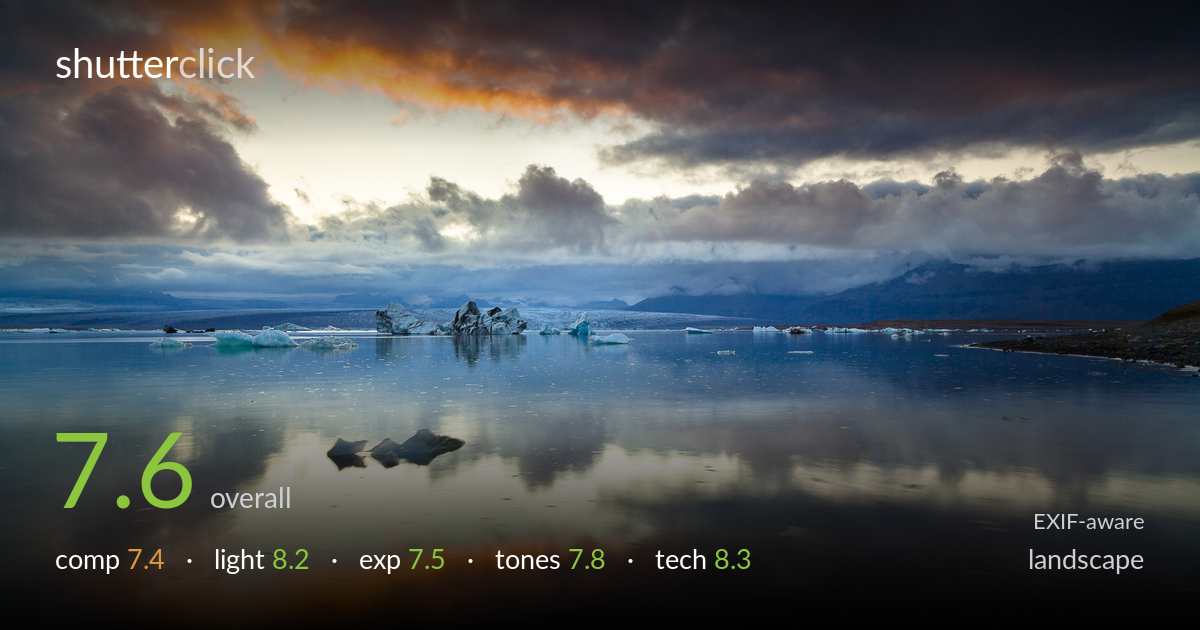
Fiery glacial lagoon sunset
Photo by Martin Sojka
.jpg)
| Focal length | 21 mm |
| Aperture | f / 16.0 |
| Shutter | 1.6 s |
| ISO | ISO 100 |
| Exp. comp. | 0.0 EV |
| Shot at | 20:09 · Jul 23, 2011 |
A glacial lagoon at sunset with a sky reflection that anchors the frame — the burning cloud over the bright break carries the image, mirrored faithfully in still water. The horizon sits near centre, which is defensible given the symmetry of the reflection, but the lower water occupies a large, dark, slightly empty band. The mid-ground icebergs are the natural subjects yet read small and scattered against the wide expanse. The light is the strength here; the composition's weakness is that no single foreground element commands attention. Pulling a stronger anchor into the bottom third would lift it.
The reflection symmetry is the organising idea and it works — the fiery cloud mirrors cleanly down the centre. The horizon sits roughly mid-frame, justified by that mirroring, though it teeters toward static. The cluster of icebergs at the horizon is the obvious subject but reads small and dispersed across the band. The small ice fragment in the lower-mid water tries to anchor the foreground but is too minor to hold it. The lower water occupies a large, dim expanse that lacks a commanding element to lead the eye in.
The standout: a break of warm sunset fire punching through heavy cloud, balanced against the cool blue-grey of the lagoon and mountains. The directional glow over the central gap gives the sky drama and the reflection doubles its impact. Timing is well caught at the peak of colour before it faded. The contrast between the warm cloud and the cold ice and water is the emotional core. The diffused light over the mid-ground mountains keeps them appropriately recessive, letting the sky dominate as intended.
A careful balance under a high-dynamic-range sky. The bright break behind the cloud is near the top of the histogram but holds texture rather than blowing out fully. Shadow detail in the foreground water and distant mountains is retained, if a touch heavy in the lower band. The warm cloud highlights are controlled and the reflection preserves the gradient. Slightly more lift in the lower-water shadows would open that dim foreground without flattening the mood, and a hair more headroom would safeguard the brightest sky patch.
The warm-cool split is the tonal engine — orange fire against teal-blue ice and steel mountains, a classic complementary pairing rendered convincingly. White balance reads neutral-to-cool, fitting the glacial setting, while the cloud retains its warmth. The reflected colour in the foreground water adds a pleasing echo. The lower water band drifts a little muddy and could use cleaner separation between the dark reflection and the surface. Saturation is restrained and believable. Mid-tone gradation in the cloud transitions is smooth and natural.
The Zeiss Distagon at 21mm on the 5D Mark II is an ideal pairing for this wide vista, and the optics show in the clean rendering and lack of obvious distortion. f/16 secures front-to-back depth, well suited to a scene running from foreground ice to distant mountains, though at f/16 diffraction begins to slightly soften critical sharpness — f/11 would have held depth with marginally crisper detail. ISO 100 keeps noise negligible, correct for a tripod-based long exposure. The 1.6s shutter is the deliberate choice that smooths the water into the glassy reflective surface that makes the image work, and any drifting ice has rendered as soft streaks rather than crisp shapes — consistent with the exposure length. Focus appears well placed for hyperfocal coverage, with the iceberg cluster acceptably sharp. The execution is clean and intentional throughout; the only refinement worth noting is the aperture choice trading a touch of edge sharpness for depth that f/11 would have largely matched.
What would elevate it
Tags
Shot something like this?
Expert photo critique, on demand — scored across six categories, EXIF-aware. Start with 3 free critiques, no credit card.
critique my photo — free