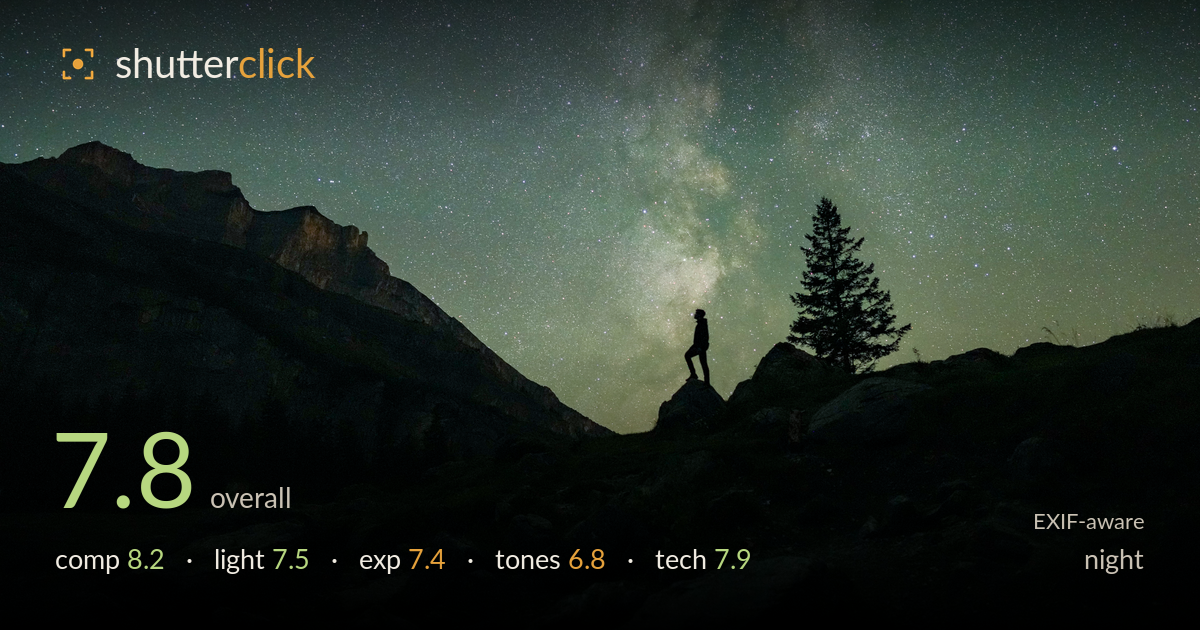
Figure beneath the milky way
Photo by Giles Laurent

| Focal length | 24 mm |
| Aperture | f / 1.4 |
| Shutter | 8.0 s |
| ISO | ISO 6400 |
| Exp. comp. | 0.0 EV |
| Shot at | 00:58 · Aug 1, 2022 |
A well-conceived Milky Way scene where the silhouetted figure gives the vast sky a human anchor and clear sense of scale. The placement of the person against the galactic core, balanced by the lone pine to the right, is the image's real strength — it tells a small story of solitude under the stars. What most holds it back is the tonal handling: a strong green-yellow cast sits across the sky and horizon glow, flattening what could be a cleaner, more dimensional starfield. The dark foreground carries little detail and reads as a heavy mass. Refined colour and a touch more foreground light would elevate a genuinely strong composition.
The figure is placed with real intent — silhouetted on its rock, aligned beneath the Milky Way's descent, with the lone pine providing a balancing vertical on the right. The mountain ridge on the left grounds the frame and leads the eye down toward the subject. Negative space in the star field is used generously and works for the scale being conveyed. The lower third is a touch heavy and empty, and a slightly lower framing of the horizon would give the galactic core more room to dominate.
The natural airglow along the horizon provides a subtle backlight that separates the figure, pine, and ridgeline as clean silhouettes — an effective use of the only light available. The Milky Way core is captured with reasonable presence. The green-yellow horizon glow, likely a mix of airglow and light pollution, competes with the darker sky above and pulls attention low in the frame. The foreground receives no fill, so the rocks read as an undifferentiated dark shape rather than textured terrain.
Exposure is a reasonable balance for the difficulty. The star field holds detail without significant clipping, and the highlights in the horizon glow stay controlled. The silhouettes are intentional and read clearly. The foreground rocks, however, sit almost entirely in the deep shadows with little recoverable detail, so the lower half of the frame carries weight without information. A slightly brighter exposure or a blended foreground frame would open those shadows while keeping the sky as it is.
This is where the image most needs work. A pronounced green-yellow cast dominates the sky and horizon, giving the whole frame a slightly murky, uneven colour balance rather than the cleaner blue-to-neutral typical of a well-graded night sky. The Milky Way's core shows warm dust tones, which is good, but the surrounding sky lacks the contrast to make stars pop. Mid-tone gradation in the sky is decent, but overall saturation feels pushed in the greens, muddying the palette and reducing depth.
The settings are well matched to the task. At 24mm, an 8-second exposure sits just under the point where stars begin to trail, so the point-light rendering holds up. f/1.4 on the 24mm GM gathers maximum light and keeps depth of field generous enough to hold both the near figure and the distant sky acceptably sharp, though wide open there will be some coma on the corner stars worth checking. ISO 6400 on the ILCE-1 is a sensible choice for the light gathered, and noise is handled respectably in the sky, if visible in the darkest shadows. Focus appears set near infinity, rendering the stars as crisp points. The main technical opportunity is the single-frame approach: stacking several exposures for the sky and a separate longer or light-painted frame for the foreground would cut noise and recover the terrain detail that the current one-shot exposure cannot hold simultaneously.
What would elevate it
Tags
Shot something like this?
Expert photo critique, on demand — scored across six categories, EXIF-aware. Start with 3 free critiques, no credit card.
critique my photo — free