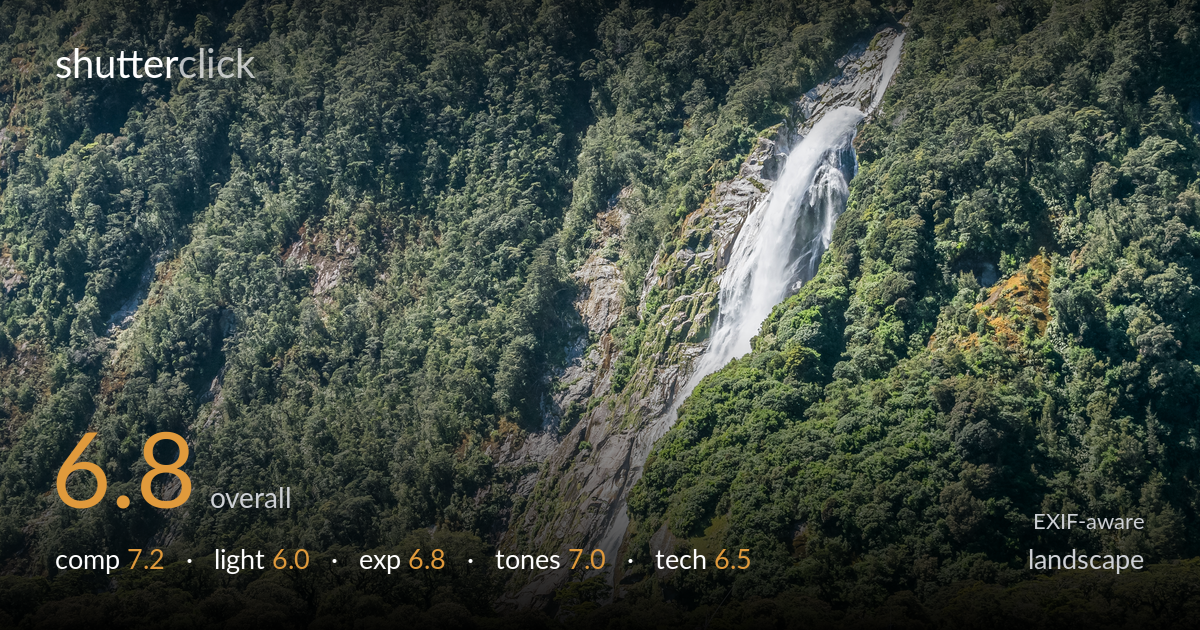
Fjord waterfall cruise
Photo by Krzysztof Golik

| Focal length | 42 mm |
| Aperture | f / 9.0 |
| Shutter | 1/1000 s |
| ISO | ISO 200 |
| Exp. comp. | 0.0 EV |
| Shot at | 04:14 · Nov 19, 2017 |
The pairing of the cruise boat against the towering waterfall and forested cliff is the photo's strongest asset, delivering genuine scale and a sense of place that reads instantly as Milford Sound. The boat anchors the lower-right, the cascade climbs the upper-right, and the teal water grounds the base — a workable diagonal relationship. What most holds it back is hard midday light flattening the dense green wall into an undifferentiated mass, and a fast shutter that froze the falls into a static white streak rather than the silky flow this subject rewards. The wall of foliage also lacks a clear tonal hierarchy.
The diagonal from the boat in the lower-right up to the waterfall works well, and placing the vessel small against the cliff sells the scale effectively. The teal water provides a clean base and the falls give the eye a destination. However, the frame is dominated by an almost uniform green wall that fills the left two-thirds without much to hold attention. A composition that gave the waterfall more breathing room, or included sky for context, would balance the heavy mass of foliage that currently crowds the upper edge.
Hard, high midday sun flattens the textured cliff face into a dense, even green, robbing the forest of the depth and modelling that raking light would reveal. The waterfall catches enough light to stand out brightly against the rock, which helps, but the overall scene lacks the dimensionality that early or late light brings to a fjord wall. There are no shaped shadows to give the terrain form. Golden-hour or softer overcast light would separate the layers of vegetation and lend the rock face far more sculptural presence.
Exposure is well controlled overall. The bright water of the falls holds together without blowing out badly, and the boat's white hull retains detail, which is the trickiest highlight in the frame. Shadow areas in the deeper folds of the forest stay readable rather than blocking up. The histogram appears to sit comfortably in the midtones. The dense greens could arguably carry a touch more brightness in the shaded recesses, but nothing here reads as accidental or careless — the exposure decisions look deliberate and balanced for the conditions.
The teal of the water is appealing and reads true to glacial fjord conditions, and it contrasts nicely with the saturated forest greens. White balance looks accurate under direct sun. The greens are slightly heavy and tend toward a single note across the wall, which reduces tonal separation between near and far foliage. A little more variation in the green channel, or a gentle pull on saturation, would let individual trees and the rock striations read more distinctly. Contrast is reasonable, with clean whites in the cascade.
At f/9 the depth of field is appropriate for a deep landscape and holds focus across the cliff and boat well. ISO 200 keeps the image clean, and the 42mm focal length on the superzoom is a sensible choice that compresses the scene nicely. The clear weakness is the 1/1000s shutter: for a waterfall, that froze the flow into a stiff white streak rather than the soft, continuous veil that even 1/4 to 1s would render. A tripod and neutral-density filter would have allowed a longer exposure for that flowing effect. The Tamron 18-270 is a convenience lens and shows it slightly in micro-contrast across the foliage, but at f/9 it performs acceptably. Focus is accurate on the boat and the falls. For a handheld grab from a moving platform the fast shutter was a pragmatic choice — but if the falls were the priority, the settings worked against the subject rather than for it.
What would elevate it
Tags
Shot something like this?
Expert photo critique, on demand — scored across six categories, EXIF-aware. Start with 3 free critiques, no credit card.
critique my photo — free