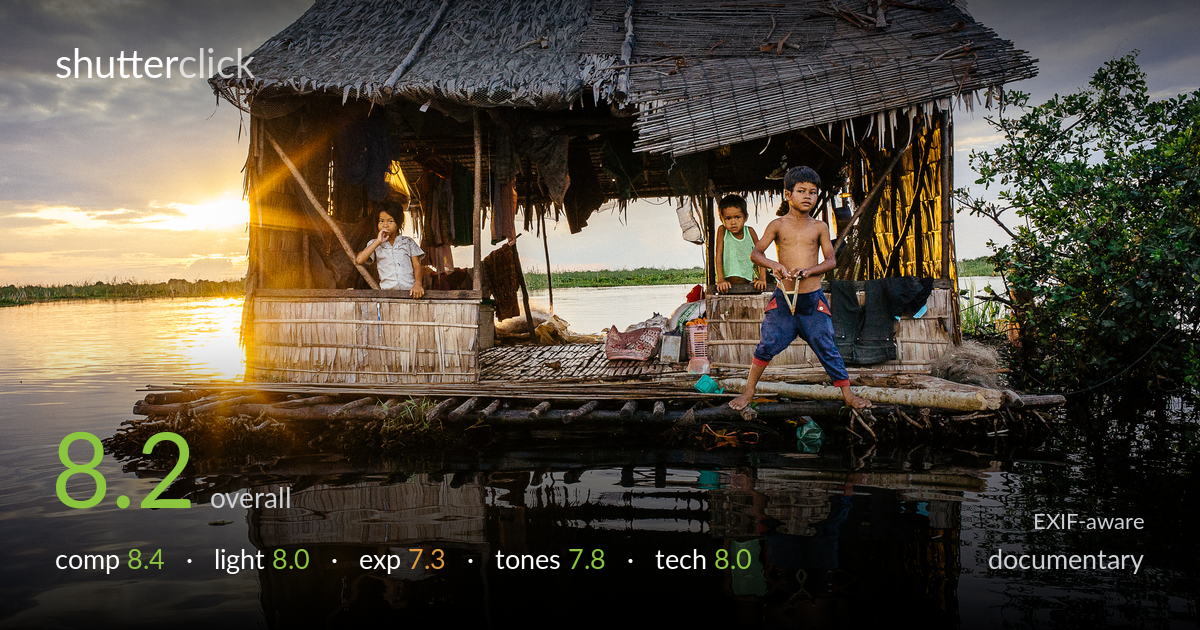
Floating home backlight
Photo by Martin Sojka

| Focal length | 35 mm |
| Aperture | f / 11.0 |
| Shutter | 1/125 s |
| ISO | ISO 1600 |
| Exp. comp. | 0.0 EV |
| Shot at | 17:21 · Nov 27, 2013 |
A genuine sense of place anchors this floating-village frame, with three children of distinct ages giving the home human scale and lived narrative. The standing boy with the slingshot is a strong central anchor, the seated girl adds a quiet secondary beat, and the reflection extends the story downward into still water. The backlit sun rendering the thatch translucent is the standout. What most holds it back is exposure balance: the bright sky and water flare push the highlight side hard while interior detail sinks, and the central placement of the house edges toward static. A reportage frame of real substance.
The floating house fills the upper frame while the calm water below carries a near-complete mirror reflection, doubling the scene's value. Three figures at varied ages and postures build a clear narrative spine, with the standing boy as the dominant anchor. The mangrove on the right closes the frame and balances the open sky left. The structure sits a touch centrally, flattening tension slightly, and the foreground reflection has dead space mid-frame, but the layering of subject, dwelling and water reads coherently and tells the story well.
Low backlight from the setting sun is the defining choice, raking through the thatch and rim-lighting the standing boy's shoulders and the wood platform. The translucence in the roof material is genuinely beautiful and gives the structure texture and warmth. Lens flare streaks down the left side, which can read as atmospheric but also veils the seated girl. The frontal subjects fall into open shade and lose modelling against the brilliant background. A reflector or fill flash would have lifted the children without killing the backlit mood.
Exposure is a balancing act the scene makes hard. The sky and sun-struck water flirt with clipping on the left, while the shaded porch and the children's faces sit underexposed, costing facial detail on the standing boy and the seated girl. The midtones in the wood and water hold well and the reflection retains tonal information. This reads as a deliberate compromise toward preserving the sun, but the shadow side is heavier than ideal. Bracketing or a graduated approach would have eased the highlight-to-shadow spread.
Warm gold from the low sun plays against the cooler blue-grey water and sky, a pleasing colour separation that suits the hour. The thatch and bamboo carry believable earthy tones and the green singlet provides a useful colour accent. White balance leans warm without going orange, which feels honest to the light. Contrast in the shadow areas is a little dense, muddying the porch interior, and the flare desaturates the lower left. Overall the palette is cohesive and documentary-honest rather than over-graded.
The f/11 aperture is a sound call for this scene, holding the house, all three children and the foreground reflection acceptably sharp across the 35mm field — a focal length well matched to the environmental-documentary intent, giving context without distortion. Focus appears placed on the standing boy and holds. At 1/125s the static subjects freeze cleanly and the slingshot stays crisp. ISO 1600 is higher than the daylight scene strictly required given the bright sky; it likely reflects the dark shaded foreground, but it introduces some noise in the lower water and shadow areas that is visible on close inspection. A base-ISO frame on a tripod, or accepting a slower shutter given the still subjects, would have cleaned the shadows. Shooting into the sun risks flare and veiling, partially managed here but costing some micro-contrast. Overall the gear choices serve the genre well; the only real lever is reining in ISO to protect shadow cleanliness.
What would elevate it
Tags
Shot something like this?
Expert photo critique, on demand — scored across six categories, EXIF-aware. Start with 3 free critiques, no credit card.
critique my photo — free