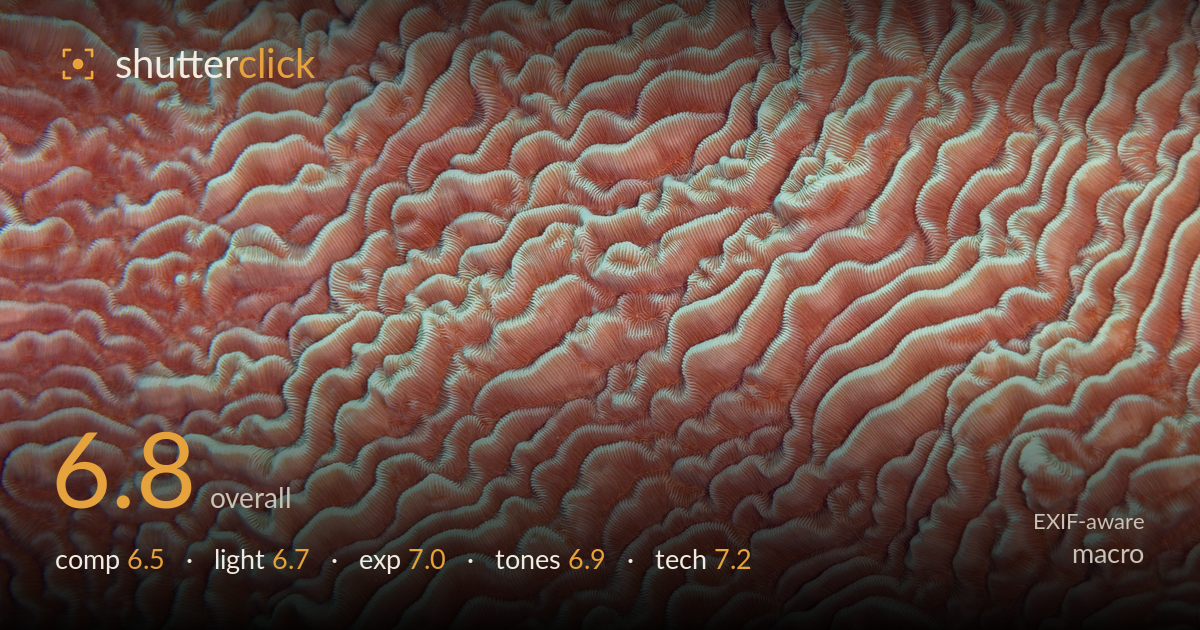
Flowing ridges of brain coral
Photo by Diego Delso

| Focal length | 100 mm |
| Aperture | f / 6.3 |
| Shutter | 1/160 s |
| ISO | ISO 500 |
| Exp. comp. | 0.0 EV |
| Shot at | 08:30 · Apr 15, 2023 |
This coral surface reads as a full-frame texture study, and the flowing ridge-and-valley pattern carries real graphic rhythm — the meandering lines pull the eye across the frame with a pleasing organic irregularity. What holds it back is the lack of a compositional anchor or focal accent: it's uniformly busy edge to edge, so the eye keeps moving without ever settling. The fine polyp striations resolve well where sharp, but focus falls off in the corners, softening the pattern unevenly. As pure texture it succeeds; as an image it would gain from a stronger internal structure or a single point of tension to organize all that repetition.
The all-over pattern fills the frame confidently and the diagonal drift of the ridges gives movement rather than static repetition. The warm coral flanked by pale valleys sets up decent tonal contrast between forms. The weakness is that it reads as sampled from a larger surface with no compositional intent about where the frame lands — no convergence, no anchor, no rest point. A crop that placed one dominant ridge cluster off-centre against calmer texture, or that found a natural pattern break, would give the eye somewhere to land instead of wandering endlessly.
The light is soft and fairly even, which suits recording the whole surface but flattens the three-dimensionality of the ridges. The valleys and crests separate mostly by their own colour rather than by directional modelling. A more raking, lower-angle light would rake across the corrugations and cast the small shadows that make texture feel tactile and deep. As it stands the relief reads more as pattern than as sculpted form. The highlight quality on the pale septa is clean without hotspots, which is a plus.
Exposure is well judged for a mid-toned subject dominated by warm reds and pale cream ridges. Highlights on the lighter septa hold detail without clipping, and the darker valley crevices retain enough information to preserve the fine radial striations. The histogram sits comfortably in the middle with no crushed blacks or blown areas. At f/6.3, 1/160s and ISO 500 the brightness is controlled and deliberate. If anything, a touch more contrast separation between crest and valley would add punch, but nothing here reads as an exposure error.
The salmon-to-terracotta reds against cream valleys form a cohesive, restrained palette that feels natural for this coral. White balance looks believable for the ambient light, avoiding the excessive magenta or over-warmed look that often creeps into macro of red subjects. Saturation is held in check, letting the subtle colour shifts within the ridges register. The mid-tones carry most of the range, which keeps things gentle but slightly muted — a small lift in local contrast would give the pattern more depth without pushing the colour into artificiality.
The 100mm f/2.8L macro is the right tool, and f/6.3 is a reasonable compromise for a subject with this much surface relief — but it isn't quite enough depth of field to hold the entire undulating plane sharp. The central and mid-frame striations resolve crisply, showing the fine radial detail the 5DS R's high resolution can capture, but the corners and the raised ridge tops drift soft, which reads as depth-of-field falloff rather than misfocus. ISO 500 keeps noise negligible and 1/160s is ample for a static subject, so motion and grain aren't concerns. For a subject this flat-but-textured, either stopping down to f/8–f/11 to hold more of the plane, or a focus stack of several frames, would deliver edge-to-edge critical sharpness. Ensuring the sensor plane sits parallel to the coral surface would also even out the falloff. Solid execution overall, limited mainly by the single-frame depth-of-field ceiling.
What would elevate it
Tags
Shot something like this?
Expert photo critique, on demand — scored across six categories, EXIF-aware. Start with 3 free critiques, no credit card.
critique my photo — free