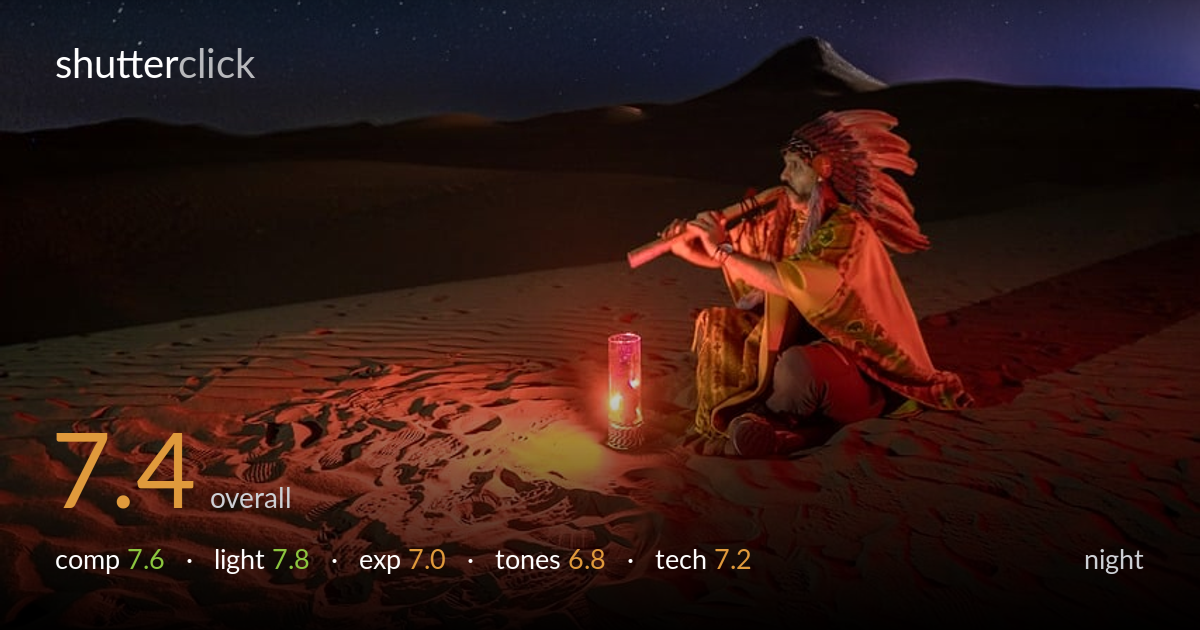
Flute player beneath the milky way
Photo by akbarnemati

No EXIF metadata in this file
Technical analysis based on visual assessment only.
A well-conceived composite of two demanding exposures — a Milky Way sky and a warm-lit foreground figure — that mostly holds together. The arc of the galactic core dominates the upper frame while the seated flute player and glowing lantern anchor the lower right, giving the eye a clear journey. What most holds it back is the tonal collision at the horizon: the cold blue-magenta sky meets an intensely orange foreground with little transition, and the warm cast is pushed hard enough to look artificial. The dune line separating the two exposures reads a touch too clean. A more restrained warm balance and a softer blend would lift this considerably.
The vertical format suits the subject, stacking the towering Milky Way over the grounded figure. The dune peak sits neatly beneath the galactic core, and the lantern-lit footprints sweep in from the lower left as a natural leading element. The subject placement in the lower right respects the thirds and leaves the sky room to breathe. The empty central sky is intentional and works. One weakness: the figure and lantern crowd the right edge slightly, and a hair more space on that side would ease the tension without losing balance.
Two distinct light stories are combined: the natural sky glow and a warm artificial source lighting the sand and figure from the lantern's position. The low, raking foreground light rakes across the ripples and footprints, revealing good texture and giving the sand real dimension. The lantern reads as a believable point source. The main issue is intensity — the foreground light is dialled far hotter than a single lantern could realistically throw, flattening subtlety near the source and creating an abrupt falloff. A gentler, more graduated spill would feel more natural and integrated.
The sky exposure is well judged, holding faint nebulosity in the core without crushing the surrounding star field, and the darker dunes retain shape rather than blocking up. The foreground is brighter and cleaner than the sky, betraying the separate exposure, but detail is preserved throughout the sand. The lantern's core is slightly blown, which is forgivable for a light source. The bigger concern is that the foreground sits noticeably higher in value than the ambient night warrants, breaking the illusion that both halves belong to the same moment.
The colour grade is the weakest link. The sky's blue-to-magenta gradient is attractive, but the foreground orange is pushed to a near-monochrome intensity that reads processed rather than lit. The transition zone at the horizon shows the two palettes meeting without a bridging midtone, so the join feels stitched. White balance is split hard — very cool above, very warm below — with no shared neutral to tie them. Pulling saturation out of the sand and warming the sky base a touch would knit the two zones together.
This is clearly a blended or composite frame, and the execution is competent within that approach. The star field is sharp and well-resolved, with the galactic core showing structure rather than mush, suggesting a tracked or short enough sky exposure with controlled noise. The foreground is clean and detailed, pointing to a separate, longer or lit exposure at low ISO. Focus on the figure is adequate though not tack-sharp — the flute and headdress hold detail but the face is a little soft, which matters less at this scale. The main technical tell is the blend seam along the dune ridge: the boundary is a fraction too crisp and the lighting logic doesn't fully carry across it, so the two exposures announce themselves. Noise is well managed in both zones. A feathered mask along the horizon and a matched grain structure between sky and ground would make the composite far more convincing and disguise the transition that currently gives it away.
What would elevate it
Tags
Shot something like this?
Expert photo critique, on demand — scored across six categories, EXIF-aware. Start with 3 free critiques, no credit card.
critique my photo — free