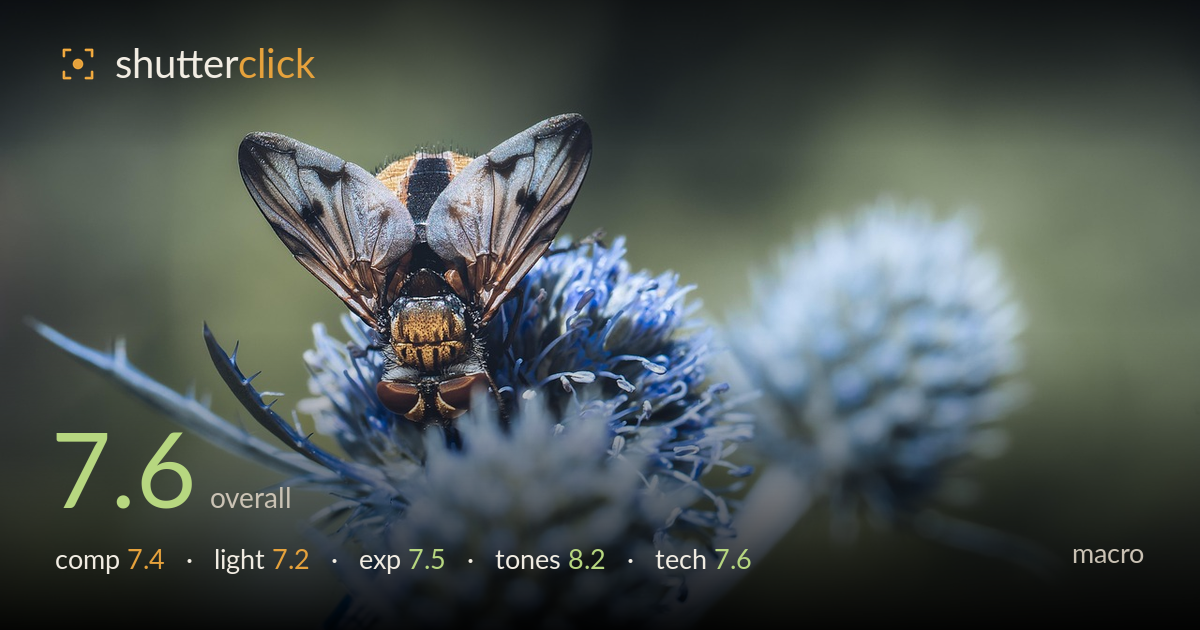
Fly perched on blue eryngo
Photo by dersil3nt

No EXIF metadata in this file
Technical analysis based on visual assessment only.
A symmetrical, head-on fly on eryngo makes a striking macro, carried by a cohesive blue-and-amber palette that sets the warm insect against cool thistle. The wings, spread wide, form a clean vaulted frame around the golden thorax and coppery eyes. The key limitation is focus placement: the wings and forward body read sharpest while the eyes — the natural anchor for any creature — sit slightly softer than ideal. The lower two thistle heads also occupy substantial frame real estate without carrying detail, pulling weight from the subject. A tighter framing and focus locked on the eyes would push this from pleasing to arresting.
The head-on, near-symmetrical view with wings spread into a wide arch is a strong, confident choice, and placing the fly in the upper third over the thistle head gives it a natural perch. The warm subject against cool blue globes reads instantly. Working against it: two large out-of-focus thistle heads dominate the lower and right frame, consuming space that adds little and competes for attention. A crop biased upward, trimming the empty lower flower mass, would concentrate the eye on the insect and its immediate perch.
Soft, diffused light — likely overcast or shaded — suits the subject well, avoiding harsh specular hits on the wings and keeping the iridescent sheen readable. It renders the thistle spines with even, gentle modelling and no blown edges. The trade-off is flatness: without a touch of directional light, the fly's thorax and the flower texture lack the raking shadow that would carve out fine three-dimensional detail. A low side light, or a subtle reflector kick, would add sculpting to the body and sparkle to the eyes.
Exposure is well controlled across a tricky range of tones — the dark wing veins retain structure while the pale blue thistle keeps highlight detail without clipping. The golden thorax sits nicely in the midtones. Shadows in the fly's underside stay open enough to read the eye and legs. Overall the histogram appears balanced, leaning slightly toward the cool low-key mood the scene invites. Nothing looks accidental here; the brightness choices support the subdued palette rather than fighting it.
The tonal treatment is the standout. A muted, cohesive palette pits the cool desaturated blues and greens of the eryngo and background against the warm amber and copper of the fly, creating natural colour contrast without oversaturation. White balance sits slightly cool, reinforcing a calm, painterly mood, and the coppery eyes glow against the surrounding blue. Gradation in the background is smooth with no banding. The restraint is admirable — nothing screams, and the whole frame feels colour-graded with intent.
The rendering shows real macro competence: the wing membranes, their veins, and the fine hairs on the thorax are crisply resolved, and the shallow depth of field cleanly isolates the subject from a creamy background. Noise is well managed and the exposure held both dark wings and pale thistle without penalty. The chief technical shortfall is focus plane placement. The sharpest zone falls across the wings and upper thorax, leaving the eyes — the critical focal point for any living subject — marginally soft. At this magnification the depth of field is razor-thin, so the choice of exactly where to land focus matters enormously. Focusing a hair closer, onto the eyes, or a short focus stack to extend the sharp band from eyes through wings, would resolve it. Stopping down slightly would also broaden the sharp plane, at the cost of more diffraction and a busier background, so a stack is the cleaner route. Solid stability and shutter discipline are evident throughout.
What would elevate it
Tags
Shot something like this?
Expert photo critique, on demand — scored across six categories, EXIF-aware. Start with 3 free critiques, no credit card.
critique my photo — free